Human Resources • Workplace Ethics • Accountability
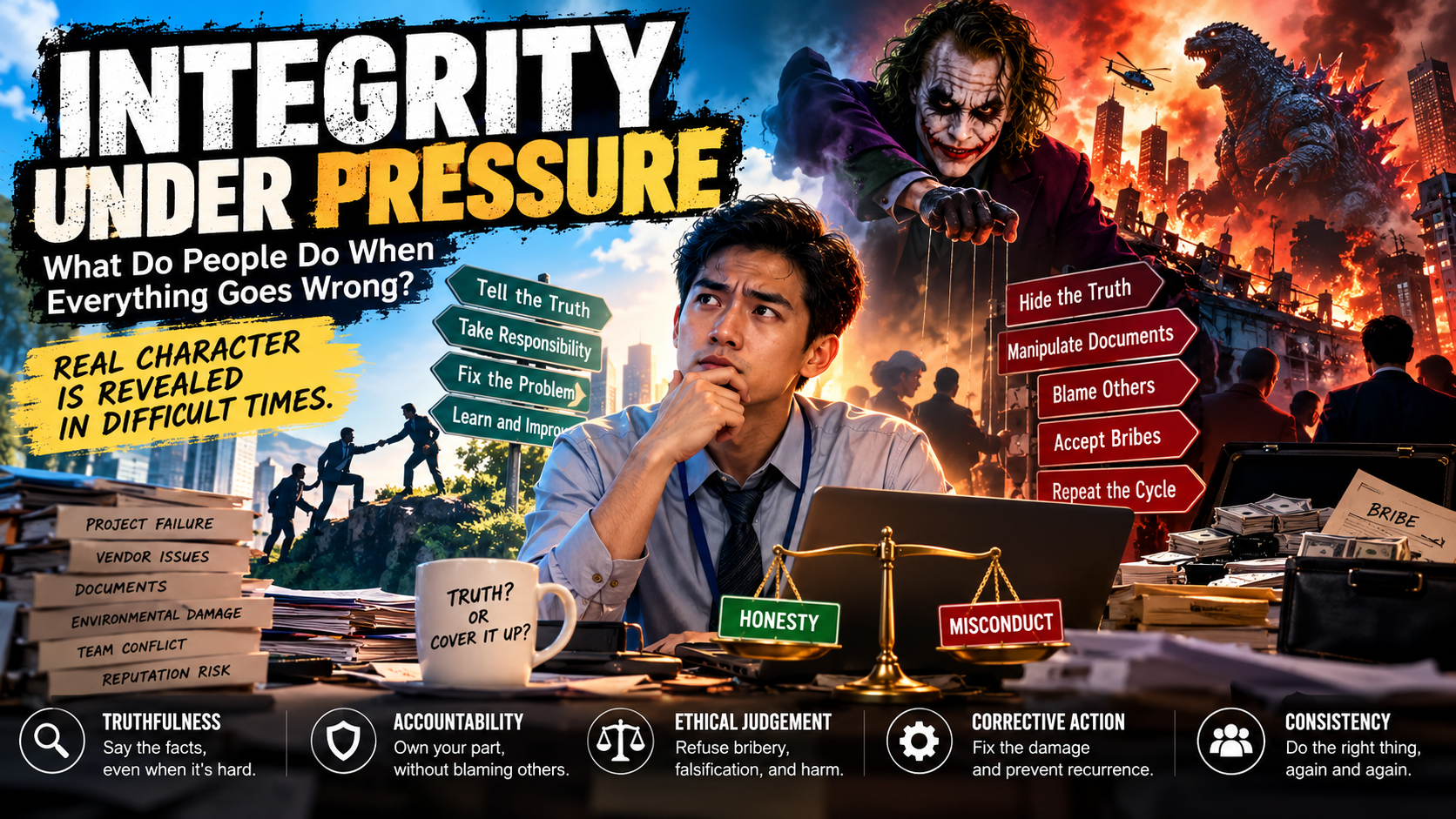
Integrity Under Pressure: What Do People Do When Everything Goes Wrong?
A reflection on honesty, accountability, and the choices people make when telling the truth becomes uncomfortable.
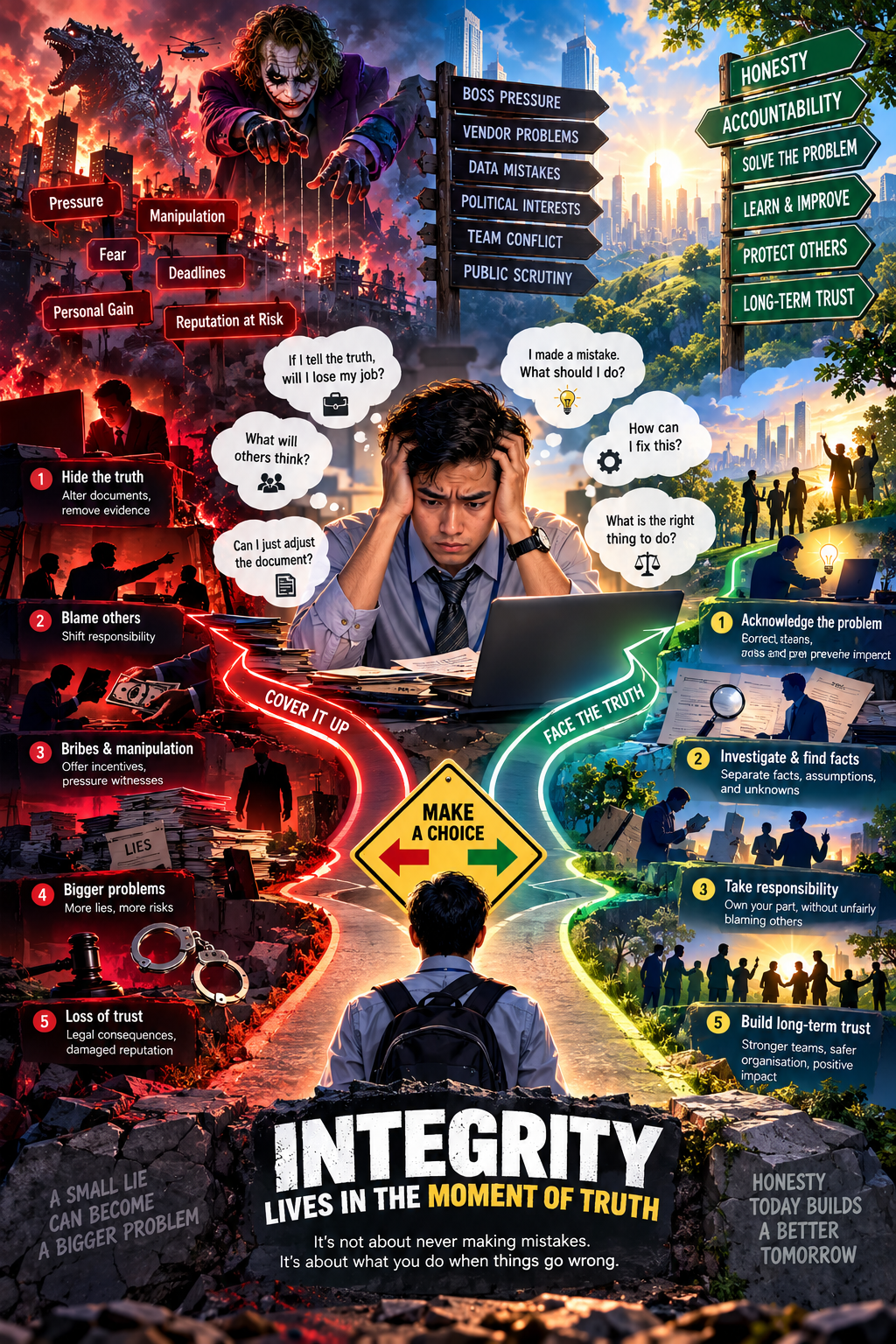
When pressure rises, do we face the truth—or build another lie to hide it?
1. The Question Is Not Simply “Are You Honest?”
I studied Human Resource Management years ago. Of course, studying a subject does not automatically make someone an expert. Knowledge evolves, and our memories should occasionally be checked against research.
One question has stayed with me: if we want to understand whether someone has integrity, should we focus only on what they say about honesty—or also on how they behave when something goes wrong?
It is easy to say, “I am an honest person.” It can be much harder to tell the truth when doing so might cost us our reputation, position, money, relationships, or sense of control.
Integrity is not tested only when honesty is convenient. It becomes especially visible when dishonesty appears to offer an easier escape.
This does not mean one difficult incident can reveal a person's entire character. It means that decisions made under pressure can provide useful evidence—especially when considered alongside other situations and patterns of behaviour.
2. Let Us Bring in the Joker and Godzilla
Imagine you are responsible for a project: you plan activities, coordinate staff and vendors, manage resources, and report the results. Then something goes wrong. There is a misunderstanding, a supplier fails, equipment is damaged, or a decision causes serious harm.
Now let us make the example ridiculously extreme. Imagine facing the Joker from Batman—or a magician who can manipulate people's perceptions, confuse a team, and make everyone feel psychologically cornered.
And for good measure, imagine that someone accidentally spills a mysterious chemical on a Komodo dragon, which somehow turns into Godzilla and starts destroying a city. 🦎💥
HAHAHA. We do not need to create a real Godzilla incident for HR assessment. The exaggeration is there to make the logic easy to grasp: some people experience even a small mistake as if the world were ending. So what happens when the stakes feel enormous?
The question is not whether everyone will remain perfectly calm. People can be frightened, stressed, confused, or overwhelmed. The question is what choices they make next: do they report what they know, seek help, and try to repair the damage—or start lying, manipulating records, and blaming others to protect themselves?
Conceptual illustration: pressure can make ethical choices harder, but the fair response is to examine evidence, context, intent, and actions—not jump to conclusions about someone's entire character.
3. The Difference Between a Mistake and Misconduct
A mistake is not automatically misconduct. A person may make an error without intending harm, and they may need help to understand what happened. Misconduct involves behaviour that violates applicable standards; intent, knowledge, context, and consequences matter when assessing the situation.
Compare two responses to the same project failure. One person reports the facts, acknowledges what they know and do not know, helps investigate, and takes corrective action. Another person falsifies records, pressures witnesses, or offers a bribe to prevent scrutiny.
The initial problem might be similar, but the subsequent decisions are not. Accountability does not mean accepting blame for everything; it means being truthful about one's own role and fair about the role of others.
4. How Cover-Ups Can Become a Bigger Problem
Consider a hypothetical sequence: a project fails, someone hides the failure, then changes a report to support the cover story. When a colleague notices, the person pressures them to stay silent. They may then offer favours or money to stop the issue from being investigated.
This is not a universal path, and corruption does not always begin with an innocent mistake. Some misconduct is deliberate from the start. But an initial act of concealment can create pressure to keep concealing, especially when reputation, money, or authority is at stake.
In organisational psychology, moral disengagement describes ways people justify behaviour that conflicts with their moral standards—for example, by shifting responsibility, minimising harm, or claiming that “everyone does it.” Such explanations do not prove wrongdoing on their own, but they can help explain how people rationalise unethical choices.
Research reference: https://pubmed.ncbi.nlm.nih.gov/34553966/
5. What HR and Leaders Can Look For
HR should not rely only on a candidate's claim that they are honest, nor should it assume that a single mistake reveals someone's whole character. A more careful approach looks at behaviour across relevant situations and over time.
Truthfulness
Do they communicate facts accurately, including facts that are unfavourable to them?
Accountability
Can they acknowledge their own contribution without automatically blaming others?
Ethical judgement
Can they recognise when a convenient solution would involve bribery, falsification, coercion, or harm?
Corrective action
Do they help repair damage and reduce the chance of recurrence?
Consistency
Do these behaviours appear across different situations, rather than only when someone is watching?
Structured interviews, realistic situational judgement tests, appropriate reference checks, and documented workplace behaviour can contribute to a broader assessment. None is a perfect lie detector, and all should be used fairly and proportionately.
Integrity-testing research: https://journals.sagepub.com/doi/full/10.1177/18344909231171729
Situational judgement testing research: https://pubmed.ncbi.nlm.nih.gov/32353895/
6. Integrity Is Not the Same as Obedience
An employee who tells the truth only because a boss orders them to do so may be behaving correctly—but obedience alone does not tell us whether they will act ethically when the boss is the one requesting a cover-up.
Imagine a manager asks an employee to alter a report to protect the organisation's reputation. A person with sound ethical judgement should recognise that protecting an institution's image does not automatically justify falsifying records or harming someone who raised a legitimate complaint.
At the same time, organisations must create safe and credible channels for reporting concerns. If every admission of error leads to humiliation or arbitrary punishment, people may learn to conceal problems. Psychological safety does not mean immunity from consequences; it means concerns and mistakes can be raised without automatic retaliation or unfair treatment.
Further reading on trust and psychological safety: https://prod.cipd.org/uk/knowledge/evidence-reviews/trust-psychological-safety/
UNODC resource on corruption investigations: https://www.unodc.org/e4j/en/anti-corruption/module-6/key-issues/investigation-of-corruption.html
7. Do Not Confuse Calmness with Integrity
Some people remain calm under pressure; others become visibly distressed. Neither reaction, by itself, proves honesty or dishonesty. A persuasive person can lie, while an anxious person can be telling the truth.
Extreme stress can affect judgement, memory, and communication. Therefore, integrity should not be measured by deliberately terrifying people or by expecting flawless composure. Use realistic scenarios, give people a fair opportunity to explain, and assess evidence rather than theatrical confidence.
8. A Practical Integrity Checklist
Separate what is known, what is suspected, and what still needs verification.
Distinguish honest error, negligence, deliberate misconduct, and factors outside the person's control.
Did the person report the problem, preserve evidence, seek help, and cooperate with a fair review?
Look for falsification, pressure on witnesses, bribery, or attempts to silence legitimate complaints.
Address harm, correct the process, and create safeguards against recurrence.
Do not infer a whole character from one dramatic incident; consider repeated behaviour and context.
The central reflection
Integrity is not the absence of mistakes. It is the willingness to face reality, tell the truth, take responsibility for one's own actions, and work to make things right—even when doing so is difficult.
When something goes wrong, do we solve the problem—or create a second problem to hide the first?
Conclusion: What Do You Do When Everything Goes Wrong?
My main point is simple: if we want to understand integrity, we should pay attention not only to what people claim to believe, but also to how they respond when honesty becomes uncomfortable.
Do they report the truth, even when it may be embarrassing? Do they investigate rather than immediately blame others? Do they repair harm instead of creating another lie to cover the first? Do they refuse to sacrifice another person's rights just to protect their own reputation?
Whether the problem is a minor misunderstanding, a failed project, a conflict of interest, a corruption scandal, or a hypothetical encounter with the Joker and Godzilla, the underlying question remains the same.
We do not need an actual monster attack to observe how people handle difficulty. But we do need fairness, evidence, context, and humility before drawing conclusions about character.
When something goes wrong, do not judge only by the mistake. Pay attention to what the person does next.
What do you think? When assessing someone's integrity, should we pay more attention to what they claim to believe—or to how they respond when a difficult situation puts those beliefs to the test?
Article 83 · Human Resources · Workplace Ethics and Accountability