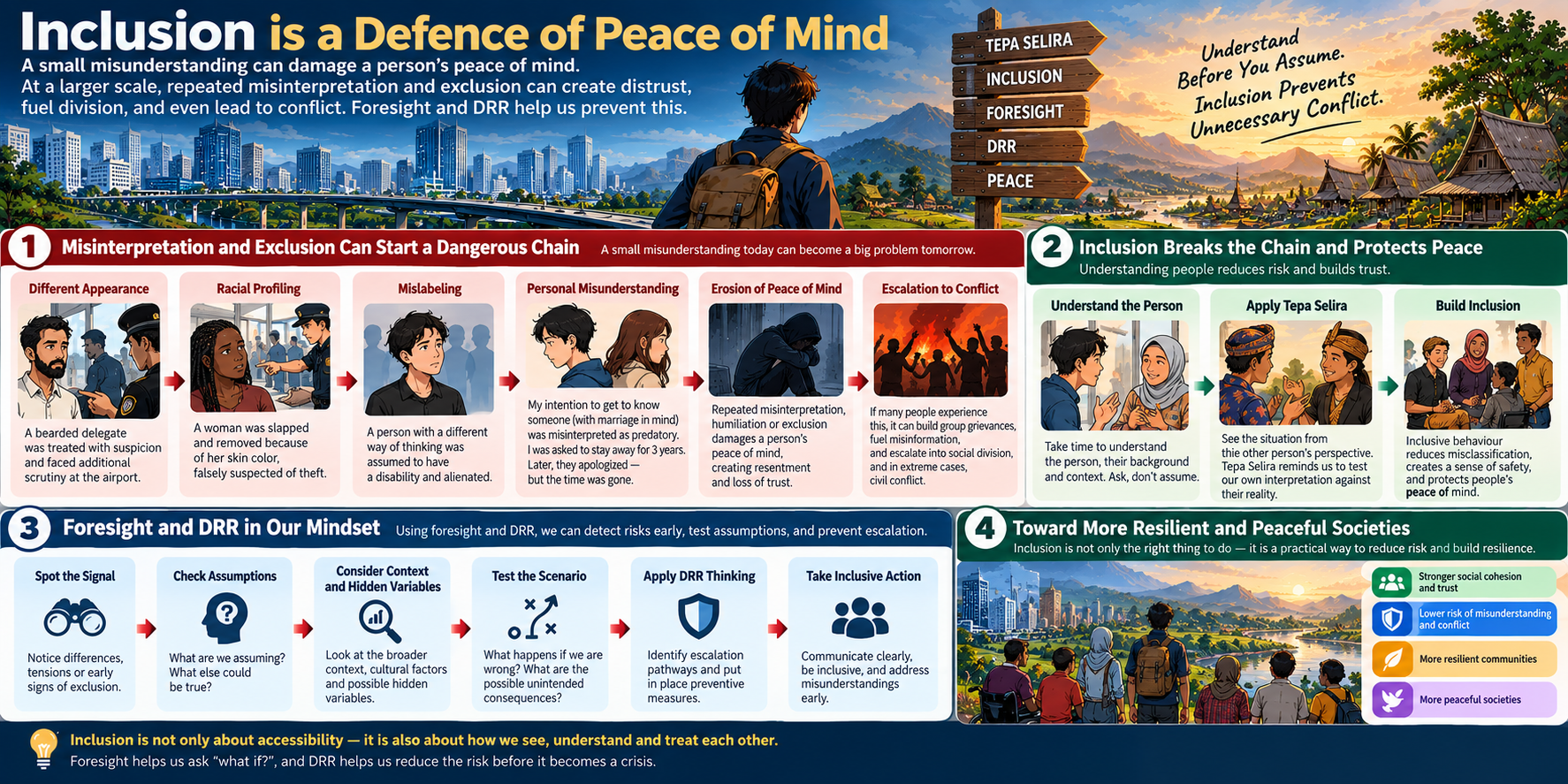
I used to think inclusion was mainly about disability. Making spaces accessible. Making participation possible. Removing barriers that prevent persons with disabilities from taking part.
That is still a critical part of inclusion.
But after working across international settings, observing how people are treated differently because of appearance, assumptions, communication style, culture, behaviour, or simply because somebody did not understand who they were, I started to see a much wider problem.
Inclusion is also about correctly understanding who is standing in front of you.
Because sometimes the most dangerous exclusion does not begin with an explicit decision to exclude someone.
It begins with a misclassification.
We see something.
We interpret it.
We classify the person.
Then we treat them according to the classification.
If the classification is wrong, everything that follows can be wrong too.
Part I — I Thought Inclusion Was Only About Disability
My first mental model of inclusion was relatively simple:
Can the person enter?
Can the person contribute?
Can the system adapt?
These questions matter enormously.
But they are not enough.
We also need to ask:
Do I understand the person accurately enough to decide how I should respond to them?
That changes the problem from physical access alone to interpretive access.
Can I understand their context?
Can I distinguish appearance from identity?
Can I distinguish behaviour from intention?
Can I distinguish difference from danger?
Can I distinguish an unusual thinking style from inability?
Can I distinguish a genuine risk from a false positive?
And can I correct my interpretation when the person tells me that I am wrong?
Part II — A Very Small Experience in China
I once travelled to China for an international meeting.
There were rules.
There was migration control.
There were procedures.
And of course, rules matter.
But at one point, I urgently needed to use the toilet. 😅
The interesting part was not that the rules disappeared.
They did not.
What I remember is that the official apparently recognised a very simple fact:
There is a human being standing in front of me, and this person has an immediate human need.
The procedure was still there. But the response became humane: I was assisted and directed quickly rather than treated as if the procedure itself was more important than the person.
It was a tiny moment.
But it stayed with me.
Because it demonstrated something that I think policy designers sometimes forget:
Rules exist to organise human activity. Humans do not exist to satisfy the emotional comfort of a rule.
This is not an argument for ignoring security, immigration controls, or procedures. It is an argument for context-sensitive implementation.
Inclusion can sometimes look like a very small operational adjustment that preserves both the rule and the dignity of the person.
Part III — When Appearance Becomes a Shortcut
Another international meeting gave me a very different lesson.
During a meeting in Korea, I observed a situation in which a participant from Indonesia who happened to have a beard was subjected to questioning and additional scrutiny that felt connected to assumptions about his appearance.
Another participant from Timor-Leste with a beard also experienced pressure. The irony was obvious: appearance had become a shortcut for identity, even though appearance could not reliably tell us a person's religion, intention, nationality, or threat level.
At one point I joked with the Timor-Leste participant that he already looked “Muslim enough” and might as well try converting. 😅
The joke was silly.
The underlying lesson was not.
A visible characteristic can be real without the meaning we attach to it being real.
A beard is a beard.
It is not automatically a religion.
A religion is not automatically an ideology.
An ideology is not automatically a threat.
And a threat assessment should not be replaced by a visual shortcut.
This is where inclusion and foresight meet.
A good risk system should reduce dangerous false negatives.
But a system that generates too many false positives can also create harm: humiliation, delays, mistrust, reputational damage, resentment, and unnecessary friction.
Part IV — The Other Side of Misclassification
I have also seen examples, through public videos and stories, where a person was treated as suspicious because of skin colour or perceived origin, and cases where somebody who behaved or thought differently was treated as though they had a disability when the actual issue was simply difference.
I do not want to turn individual incidents from videos or anecdotes into a universal claim about an entire country, institution, or population. The important point is the mechanism:
When the observer's category becomes more important than the actual person, misclassification can become treatment.
And treatment can become experience.
Experience can become memory.
Memory can become grievance.
Grievance can affect trust.
And damaged trust can influence what people do next.
This does not mean every misunderstanding becomes violence, let alone war.
That would be an unjustified leap.
The foresight lesson is more modest and more useful:
Misunderstanding can be an upstream risk factor in an escalation pathway.
Part V — Inclusion as a Defence of Peace of Mind
This is where I started thinking about a phrase I call:
Working concept
Inclusion as a Defence of Peace of Mind
Usually, inclusion is framed around rights, equality, participation, accessibility, or dignity.
All of those are important.
But there is another systems-level interpretation:
Inclusion reduces the probability that we will make expensive mistakes about people.
If I understand the person correctly, I am more likely to:
That is not simply kindness.
It is risk intelligence.
Part VI — Then I Remembered My Own Story
And yes, I have been on the receiving end of misclassification too. 😂
I like women.
I enjoy getting to know someone.
My preferred trajectory is fairly direct: if we are compatible, I would rather move toward marriage than spend years in an undefined relationship.
But imagine someone sees “man who approaches a woman” and jumps directly to:
“Predator.”
Without understanding the actual context.
Now imagine that assumption affects what happens next.
I was told to stay away for years because of that interpretation.
And eventually the interpretation turned out not to match reality.
The response later became something like:
“We misunderstood you. Sorry. You can continue getting to know her now.”
My response was basically:
“Now?” 😅
Because time is a hidden variable.
Three years do not disappear because somebody says sorry.
People change.
Situations change.
Trust changes.
Other options appear.
The opportunity that existed three years earlier may simply no longer exist.
That is another foresight lesson:
A correction can be accurate and still arrive too late to restore the original outcome.
Part VII — The Joker and Harley Quinn Thought Experiment
Now for the deliberately ridiculous thought experiment. 😄
Imagine two people are repeatedly misclassified.
One is treated as a threat when they are not.
The other is treated as something they are not.
Both lose trust.
Both become angry.
Both start interpreting the world through grievance.
Then they begin making decisions based on that grievance.
This is where my joke about “becoming Joker and Harley Quinn” comes from.
Obviously, real conflicts are far more complicated than a comic-book origin story.
But the metaphor exposes a useful foresight question:
What if today's small misclassification becomes tomorrow's grievance?
And what if repeated grievances accumulate?
Not every grievance becomes violence.
Not every misunderstanding becomes conflict.
But resilient systems should still ask:
What pathway could turn misunderstanding into escalation, and where can we interrupt it early?
Part VIII-A — When Peace of Mind Breaks, Risk Can Escalate
There is one part of this argument that I want to make much more explicit.
When people are repeatedly misunderstood, incorrectly classified, humiliated, or treated as a threat, the damage is not only practical.
It can affect something much less visible:
Working concept
Inclusion can function as a defence of peace of mind.
By “peace of mind”, I mean a person's basic sense that they can move through a system without constantly expecting to be misread, humiliated, targeted, or forced to defend an identity they do not actually hold.
When that sense is repeatedly damaged, a small incident can stop being “just a small incident”.
A misclassification can become a memory.
A memory can become a grievance.
A grievance can become a story about “what they always do to people like us”.
That story can spread through a group.
The group can begin interpreting later events through the same grievance.
Then the other side can respond to that reaction.
This is where feedback loops become more important than any single incident.
Misunderstanding does not have to directly cause violence to become a risk. It can create the conditions in which mistrust, grievance and reciprocal escalation become easier.
Research and operational guidance on conflict prevention similarly emphasise that exclusion, grievances, declining trust and weakened social cohesion can contribute to fragility and violent conflict, while inclusive, participatory and responsive institutions are part of prevention. That does not mean every exclusion or misunderstanding leads to violence. It means that these conditions belong in the risk assessment rather than being treated as irrelevant “soft issues”.
At the extreme end of this pathway, if grievances become group-based, mutually reinforced, politically organised, and institutional channels for correction or peaceful dispute resolution fail, a society can move toward serious communal violence or civil conflict. Civil war is an extreme scenario, not a deterministic endpoint of misunderstanding. The foresight value is precisely to identify the earlier stages where intervention is still possible: clarification, participation, dialogue, trusted institutions, mediation, and grievance resolution.
This is why I increasingly see DRR not only as “what do we do after the hazard appears?” but also as:
“Which relationships, assumptions and feedback loops should we strengthen now so that a future shock does not turn into a larger crisis?”
The mindset is preventive:
Understand people and contexts.
Clarify before categorising.
Give it a legitimate channel.
Use dialogue, mediation and early warning.
Protect trust while managing the hazard.
Learn what the system misread.
In that sense, peace of mind is not merely a private feeling. At scale, it can become part of the social conditions that support trust, cooperation and resilience.
Part VIII — This Is Where Disaster Risk Reduction Gets Interesting
When I first learned to think about DRR, it was easy to picture physical hazards:
earthquakes, floods, tsunamis, droughts, storms, fires.
But disaster risk is not only the hazard.
UNDRR describes risk in terms that include hazards, exposure, vulnerability and the decisions that shape how societies organise and protect people and assets. UNDRR also emphasises people-centred approaches, participation, inclusion and accountability in risk assessment and disaster management.
That means human relationships and social conditions matter to risk.
And this creates a fascinating possibility:
Some risks can be reduced before they become “disasters” simply by improving how we understand the people inside the system.
For example:
Misread identity → unnecessary friction.
Visual shortcut → false positive.
Different thinking → mistaken as incapability.
Unusual behaviour → incorrect intervention.
Misunderstanding → grievance and distrust.
Generic assumptions → people unable to act on warnings.
UNDRR's people-centred early-warning guidance makes a similar operational point: warnings and protective actions need to be designed with the individuals and communities who will use them, taking into account the complexity of different groups' circumstances.
Part IX — Tepa Selira: The Living Heritage Connection
This is where I return to Living Heritage.
One contemporary 2026 systematic literature review describes tepa selira as the ability to place oneself in another person's position, respect differences, and maintain harmonious social relations. It identifies cognitive, affective and behavioural dimensions of empathy, and discusses its relevance to inclusive, culturally respectful relationships.
Another 2024 study explores tepa selira as an empathy-oriented cultural value for preventing bullying, emphasising respect, care for others, and attention to one's words and behaviour.
I am interested in taking the principle one step further.
Not simply:
“Be empathetic.”
But:
“Before I act on my interpretation of another person, I should test whether my interpretation is actually valid.”
That turns a cultural value into a foresight question.
Part X — Living Heritage Is Not Only About Preserving the Past
UNESCO's 2003 Convention places communities, groups and individuals who create, maintain and transmit intangible cultural heritage at the centre of safeguarding, including their active participation in management under Article 15. ...
That matters here because inclusion is not only something we do to communities.
It is also about recognising communities as holders of knowledge about their own realities.
This has a direct parallel with DRR.
UNDRR's work on traditional and Indigenous knowledge explicitly argues for bringing traditional knowledge into disaster risk reduction and for allowing traditional and scientific knowledge to coexist and inform decision-making.
And UNDRR has documented cases where community-based DRR struggled precisely because local knowledge and participation were not meaningfully incorporated.
So the connection is bigger than culture.
It is epistemological:
Who gets to tell us what is really happening?
If we only listen to the model, the institution, the database, or the external expert, we may miss the people living inside the system.
And if we miss them, we may also miss the risk.
Part XI — From Inclusion to Risk Intelligence
I now think the chain can be represented like this:
Working framework
Living Heritage → Tepa Selira → Inclusion → Better Interpretation → Better Foresight → Earlier Risk Detection → DRR
This is not a claim that tepa selira is an official DRR framework.
It is my working synthesis: a way of connecting a local ethical principle with contemporary approaches to human-centred risk.
The logic is:
Tepa Selira reminds us to consider another person's position.
Inclusion gives that person space to correct our assumptions.
Foresight asks what happens if our interpretation is wrong.
DRR asks how we can reduce the risk before an adverse outcome becomes severe.
Part XII — The Inclusion Test I Want to Use
Before acting on a classification, I would ask six questions:
1. What did I actually observe?
Separate observation from interpretation.
2. What am I assuming?
Name the shortcut.
3. Who could correct me?
Invite the person or community into the interpretation.
4. What if I am wrong?
Run the edge case.
5. What could escalate?
Think one or two steps beyond the immediate response.
6. What preserves trust?
Choose the response that reduces avoidable harm while still meeting the legitimate objective.
This is where inclusion stops being a decorative value and becomes an operational capability.
Part XIII — The Point Is Not “Always Be Nice”
This distinction matters.
Inclusion does not mean:
“Ignore security.”
“Ignore rules.”
“Believe every claim.”
“Never classify risk.”
“Everyone is harmless.”
That would be another form of context blindness.
The goal is more disciplined:
Keep the rule. Improve the interpretation.
Keep the security objective.
Improve the identification.
Keep the policy.
Improve the feedback loop.
Keep the risk assessment.
Improve the understanding of the people inside it.
Part XIV — My New View of Inclusion
I began with a simple idea:
“Inclusion means making sure people with disabilities are not left behind.”
I still believe that.
But now I would add:
Inclusion also means refusing to reduce a human being to the first explanation that comes to our mind.
A beard is not a threat.
Skin colour is not a crime.
Unusual thinking is not automatically disability.
Approaching someone is not automatically predation.
Difference is not automatically danger.
And a person who does not fit our mental model is not automatically a problem.
Sometimes the problem is our model.
Part XV — The Foresight Question
What if the first disaster is not the hazard — but our interpretation of the people experiencing it?
Maybe the next step in human-centred foresight is not simply to ask:
“What could happen?”
But:
“Whom might we misunderstand?”
“What would that misunderstanding cause?”
“Who could be harmed by our classification?”
“How could the grievance propagate?”
“Where can we interrupt the chain?”
That is where I see a bridge between Living Heritage, Inclusion, Foresight and Disaster Risk Reduction.
And perhaps the most practical lesson is the oldest one:
Before deciding what someone is, try to understand where they are.
Maybe that is not only empathy.
Maybe it is risk prevention.
Closing thought
Foresight begins before the forecast. It begins with correctly understanding the human being inside the system.