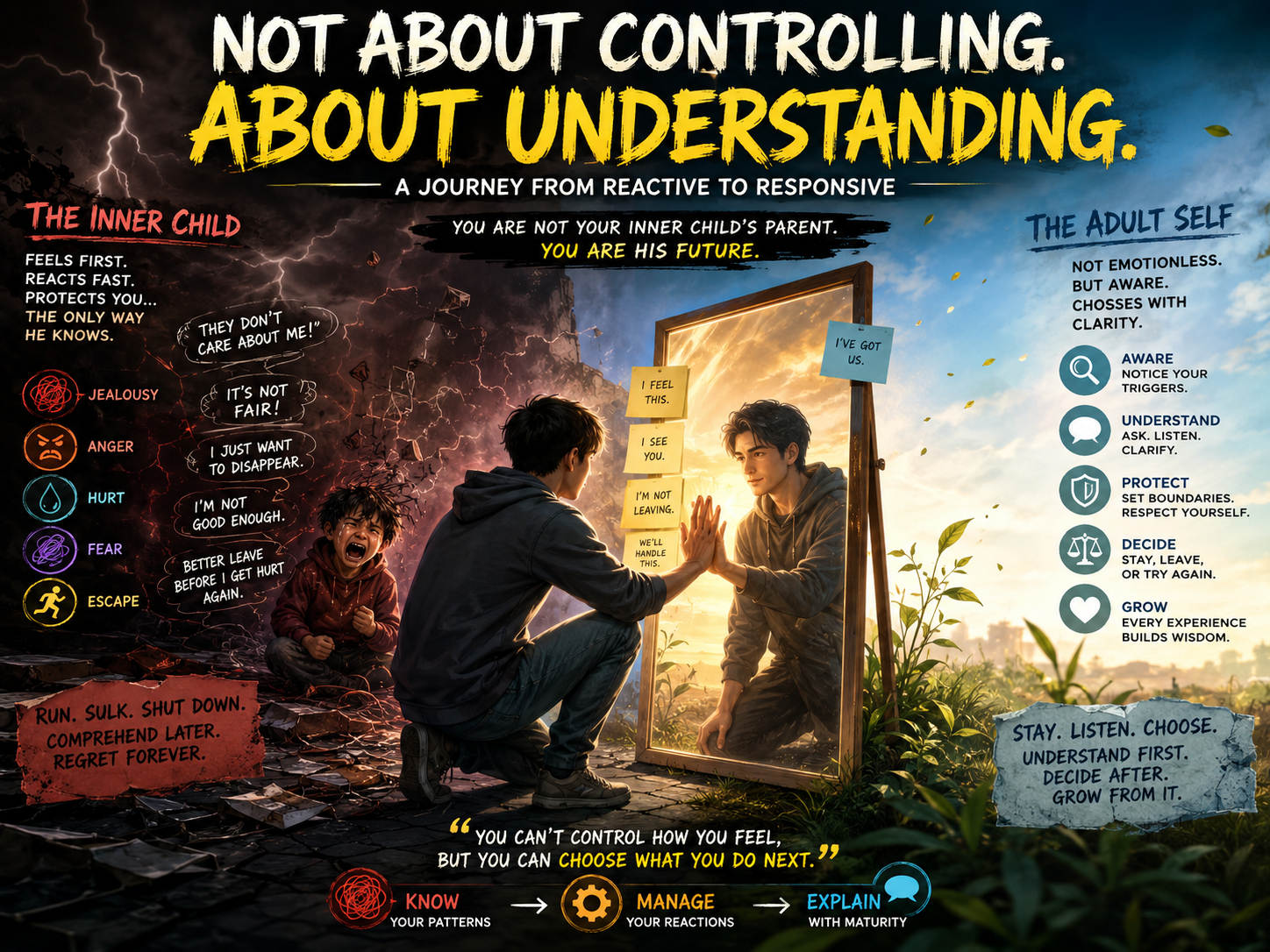
For a long time, I thought growing up meant getting rid of the childish parts of myself. I was wrong. The fire never went out — I still get angry, jealous, and I still sulk. What actually changed was much smaller, and much more useful: who holds the steering wheel.
Part I — You Cannot Control Yourself 100%
I used to be extremely childish. When I made a mistake, my instinct was simple: leave. I did not want to face the consequences, the uncomfortable conversation, or the moment of sitting across from someone I had hurt and hearing what my actions had done to them. Running was easier — until one day it cost me someone I deeply loved.
She lived only a few steps away from me. I loved her enormously. Yet because of how I handled things, I lost her, and then she moved away entirely. There was no psychological theory in my head at the time. Just the plain, painful arithmetic of consequence.
That loss installed one rule inside me: if I am the one who made the mistake, I am not allowed to run from it. Not because I suddenly became emotionally mature. Not because the childish part of me died. But because I finally understood what happens when I let that part of me drive.
The Fire Never Went Out
This is where I think most of us misunderstand self-control. We picture emotional maturity as extinguishing the fire — no anger, no jealousy, no sulking, no urge to disappear. Years later, I can tell you: the fire is still there.
I still get angry. I still get jealous. I still sulk. I can still turn irrational when someone I care about hurts me. The only difference is that now, sometimes while it is happening, another part of my mind is watching.
"Angga, you're sulking." — Yes.
"You know this isn't mature, right?" — Yes.
"Are you going to stop?" — Not necessarily.
Psychologists call this metacognition — thinking about your own thinking. In therapy it is sometimes called the observing self: the part of you that can watch an experience without being fully dissolved into it.
And here is the uncomfortable finding: awareness does not equal control. Knowing you are behaving irrationally does not dissolve the irrational behaviour. You can narrate your own childishness in real time and keep doing it. That sounds absurd. It is also progress — because the old version of me was the emotion. There was no gap between feeling and acting. The current version of me can sometimes hold both at once: this is an emotional state, this is not necessarily reality, and I should not make an irreversible decision from inside it.
Control Is a Bad Word for It
"Self-control" may simply be the wrong phrase. If we truly controlled ourselves, nobody would lose their temper, procrastinate, or send a message at midnight and regret it at breakfast. Nobody would recognize a terrible idea and execute it anyway.
Research on willpower points the same direction. Whatever you call it — depletion, fatigue, competing motivation — the practical finding holds: self-control that depends on in-the-moment strength is unreliable. It fails exactly when you need it most, because the moments that require the most restraint are also the moments you have the least.1
So what is left is something less impressive-sounding but far more durable: self-management. I cannot always stop the fire from appearing. I can learn where I store the gasoline. I can recognize the situations that make me irrational. I can delay decisions. I can leave a conversation before anger makes me cruel. I can say, "I'm upset. Give me a little time." I can notice "I want to disappear right now because I feel ashamed" — and answer myself: "No. This is exactly where you used to run. Stay."
The Reframe
The goal was never to stop being childish. The goal is to stop letting the childish version of me make every important decision. My inner child can sit in the car. He can complain, get jealous, sulk in the back seat, yell "I DON'T LIKE THIS, LET'S GO HOME." Sometimes he even has a point. He just doesn't get to drive.
Not domination. Not suppression. Not perfection. Awareness, management, and choice. We probably never fully control the fire inside us — growing up is learning not to hand it the matches.
Part II — Your Feelings Are Not Facts. But They Are Not Noise Either.
In Part I, I said I cannot stop my inner child from getting angry or jealous — I can only keep him out of the driver's seat. Simple enough, until a harder question arrives: what if he is reacting to something real?
There is someone I care about. From a purely rational position, I can generate endless explanations for her behaviour: maybe I misread her, maybe it is cultural, maybe I mistook friendliness for something more, maybe she simply communicates differently with different people, maybe I expected something she never promised. My rational mind is genuinely good at producing alternative hypotheses. Intellectually, I respect that.
One problem: my heart does not read my hypotheses. What it registered was much simpler — she gave someone else a kind of attention she did not give me. And that felt like a double standard. My brain says: Careful. Feeling ≠ fact. Correct. Another part answers: Fine. But something still hurt. Also correct. Both are true simultaneously, and that is precisely what makes emotional maturity harder than the slogans suggest.
Where the Emotion Actually Comes From
Richard Lazarus's cognitive appraisal theory offers a useful correction. Emotion does not come from an event. It comes from your interpretation of an event.2
Emotions Are Signals, Not Verdicts
There is an equal and opposite mistake, and I have made it too. After learning that emotions distort judgment, you start distrusting all of them. Jealous? Irrational. Angry? Calm down. Hurt? Overthinking. Sulking? Grow up.
But Schwarz and Clore's work on feelings-as-information shows that emotions function as data about your internal state and your reading of a situation.3 They are not proof of external facts, but they are not meaningless static either. If I feel excluded, that does not prove anyone excluded me — it proves something in the interaction registered as exclusion. The signal is real. The conclusion is unverified.
Why I Sulk Instead of Asking
Attachment theory gave me language for something I had been doing for years without understanding it. When we feel a connection is threatened, we produce protest behaviour — attempts to re-establish closeness that often arrive disguised as their opposite. Withdrawal. Coldness. Sulking. Testing.4
Sulking, Decoded
Sulking is a protest behaviour wearing a costume. Underneath "I don't want to talk to you" is usually "I want you to notice that something is wrong, because asking directly would require admitting you have the power to hurt me." It is a request for reassurance, engineered to avoid the vulnerability of requesting reassurance. Which is exactly why it so rarely works.
Some former partners could read it. They would recognize "Oh. He's sulking" — not agreeing with me, not conceding I was right, just accurately identifying the state. And because they could name it, communication survived. Others could not, and those relationships ended very differently. That taught me something I resisted for a long time: emotional regulation inside a relationship is not purely a solo activity. I am responsible for managing myself. But repair, clarification, and disagreement all require a second person. Even being proven wrong requires someone willing to prove it.
Testimony, Not Verdict
Here is the arrangement I have landed on with my inner child. Do not silence him. Do not mock him. Do not automatically obey him. Take his testimony.
Part III — Facing the Problem vs. Chasing a Person
There is advice I hear constantly: "Whether you're right or wrong, face the problem." I agree — mostly. That is the lesson I paid for by losing someone: don't run just because accountability is uncomfortable. Then I hit a wall the advice never mentions. What happens when I am willing to face the problem and the other person isn't?
Repair Requires Two
Marriage researchers have a finding I keep returning to: what distinguishes stable relationships from unstable ones is not the absence of conflict. It is the presence of repair attempts — the small moves that interrupt escalation and reopen connection.5 The critical part is that a repair attempt only functions if someone receives it.
Developmental research shows the same structure. In the "still face" experiments, an infant whose caregiver goes unresponsive escalates, protests, tries harder — then withdraws entirely.6 Not because the child stopped caring, but because rupture without repair eventually teaches the nervous system that reaching is pointless. I recognize that sequence. I have lived it from both sides.
I am responsible for opening the door. I am not responsible for dragging anyone through it.
The Test I Have to Pass First
Before I use that rule, I have to survive an uncomfortable question. Sometimes "I just want communication" is a cover story for "I want you to admit I was right." Those are not the same, and conflating them lets me perform openness while demanding surrender. Real communication carries risk — I might discover I was wrong, that the double standard I saw had context, that the rejection I felt was not rejection.
So the rule cannot be "talk to me until you concede." It has to be "talk to me so both of us have enough information to know what actually happened" — which is significantly harder, especially when the inner child has already prepared a presentation titled Why I Am Obviously the Victim Here.
Disagreement Is Communication
Before I walk away, I owe myself one honest audit: did they refuse the conversation, or did they refuse my version of it?
Historically, running was my weakness. But maturity cannot mean swinging to the opposite extreme and staying forever in situations where I am the only one repairing. That is not regulation — that is avoidance with the polarity reversed. I have simply replaced fleeing with pursuit.
Don't Weaponize Distance
The hardest distinction for someone like me: there is leaving because I need space, and there is leaving because I want to be chased. From outside they are identical. Inside they are opposites. "This is hurting me and I need to step away" is a boundary. "I'll disappear until you suffer enough to come find me" is punishment.
My inner child prefers the second. He wants the dramatic exit, the moment they realize oh no, I hurt him, ideally with a soundtrack. Adulthood has terrible production values. Usually nobody chases, nobody explains, and no one delivers the closure scene your brain already storyboarded.
Closure Is a Decision, Not a Gift
I used to believe closure was something another person handed you. Sometimes you get it. Often you don't. When you don't, you face a different test: can I tolerate an unanswered question without destroying myself trying to force the answer? That might be the most adult form of regulation there is. Not suppressing the question. Not pretending I don't care. Just: I wanted an answer. I didn't get one. I cannot compel another human being to provide it. That hurts. It still beats surrendering your dignity to an endless pursuit.
So the question is not always should I stay? The better question is: is there still a conversation here? If yes — stay long enough to hear it, even if you are angry, even if it proves you wrong. If no — stop arguing with the empty chair.
Part IV — Decide Before Your Ego Gets a Vote
Emotional maturity is suspiciously easy when the other person is not in the room. Right now, calm and thinking clearly, I can say: "If she comes back and genuinely wants to explain, I'll listen." Beautiful. Mature. Ten out of ten. One small problem — what happens when she is actually standing in front of me?
The calm version of me is excellent. He understands appraisal theory. He can write five parts about emotional regulation. He may not be on duty when it counts. The one answering the door is the one who remembers being hurt, and his opening thought is likely: "Oh. NOW you want to talk?" He will go cold. Refuse. Walk away. Become extremely busy doing absolutely nothing elsewhere. The genuinely absurd part is that I might narrate the whole thing while it happens.
Why Willpower Is the Wrong Tool
Self-awareness gets mistaken for a control panel — understand your triggers, press the right buttons. It does not work that way. Awareness supplies information. It does not guarantee compliance. Which is why regulation cannot rest on what I feel capable of in the moment. The moment is precisely when capacity collapses.
Gollwitzer's research on implementation intentions gives the alternative. Vague goals ("I'll stay calm") fail reliably. Pre-committed if-then rules perform substantially better, because they hand your future self a single instruction instead of a decision.7
Disarming the Ego
The real opponent is not anger or jealousy. It is pride, and pride argues well: She had her chance. Why make this easy for her? She hurt you — and now she walks back in whenever she feels like it?
No. She doesn't. And here is the reframe that defuses the whole argument:
Two Outcomes I Have to Accept in Advance
If she proves me wrong. Suppose she explains and the story I carried for months collapses. Then self-control becomes humility. Being hurt does not guarantee being correct. "That hurt me" and "what I believed caused it wasn't what happened" can both be true at once. The pain was real. The appraisal was wrong. I would owe reality an update — and probably a person an apology.
If I was right. She explains, I listen, and I still conclude it was genuinely unfair. Then at least the conclusion survived contact with reality instead of living entirely in my head. Now a different question opens: given what I know, what relationship is actually possible from here? The child asks "who hurt me?" The adult asks "what's possible now?"
If I Run Anyway
I could still fail. The ten-minute rule could evaporate on contact. The old version of me says: "You ruined it. Too late." That is exactly the logic that turns one mistake into a permanent condition. Self-control includes repairing your own failures of self-control. If I run and realize I shouldn't have, I can come back: "I'm sorry. Seeing you brought up more than I expected and I reacted defensively. If you still want to talk, I'm willing to try again." Uncomfortable. Good — accountability usually is. The rule I learned years ago still holds: don't use embarrassment as an excuse to disappear. Even when the mistake was disappearing.
Don't Make People Pass Tests They Can't See
When hurt, we build tests. We withdraw hoping to be followed. We say "leave me alone" while praying they won't. Then when they respect our stated words, we conclude: see, they never cared. That is not fair. Nobody can reliably distinguish a boundary from a coded loyalty test.
| What I used to do | What they receive | The honest version |
|---|---|---|
| Go silent and wait to be noticed | "He doesn't care anymore." | "I'm hurt. I need a little time, but I'm not leaving." |
| Say "leave me alone," hope they stay | They leave — respectfully. | "I do want to hear you. I'm too emotional right now. Ask me again later." |
| Reject the first approach on principle | "The door is closed permanently." | "I'm still upset. Give me ten minutes before I answer." |
| Expect them to know my pattern | A puzzle with no key. | Name it before conflict: "When I'm badly hurt, my instinct is to withdraw." |
That said, there is something true underneath my joke that someone should just drag me back. What actually helps is not pursuit — it is persistence without coercion. Someone who can say: "I'm not going to fight you. I'm also not disappearing because this got uncomfortable. I'm here when you're ready." Nobody owes me that. But it is the thing that has ever worked.
My Ego Doesn't Have to Die
Mine protects something legitimate — dignity, boundaries, the memory that this hurt once and could hurt again. I don't want it silenced. I want it out of the decision seat while information is still missing. So I can tell the defensive part of me: "I know you're protecting me. You don't have to disappear. We're only listening. If this turns unhealthy, we can still leave." That reframes the entire task. I'm not asking my inner child to trust the person who hurt him. I'm asking him to trust me.
Part V — Maybe Growing Up Was Never About Silencing the Child
I opened this series with a confession: I used to be extremely childish. When I made mistakes, I ran — and eventually that cost me someone I loved. For a long time I thought the lesson was obvious. Grow up. Stop running. Control yourself. Kill the childish part. Being human for a few decades taught me something inconvenient. The child never left.
I Was Trying to Control the Wrong Variable
Rotter's locus of control clarified this for me, mostly by exposing how badly I had been applying it.8 I had been treating other people's honesty, willingness, and return as things I could somehow influence with sufficient effort — while treating my own reactions as weather I simply had to endure. That is exactly backwards.
The Child Was Never the Enemy
Calling it an "inner child" makes it sound like something requiring discipline. But look at what he is actually saying underneath. Jealousy: I'm afraid I don't matter. Anger: Something feels unfair. Sulking: I was hurt and I don't know how to ask for reassurance without becoming vulnerable. The urge to run: I don't want to feel that again.
Those produce terrible decisions. The impulse underneath them is not malicious. He is protecting something. The trouble is that children make excellent alarm systems and terrible generals. So my job was never to defeat him — it was to hear the alarm and then determine whether there is actually a fire.
Self-Control Is Really Self-Trust
Murray Bowen's concept of differentiation of self describes the ability to stay emotionally connected to others while remaining a distinct person — to feel intensely without being governed by the feeling, and to stay close to someone without dissolving into their reactions.9 That is a better description of what I have been building than "self-control" ever was.
Because what I actually needed was not control. It was self-trust. Trusting myself not to make permanent decisions from temporary states. To investigate before accusing. To apologise when wrong. To leave when staying harms me. To return when pride made me leave too fast. To survive an answer I don't like. That is a different project than controlling myself 100%. I no longer think 100% exists. I don't think we need it.
The Child Grows Because We Do
Something else I had wrong. I pictured the inner child as fixed — permanently wounded, permanently impulsive, waiting to sabotage. He learns.
Maybe regulation is not only the adult managing the child. Maybe the child is slowly learning from the adult.
I'm Still Childish Sometimes
I am finally okay saying that. I sulk. I get jealous. I can be stubborn. I sometimes want reassurance while making it unnecessarily difficult to reassure me. I sometimes know the mature response precisely and still need time before I can produce it. The difference is I no longer pretend those parts don't exist — hiding them makes them harder to manage, not easier.
Self-awareness starts with an uncomfortable sentence: "This is what I'm capable of when I'm hurt." Not "this is who I permanently am." Just: this pattern exists in me, so I have to account for it. Once you know the terrain, you can prepare for it.
So, Did I Finally Grow Up?
Ask me next time I'm sulking. You may get a very different answer. But I am no longer the person who believes maturity means never feeling childish again.
Growing up isn't the moment the child disappears. It is the moment you start recognizing his voice. Then, slowly, you learn when to comfort him, when to question him, when to tell him he's wrong, when to admit he saw something you missed, when to let him cry, when to say not today — and sometimes, when he is already reaching for the door: "No. We made the mistake. We're staying." Other times: "Yes. We've tried enough. We can go."
The child still speaks. The fire still burns. The ego still complains. The heart still gets hurt. But there is someone else in the room now — someone watching, someone deciding, someone able to say: "I know what you're feeling. I'll take it from here."
He can keep the back seat. He can complain the entire drive. I'm holding the wheel.
Key Sources
1 Baumeister, R. F., Bratslavsky, E., Muraven, M., & Tice, D. M. (1998). Ego Depletion: Is the Active Self a Limited Resource? Journal of Personality and Social Psychology, 74(5), 1252–1265 — the classic case that in-the-moment restraint is an unreliable resource. (Later replication debates only strengthen the practical conclusion: don't build your plan on willpower.)
2 Lazarus, R. S. (1991). Emotion and Adaptation. Oxford University Press — cognitive appraisal theory, and the event → appraisal → emotion sequence used in Diagram 4.
3 Schwarz, N., & Clore, G. L. (1983). Mood, Misattribution, and Judgments of Well-Being. Journal of Personality and Social Psychology, 45(3), 513–523 — the feelings-as-information account.
4 Bowlby, J. (1969/1982). Attachment and Loss, Vol. 1: Attachment. Basic Books — protest behaviour and deactivating strategies; see also Mikulincer, M., & Shaver, P. R. (2007). Attachment in Adulthood.
5 Gottman, J. M., & Silver, N. (1999). The Seven Principles for Making Marriage Work. Crown — repair attempts and why reception matters more than the attempt itself.
6 Tronick, E., Als, H., Adamson, L., Wise, S., & Brazelton, T. B. (1978). The Infant's Response to Entrapment Between Contradictory Messages in Face-to-Face Interaction. Journal of the American Academy of Child Psychiatry, 17(1), 1–13 — the "still face" paradigm.
7 Gollwitzer, P. M. (1999). Implementation Intentions: Strong Effects of Simple Plans. American Psychologist, 54(7), 493–503 — the if-then structure behind the ten-minute rule.
8 Rotter, J. B. (1966). Generalized Expectancies for Internal Versus External Control of Reinforcement. Psychological Monographs, 80(1), 1–28.
9 Bowen, M. (1978). Family Therapy in Clinical Practice. Jason Aronson — differentiation of self: feeling intensely without being governed by the feeling.
Background soundtrack: "Beautiful Place Is in Your Mind" — thum/Beautiful Place is in your mind.m4a