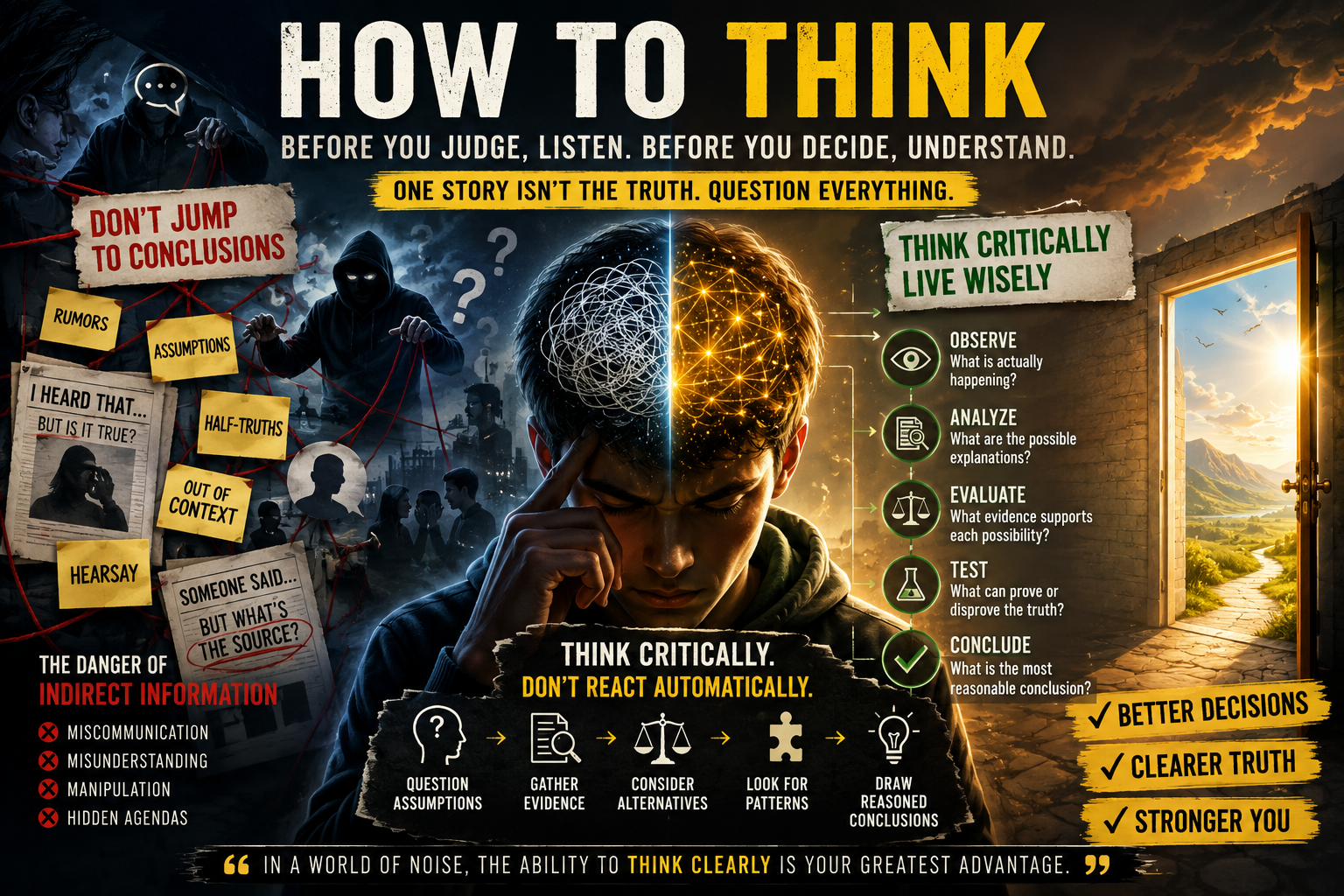
“We like to think we understand what's happening around us. Someone tells us a story, we hear a rumor, we notice a pattern, and within seconds we've already reached a verdict. He can't move on. She's playing games. They're against me.”
It feels natural, almost instinctive — judging quickly is how the human mind is wired to survive. But survival instincts and truth are not the same thing.
Here is the uncomfortable reality: most of what we “know” about other people's intentions is not knowledge at all. It's inference, stitched together from fragments — a comment someone made, a behavior we half-witnessed, a story retold by someone who heard it from someone else. We call this indirect information, and yet we treat it as fact. We build entire judgments on top of it, then defend those judgments as if they were self-evident.
The problem is not that we think. The problem is that we stop thinking too soon.
Dual-Process Theory (System 1 vs System 2)
Daniel Kahneman's framework describes two modes of thought. System 1 is fast, automatic, and emotional — the part that instantly delivers a verdict from a single comment or rumor. System 2 is slow, deliberate, and effortful. Critical thinking is the act of deliberately engaging System 2 before System 1 locks the conclusion in place. The discomfort of uncertainty is the price of accuracy.
Miscommunication happens. Misunderstanding happens. And sometimes — more often than we'd like to admit — we are deliberately misled, manipulated, or fed a version of events crafted specifically to make us conclude the wrong thing. Not always by the person standing in front of us, either. Sometimes the hand shaping our perception is invisible: a friend of a friend, a whisper inside someone else's circle, an opinion quietly planted by a person we never even suspected. We think we're seeing the whole picture. We're seeing what someone else wants us to see.
This is why critical thinking cannot stop at a single data point. One story is not proof. One behavior is not the full explanation. One conclusion, drawn in isolation, is almost always incomplete — because human situations are rarely a clean equation where A simply equals B. Sometimes A equals Z, because B was never the real variable to begin with; something else — call it C, or D, or a variable we haven't even identified yet — was quietly doing the work all along.
This isn't cynicism. It isn't refusing to trust anyone. It's simply acknowledging that people, relationships, and motives are complex systems — and complex systems deserve to be examined, not assumed. Before we judge, before we decide who is right and who is wrong, before we let a single story rewrite how we see someone, we owe it to ourselves — and to them — to ask: what else could explain this? What am I not seeing? Who else might be shaping what I think I know?
In the sections that follow, we'll walk through real situations where the obvious conclusion wasn't the true one — where a second look, a harder question, or a willingness to sit with uncertainty revealed something the first impression completely missed. Because thinking critically isn't about being suspicious of everyone. It's about respecting the truth enough to actually look for it — instead of settling for whatever story arrived first.
Example 1: “He Just Can't Move On From His Ex”
Someone once told me about a guy who, months after his breakup, still isn't over his ex. The evidence? He still talks about her sometimes. He still seems affected when her name comes up. The verdict was already written before the conversation even finished: he can't move on.
But here's the question nobody asked: what does “moving on” actually require?
I'll admit something about myself here. When I'm single, I'm free — free to talk to whoever, free to go wherever, free to keep my options open. That's what being single means, structurally. But the moment I commit to someone, everything changes. I block. I close every door that isn't hers. Not because I'm told to, but because that's what commitment means to me.
Now flip the lens. If someone is single and still occasionally thinks about, mentions, or feels something toward an ex — is that actually evidence of an unfinished relationship? Or is it simply evidence that they are, in fact, single — free to feel whatever they feel, free to have unresolved emotions, because there is no one they owe an explanation to?
Fundamental Attribution Error
We tend to explain other people's behavior by their character (“he can't move on”) while explaining our own by the situation (“I'm single, so of course I still feel things”). This bias, identified by Lee Ross, is one of the most robust findings in social psychology. The structural reality of someone's status is a hidden variable that the observer almost never accounts for.
This is the trap: we confuse status with behavior, and then we confuse behavior in freedom with behavior in commitment. A single person reflecting on an ex is not automatically a person who is “still hooked.” A single person is, by definition, allowed to carry whatever they're carrying — because nothing currently constrains them not to. The real test was never whether someone thinks about an ex while single. The real test is what they do the moment they are no longer single. Does the door actually close? Does the behavior actually change?
Judging someone as “not over it” based on a single visible fragment — a comment, a mood, a pause — while ignoring the structural reality of their situation, is exactly the kind of shortcut this whole piece is warning against. One data point. Zero context. A verdict anyway.
Example 2: “You're So Shallow for Even Questioning It”
This one is personal, because it happened to me directly.
I once raised a simple question about someone's situation: if you say you want to move forward with someone new, why are you still deeply engaged with your ex — while simultaneously avoiding closeness with the person you claim to actually want? I wasn't accusing anyone of lying. I was pointing out a contradiction and asking, genuinely, why does this pattern exist?
The response I got wasn't an answer. It was a label: you're shallow for even thinking that way.
But here's what I actually believe, and what I think got lost in translation: I never claimed to know the truth. I claimed that a contradiction in behavior is data — and data deserves an explanation, not dismissal. If someone maintains closeness with an ex but creates distance from a new interest, that's not something to wave away as irrelevant. It's a variable. It might have an innocent explanation. It might have a complicated one. But pretending the contradiction doesn't matter — that's the actual shallow move, not questioning it.
Confirmation Bias & Motivated Reasoning
When a question threatens a preferred narrative, the brain often defends the narrative instead of examining the data. Labeling the questioner as “shallow” is a classic defensive move: it reframes the inquiry as a character flaw rather than a legitimate request for clarification. The contradiction remains untouched; only the conversation is shut down.
This is where I think a lot of people get critical thinking backwards. They assume that asking “why” is an accusation. It isn't. Asking “why” is the opposite of jumping to conclusions — it's refusing to accept the first available story as the whole story. I wasn't told to trust blindly. I was told that trust requires understanding, and understanding requires looking at behavior that doesn't add up and actually asking about it instead of looking away.
Calling that shallow doesn't make the contradiction disappear. It just makes it more comfortable to ignore.
Example 3: “Why Is My Friend Group Suddenly Keeping Me Away From This Person?”
This is the example that, for me, cuts the deepest — because it has no single obvious answer. It only has hypotheses.
Imagine this: a group of your friends starts subtly steering you away from someone you're interested in. Nothing dramatic. No confrontation. Just… redirection. Fewer invitations when that person is around. Small comments that plant doubt. A shift in tone whenever the name comes up.
The instinctive reaction is to pick one story and run with it. Maybe they think that person isn't good for me. Maybe they're protecting me. Maybe it's jealousy. But if you actually stop and think — the way you'd approach a research question, not a gut feeling — you realize there isn't one hypothesis here. There are several, and they don't cancel each other out:
- Is this simple misunderstanding — has something been misread and blown out of proportion?
- Do they want me, and this is a way of removing competition?
- Do they want the other person, and I'm the one being quietly pushed out?
- Or is it neither — is one single person inside that circle shaping the entire group's opinion, and everyone else is just repeating what they've absorbed, without independent verification of their own?
Method of Multiple Working Hypotheses
In 1890, geologist Thomas Chamberlin argued that the greatest danger in inquiry is falling in love with a single explanation. His solution: deliberately keep several competing hypotheses alive at the same time. Each hypothesis points to a different truth, and none can be resolved by indirect information alone. Volume of repetition is not verification. Only direct testing separates them.
Each of these hypotheses points to a completely different truth. And critically — you cannot resolve any of them using indirect information. Not by what someone “said.” Not by what someone “implied.” Not by group consensus, because group consensus can just as easily be one person's narrative wearing everyone else's voice.
If you've ever written a thesis, this will sound familiar: you don't accept a conclusion because it sounds plausible. You isolate variables. You test directly. You ask who actually said what, to whom, and why — instead of accepting the version that has simply been repeated the most times. Indirect information, no matter how many people repeat it, is still indirect. Volume is not verification.
This is the hardest kind of situation to navigate, because the people involved are your own circle — people you're inclined to trust by default. But trust without verification isn't trust. It's assumption wearing a trusted face.
Detailed Analysis 1: The Matchmaker's Paradox
Some situations don't just involve misunderstanding. Some involve someone actively engineering the misunderstanding — and refusing to admit it. Beneath a surprising number of these situations lies a premise darker than simple jealousy: if I can't have it, no one can.
Let's build a case study around this.
The Setup
You ask someone to introduce you to a person you're interested in — romantically, professionally, doesn't matter. That intermediary now holds a position of quiet power: they control the pace, the framing, the timing of everything that follows.
Most of the time, this goes exactly as it should. But sometimes, the intermediary has a hidden agenda. Maybe they want that person for themselves. Maybe they're protecting someone else's interest in them. Whatever it is, they become — knowingly or not — a gatekeeper.
And gatekeepers rarely refuse you outright. Refusal is confrontational, and confrontation invites questions. Instead, they stall.
Not with a clear “no,” but with a seemingly endless series of “not yet.”
- “They changed their mind — let's wait until your birthday.”
- “Bad timing — let me reschedule.”
- “The window closed — let's push it back again.”
- “Let's wait until next month.”
- “Things are a little complicated right now.”
- “I'll let you know soon.”
- “Let's see how things develop.”
- “Now isn't the right time.”
- “Maybe after this project is finished.”
- “We're still discussing it.”
- “I need to talk to someone first.”
- “Let's not rush.”
- “Give it a little more time.”
- “We're almost there.”
- “Just be patient.”
- “We're waiting for the right moment.”
- “Something unexpected came up.”
- “We'll revisit this later.”
Instead, they ask a better question: “Is this a temporary obstacle, or is postponement itself becoming the answer?”
Each excuse, taken alone, sounds reasonable. That's the point. Delay is easy to justify one step at a time. But stretch enough small delays end to end, and they stop being delays — they become a strategy. The goal was never to connect you. The goal was to stall the connection until it quietly died of old age, with no one ever having to say no.
Two Hypotheses, Not One
Here's where critical thinking has to do real work, because there are at least two very different explanations hiding inside the same set of facts.
Hypothesis A — The Reluctant Gatekeeper. The intermediary is conflicted, maybe wants the person themselves, and is stalling out of their own hesitation. This is selfish, but passive. It's about their own unresolved feelings, not about actively working against you.
Hypothesis B — The Saboteur. Someone inside the process — not necessarily the intermediary — genuinely wants that person, and is not simply delaying. They are actively shaping the outcome from the inside, using information you gave in good faith.
These two hypotheses look identical from the outside. They feel completely different once you understand what evidence would separate them.
What Sabotage Actually Looks Like
If a saboteur exists, they have one enormous advantage: they know things about you that you volunteered, trusting the process. And information given in trust can just as easily be turned into a weapon — quietly, deniably.
Consider how specific, personal preferences you shared start reappearing, inverted, in the world:
- You mention you're drawn to dark hair. Somehow, word reaches her that lighter hair suits her better.
- You mention you like long hair. Somehow, it gets cut short.
- You mention you're drawn to a natural gap-toothed smile — a look plenty of people find distinct and charming. Somehow, someone suggests braces would “fix” it.
- You mention long-distance doesn't work for you. Somehow, she's advised to create space, because distance apparently “makes people fall harder.”
- You mention you tend to get jealous. Somehow, she's told to be seen with other guys, because jealousy supposedly makes people chase.
- You mention you're about to travel. Somehow, every attempt to meet before you leave gets absorbed into “let's just wait until you're back” — and “when you're back” never actually arrives.
None of these events, alone, proves anything. Each has an innocent alternative explanation — genuine taste, unrelated timing, coincidence. That's exactly what makes this hard, and exactly why the hypothesis needs to be tested, not assumed.
The Test: How Do You Actually Know?
This is the part most people skip. They notice one suspicious pattern and immediately convict someone in their head. But a real hypothesis needs a real test — and here is the test that actually separates Hypothesis A from Hypothesis B, and both of those from simple misunderstanding:
If it's genuinely just a misunderstanding, it resolves quickly and directly once raised. A misread signal, once clarified, stops repeating. The person doesn't need to keep manufacturing new excuses each time you get close, because there was never anything to hide — an honest mistake corrects itself the moment it's named. Directness is cheap when there's nothing being protected.
Sabotage, on the other hand, doesn't behave that way. It doesn't resolve when you ask directly — it evolves. The excuse changes shape, but the delay never actually ends. New reasons appear precisely when old ones expire. Information you shared privately keeps resurfacing in ways that consistently work against you, never in your favor, never randomly.
That asymmetry — the fact that every “coincidence” points in the same direction, and directness never actually closes the loop — is the signal. Not the individual events. The pattern across them.
Falsifiability (Karl Popper)
A genuine explanation must be capable of being proven wrong. A misunderstanding, once named, should stop. A protected agenda will keep shifting the goalposts. The behavior of the explanation under direct challenge is itself the evidence. This is the same discipline science uses: an unfalsifiable story is not knowledge.
This is the same discipline as before: don't convict on a single data point, don't dismiss the pattern either. Ask what a genuine misunderstanding would look like once confronted — then check if reality matches that, or keeps quietly moving the goalposts instead.
Detailed Analysis 2: “It's Too Soon” — The Timeline Fallacy
Another common way we sabotage clear thinking is by outsourcing judgment to a timeline. You just met — how could you possibly know? It sounds like wisdom. It's repeated so often it feels like a rule. But a rule based on how much time has passed is one of the weakest predictors we have — and the moment you go looking for counter-examples, they're not hard to find.
The Premise Being Used
When someone moves quickly toward commitment — a proposal, a marriage, a serious relationship — with someone they just met, the people around them often step in as informal judges. The verdict is delivered before the outcome is even known: this is reckless. This won't last. Slow down. And often, this verdict is used as justification to interfere — to create distance, to “protect” someone from a decision that hasn't even had time to prove itself right or wrong.
But here's the problem: the verdict is based entirely on speed, not on the actual health of the relationship. And speed, on its own, has almost no predictive power.
Case Study: Two Data Points That Break the Rule
Consider a friend who got engaged two days after meeting someone. By most people's instinct, that's a red flag loud enough to justify concern, maybe even intervention. And yet — six years later, they're still together. Whatever happened in those two days, it clearly wasn't reckless in the way outside observers assumed.
Now take another case: married after three days of knowing each other. Today, two kids in, still together. By the “too soon” standard, this relationship should have statistically been doomed before it began. It wasn't.
These aren't fairy tales pulled from nowhere — they're real patterns that exist alongside the equally real cases of fast relationships that do fail. And that's exactly the point: speed doesn't correlate cleanly with outcome in either direction. Some two-day decisions collapse in two weeks. Some two-day decisions last decades. If speed alone determined outcome, we wouldn't see both results sitting side by side. We'd only ever see one.
Correlation Is Not Causation + Survivorship Bias
Elapsed time is highly visible, quantifiable, and easy to gossip about — which is precisely why it gets overweighted. But visibility is not relevance. The same hidden variables (compatibility, communication, intention, groundedness) determine outcomes whether the courtship lasted two days or five years. Outsiders see only the clock; they miss the actual predictors.
The Deeper Problem: Whose Norm Are We Even Using?
Push a little further and the “too soon” argument runs into a second issue: it assumes there's one agreed-upon standard for what “too soon” even means — and there isn't.
If you appeal to religious reasoning, plenty of frameworks don't treat a short courtship as inherently reckless — some traditional and faith-based approaches to marriage are built on rapid formal commitment followed by a lifetime of building the relationship after the decision, not before it. So the religious objection doesn't hold uniformly.
If you appeal to social norms, you immediately hit a wall: whose norms? Norms vary by culture, generation, region, even by neighborhood. What's “reckless” in one social circle is simply “how it's done” in another. There is no single, agreed “normal” timeline that everyone quietly measures against — everyone is just measuring against the norm they personally grew up with, and assuming it's universal.
And if you appeal to a more Western, individualist framework — meet, date, move in quickly, formalize much later or never — that comes with its own fast-moving pattern too: people who barely know each other cohabiting almost immediately, which by the “too soon” logic should be judged just as harshly. Yet in that framework, it's considered completely normal.
So which standard is the “correct” one to judge speed against? Religious? Social? Western-individualist? The honest answer is: none of them is universally correct — they're all just different frameworks, each internally consistent, each producing a different verdict on the exact same situation.
What This Means for Judgment
This is the same discipline running through every example so far: a single visible variable — in this case, elapsed time — is being treated as if it's sufficient evidence to predict an outcome or justify interference. It isn't. Time is easy to observe, which is exactly why it gets overused as a measuring stick. It's visible, quantifiable, easy to gossip about. But visibility isn't the same as relevance.
What actually determines whether a fast relationship works isn't the number of days that passed. It's the underlying variables no outsider can see in a glance — compatibility, communication, intention, groundedness — the same hidden variables that determine whether a slow relationship works too. Two people who take five years to commit can be just as mismatched as two people who commit in five days. The clock was never the real variable. It just felt like the easiest one to point to.
Detailed Analysis 3: Policy by Instruction, Not by Understanding
Not every case of jumping to conclusions happens between two people. Sometimes the “judgment” is made at scale — by an institution, over an entire population — and the mistake isn't malice. It's the same mistake as before, just wearing a bureaucratic uniform: someone looked at one variable, decided it was the whole picture, and turned that single variable into a rule.
The Premise
A policymaker sees a problem. Somewhere in the chain of decision-making, a directive gets issued: do A. On paper, A solves the visible problem. It looks clean in a report, sounds reasonable in a meeting, satisfies whoever needed a decision made quickly. What it doesn't do is account for everything A touches once it leaves the meeting room and lands on the people who actually have to live with it.
Case Study: The Instruction That Solves One Problem by Creating Five
Picture a regulation that requires every local office, school, or village unit to submit reports through a single standardized digital system — replacing whatever informal methods were used before. The intention is obvious and even admirable: consistency, transparency, easier oversight from the center.
But the instruction assumes something it never actually verified: that every unit required to comply has the same starting conditions. Reliable internet. Devices that work. Staff trained to use the platform. Time in their schedule to learn a new system on top of their existing workload.
In practice, this is rarely uniform. An office in a well-connected city can adapt in a week. A unit in a remote area — one staff member, unstable signal, no technical background — now has to choose between missing the deadline, submitting incomplete data, or quietly asking someone else to fill it in for them, which defeats the entire purpose of the system in the first place.
The policy didn't fail because the idea was bad. It failed because it was built on one variable — does the system exist — while ignoring every variable that determines whether the system can actually be used.
Goodhart's Law & Implementation Gap
“When a measure becomes a target, it ceases to be a good measure.” A policy that optimizes only for the existence of a system, without accounting for capacity on the ground, creates the appearance of control while producing the opposite of its stated goal. The visible variable (compliance reports submitted) replaces the actual outcome (accurate, usable data from every unit).
Two Hypotheses
Just like the earlier examples, there are at least two very different explanations for why a policy like this struggles, and they get treated as if they're the same thing.
Hypothesis A — Genuine Oversight. The people who designed the policy simply didn't have visibility into the conditions on the ground. Not malicious, not careless in spirit — just distant from the reality they were regulating. This is a knowledge gap.
Hypothesis B — Deliberate Simplification. The policy was written to look good on a report or satisfy a higher authority's demand for “action,” with implementation difficulty treated as someone else's problem to solve later, if at all. This is a priorities gap, not a knowledge gap.
From the outside — a struggling rollout, frustrated field staff, missed deadlines — both hypotheses produce identical symptoms. You cannot tell them apart just by watching the failure happen.
The Test
The same discipline from every previous analysis applies here: don't diagnose from one data point — the failure itself. Diagnose from what happens after the failure is reported.
If it's genuinely Hypothesis A — an honest gap in understanding — the response to feedback is fast and direct. Field data comes in, the policy adjusts: exceptions are made, timelines extended, alternative formats accepted for units that can't yet comply. The instruction bends to the reality, because the goal was always the outcome, not the instruction itself.
If it's Hypothesis B, the response looks different. Feedback gets acknowledged but nothing structurally changes. The deadline stays fixed regardless of who it excludes. Compliance is measured by whether the report was submitted, not by whether the underlying problem was solved. The instruction becomes the goal, and the people struggling to meet it become the ones blamed for “not adapting” — rather than the design being questioned.
Why This Belongs in the Same Conversation as Everything Else
This might look like a different category of mistake — impersonal, institutional, far from a conversation between two people. But the underlying error is identical to every case before it: mistaking one visible variable for the whole explanation, and building a conclusion — or in this case, a rule — on top of it without checking what else might be in play.
A relationship judged only by how much time has passed. A person judged only by their current relationship status. A friend group's motive judged only by their behavior, without asking who's actually steering it. And now, a population judged only by whether they can follow an instruction — without asking whether the instruction was ever built to be followable by all of them in the first place.
Different scale. Same flawed method. The fix is the same too: look for the variable that isn't visible yet, before deciding you already understand the whole equation.
Detailed Analysis 4: When the System Contradicts Itself
There's a specific kind of frustration that doesn't come from being told “no.” It comes from being told two things at once that can't both be true — being handed a goal and then handed an obstacle that makes the goal nearly impossible to reach, from the same source, seemingly without anyone noticing the contradiction.
The Pattern
Look at four separate demands, each reasonable on its own:
- Pay your taxes. Fair — taxes fund the state. But try to actually pay, and the process is layered with friction: confusing systems, inconsistent requirements, procedures that seem designed to test patience rather than collect revenue efficiently.
- Grow the economy. Also fair — nobody disagrees this is the goal. But try to build something that could genuinely contribute — modify a product, customize a vehicle, innovate outside the standard template — and restrictions appear that block the very innovation that would drive growth.
- Develop small and medium businesses. Stated as a national priority, repeated in speeches and slogans. But try to actually access the capital, licensing, or market access that would let a small business scale, and the path is narrow, slow, and gated by requirements that favor whoever is already large enough not to need help.
- Increase foreign exchange earnings. Another stated priority. But make it structurally difficult for the businesses capable of earning that foreign exchange — through export, through investment, through production — to actually operate efficiently, and the target undermines itself.
- Create jobs. Perhaps the clearest case. Businesses are pushed to hire, to expand, to formalize. But squeeze them hard enough — through cost, bureaucracy, or unpredictable rule changes — and some of them don't shrink quietly. They leave. They relocate operations, capital, and the jobs that came with them to another country that made the maths simpler. The goal of “more jobs” collapses into fewer jobs, self-inflicted.
Each of these, alone, looks like an isolated inefficiency — a form here, a permit there, one frustrating office visit. Strung together, they stop looking like isolated friction and start looking like a pattern: the stated goal and the operational reality are pointing in opposite directions.
Two Hypotheses — Again
Just like every case before this, the same failure can come from two very different places, and they look identical from the outside.
Hypothesis A — Structural Disconnect. The people who set the goals (grow the economy, increase jobs, raise foreign exchange) are not the same people who design and enforce the day-to-day procedures. Each department optimizes for its own narrow mandate — one for compliance, one for revenue, one for control — without anyone owning the combined effect on the person or business trying to move through all of them at once. Nobody intends the contradiction. It emerges from fragmentation.
Hypothesis B — Misaligned Incentives. Somewhere in the system, the people enforcing friction benefit from the friction itself — through informal fees, discretionary power, or simply because complexity justifies their role. In this version, the obstacle isn't an accident of poor coordination. It persists because someone, somewhere, has no real incentive to remove it.
The Test
Same discipline as every analysis before this: don't conclude from the frustration alone — a slow process, a rejected application, a company that left. That's one data point, and one data point fits both hypotheses equally well.
Look instead at what happens when the contradiction is named and raised through legitimate channels. If it's Hypothesis A — a structural disconnect — naming the contradiction tends to produce visible correction over time: procedures get merged, mandates get aligned, someone eventually takes ownership of the gap between stated goal and lived experience. Slow, imperfect, but moving.
If it's Hypothesis B, raising the issue changes nothing structurally. The friction persists no matter how many times it's flagged, because removing it would remove the reason it exists in the first place. The complaint gets acknowledged in language, never in procedure.
Why This Still Belongs Here
It's worth saying plainly: this is a case study in a pattern, not a verdict on any specific policy or institution — different governments, sectors, and situations will land closer to Hypothesis A or B for different reasons, and reasonable people looking at the same friction can genuinely disagree about which one explains it, or whether both are true in different corners of the same system at once. The discipline here isn't to assume the worst explanation is automatically the right one. It's the same discipline as every case before it: a single frustrating outcome — a company leaving, a stalled application — is not proof of intent. It's a signal that a variable is missing. The work is finding out which variable, before deciding what the pattern means.
Closing
We started with a question that sounds simple but rarely gets a real answer: how do we think rationally?
By now, the answer should feel less like a definition and more like a discipline — one we've walked through five times, in five completely different contexts, and watched behave the exact same way each time.
A single “he still mentions his ex” became a verdict about someone's heart, when the real variable was never visible to anyone watching from outside. A single contradiction — closeness with one person, distance from another — became a label of shallowness, when it was actually the only honest response to data that didn't add up. A friend group's quiet redirection became a single assumed motive, when in reality it held at least four separate, mutually exclusive explanations, none of which could be resolved by watching harder — only by asking directly. A relationship's speed became a referendum on its future, using a “normal” that turned out to have no fixed definition to measure against in the first place. A stalled policy became proof of either negligence or bad faith, when the truth required watching what happened after the failure, not just the failure itself. And a system telling people to grow while quietly making growth harder became either an accident of fragmentation or a feature nobody wants to admit — indistinguishable from the outside, resolvable only by tracing what happens when the contradiction is finally named out loud.
Different people. Different scales. Different stakes — from a private relationship to national policy. And yet, every single time, the mistake wore the same face: one visible variable, mistaken for the whole equation.
The Discipline in One Sentence
Rational thinking isn't about being suspicious of everyone, or refusing to trust anything until it's been interrogated to exhaustion. It isn't cynicism dressed up as intelligence. It's something far simpler, and honestly, far more demanding: holding a conclusion loosely until enough of the picture has actually been checked.
That means noticing when you're working with indirect information — a story, a rumor, a “someone told me” — and treating it as a starting point for a question, not the final word on an answer. It means recognizing that people, relationships, institutions, and systems are rarely explained by a single cause, no matter how convenient that single cause is to point to. It means being willing to hold two or three competing explanations in your head at once, without rushing to collapse them into one just because uncertainty feels uncomfortable. And it means understanding that the real test of any explanation isn't how it looks in the moment — it's how it behaves after you ask the harder question. Does it resolve directly, the way a genuine misunderstanding does? Or does it keep shifting shape, the way something being protected always does?
None of this makes life simpler. If anything, it makes it slower — thinking this way takes more effort than accepting the first story that arrives. But the alternative is worse: a life spent reacting to conclusions that were never actually earned, trusting people who never deserved it, distancing from people who never deserved that either, and mistaking the loudest explanation for the truest one.
“So the next time a verdict arrives fully formed — about someone's character, someone's intentions, or even a policy on paper — the question worth asking isn't does this make sense? It's the harder one: What else could explain this — and have I actually checked, or did I just stop at the first thing that felt true?”