How the environment
shapes human behaviour
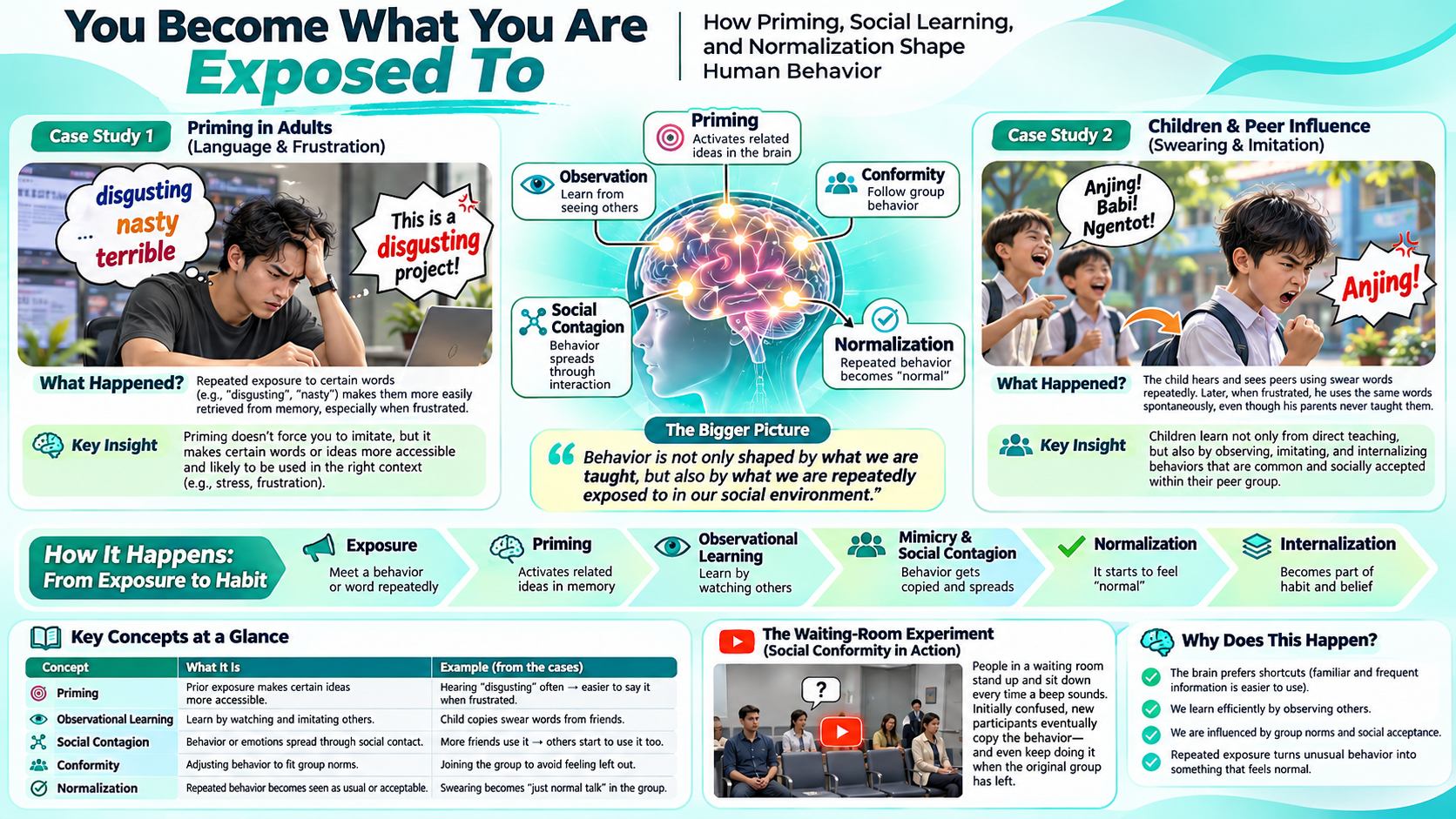
We often assume that behaviour is shaped mainly by what people are explicitly taught. But what they repeatedly see, hear, imitate, and come to regard as normal can also influence how they think and respond.
A child does not need to be directly taught a swear word to start using it. Repeated exposure, observing peers, imitation, and group norms can all contribute to learned behaviour. These influences are powerful, but they are not automatic: people differ, and context matters.
“I never taught my child to speak like that. Where did they learn it?”
One possible answer is the social environment. People learn not only through direct instruction, but also by observing others and noticing which behaviours are repeated, rewarded, tolerated, or socially accepted.
Learning does not always look like a lesson
Peers, siblings, adults, admired figures, and media characters can all become behavioural models. A child may pick up a phrase, tone of voice, gesture, or way of handling conflict without anyone formally teaching it.
If a behaviour is frequently visible, attracts attention, or appears to be accepted by a group, it may become easier to imitate. If the child sees that the behaviour leads to rejection or other negative consequences, imitation may be less likely.
Influence is not destiny
Not every exposed child will copy a behaviour. Temperament, age, relationships, parental guidance, personal values, and the consequences of the behaviour all matter.
The point is not that children should be isolated from anyone who behaves differently. It is that adults should pay attention to the environments in which children spend time—and help them think critically about what they observe.
Several concepts work together
“Priming” is relevant, but it does not explain every kind of imitation. The examples below involve overlapping mechanisms that should be distinguished rather than treated as one single effect.
Priming
Exposure to one stimulus can influence how quickly or readily related information is processed later. A recently activated word, idea, or association may become more accessible.
Observational learning
People can learn by watching what others do and what happens to them. They may acquire a new response without receiving a direct instruction themselves.
Mimicry & social contagion
Mimicry is the tendency to copy aspects of another person’s behaviour. Social contagion describes how behaviours, emotions, or practices can spread through social contact.
Conformity
People may adjust their behaviour to match a group, because they want to fit in or because they assume the group knows what is appropriate.
Normalisation & descriptive norms
Repeated behaviour can begin to feel ordinary. Descriptive norms are perceptions about what people commonly do—not necessarily what they approve of or what is morally right.
Internalisation
A group’s expectations or practices may eventually become part of a person’s own habits, assumptions, or values. This is not inevitable, but it can happen over time.
How repeated exposure can become a social habit
This is a simplified pathway, not a fixed sequence. Some steps may be absent, reversed, or interrupted by reflection, guidance, or negative consequences.
Two examples—and why they may happen
The first example is mainly about word accessibility and semantic association. The second is more directly about social learning, imitation, and peer norms.
Someone repeatedly hears “disgusting” and later reaches for related language when frustrated
Scenario: An adult repeatedly encounters words such as disgusting, nasty, or terrible. Later, when frustrated while describing a piece of work, they might say “a disgusting project,” “nasty evidence,” or choose a related negative expression more readily than they otherwise would.
Why might this happen?
Words are connected in semantic memory. “Disgusting,” “nasty,” and “awful” share negative meaning and emotional associations. Activating one part of this network can sometimes make related concepts easier to retrieve.
When a person is frustrated, they may have less patience for carefully searching for a precise phrase. A readily accessible expression can win the competition for selection.
What is the psychological explanation?
This is a plausible illustration of semantic priming and lexical accessibility. The prior exposure may influence which words are readily available during later language production.
However, the exact phrase is not guaranteed. “Disgusting” does not mechanically cause someone to say “nasty evidence.” Mood, topic, personal vocabulary, context, and individual differences also shape word choice.
What this case illustrates: the mind does not retrieve every possible word with equal ease. Recent or repeated activation can sometimes tilt what comes to mind first.
A child hears friends use swear words—and later uses one when angry
Scenario: A child regularly hears peers use expressions such as “anjing,” “babi,” or other swear words. The parents do not use those words at home and never deliberately teach them. One day, when the child becomes frustrated, the child blurts out one of the expressions.
Why might the child copy it?
Observational learning: children learn by watching peers, not only by following parental instructions. Friends can become influential models because they are present often and matter socially.
Repetition: hearing the same words repeatedly makes them familiar. The child learns the sound, context, and social use of the expression.
Social feedback: if peers laugh, pay attention, or treat the language as ordinary, the child may infer that it is acceptable in that group. Attention can unintentionally reinforce repetition.
Why might it appear during frustration?
The child may have learned that the expression is used in moments of anger, excitement, teasing, or emphasis. When a similar emotional situation occurs, that learned phrase may be retrieved as a ready-made response.
Priming and accessibility may contribute, but observational learning and social reinforcement are the more direct explanations for how the child acquired the expression in the first place.
In other words, the child may not be copying a specific friend at that exact moment. The child may be using language already learned from repeated social exposure.
What this case illustrates: the child may acquire a behaviour without direct instruction. The social environment can act as an informal teacher.
From Psychological Signals to Possible Futures
What might happen when a child repeatedly spends time with peers who use harsh language? Use the ideas in this article as starting points—not as proof of what will happen next.
It explores plausible futures, tests assumptions, and considers uncertainty. A connection between two ideas means “this may influence that”—not “this will definitely happen.”
Explore the signal map
Select any node to inspect its role, possible influence, and questions worth discussing. Dashed lines represent hypotheses, not proven causal links.
Build more than one future
Brainstorm possibilities before settling on a conclusion. Different pathways can emerge from the same initial signal.
These are illustrative scenarios for brainstorming, not measured probabilities or forecasts. The same exposure can lead to different outcomes.
Challenge the hypothesis
Invite a friend or colleague to review your reasoning. Record their disagreement instead of dismissing it.
No perspectives added yet. Capture a counterargument to make the exercise stronger.
The waiting-room conformity video
You also described a video in which people in a waiting room follow a group behaviour—then continue even after the original group members leave. The clip below is commonly shared as a demonstration of social conformity.
What does the demonstration suggest?
- A newcomer sees several people behaving in the same unusual way.
- They may assume there is a reason or an unwritten rule.
- They begin to copy the group, even without knowing why.
- After the original participants leave, the newcomer may continue the behaviour.
- A later newcomer sees the behaviour already established and copies it in turn.
Why might the behaviour continue after the original group leaves?
The behaviour may have become a local norm. The person no longer needs the original actors to be present: the setting itself now contains a visible pattern that seems to signal “this is what people do here.” A newcomer can then learn the practice from the person who adopted it earlier.
This resembles conformity and can be discussed alongside an information cascade: people use the actions of those before them as information when they are uncertain. But the video alone cannot establish exactly which psychological mechanism caused each participant to act.
Interactive comparison table
Search or filter the concepts to see which mechanism best fits a particular behaviour.
| Concept | What it explains | Example | Best fit |
|---|---|---|---|
| Priming | Earlier exposure can make related information more accessible. | After hearing “disgusting” repeatedly, related negative words may come to mind more readily. | Adult language example |
| Observational learning | Learning by watching another person’s behaviour and its consequences. | A child learns expressions by hearing and watching peers use them. | Child language example |
| Mimicry | Copying another person’s actions, expressions, or speech patterns. | A child repeats a phrase used by a friend. | Child language example |
| Social contagion | How behaviours or emotional states spread through social contact. | A habit spreads through a group as members observe one another. | Group behaviour |
| Conformity | Adjusting behaviour to align with a group. | A newcomer follows an unusual waiting-room routine. | Waiting-room demonstration |
| Descriptive norms | Beliefs about what people commonly do. | “Everyone here uses that expression, so it must be normal.” | Peer culture |
| Internalisation | A group practice may become a personal habit or belief. | A repeated group behaviour continues even when the original model is gone. | Long-term influence |
Showing 7 of 7 concepts.
Quick knowledge check
Select the statements you believe are true.
Build a healthier social environment
Tick the practices that can help encourage positive learning.
The message is bigger than “do not be friends with naughty children”
The goal is not to make children afraid of everyone who behaves differently. It is to help them recognise, evaluate, and choose healthy influences—while adults remain attentive to the environments children experience every day.
Social influence can be positive or negative
| Frequently observed environment | Behaviours that may be learned |
|---|---|
| People who are disciplined and responsible | Consistency, punctuality, accountability |
| People who routinely lie | Lying may begin to look like an ordinary way to avoid consequences |
| A group that treats others with respect | Healthy communication and empathy |
| A group that constantly humiliates others | Insults may be reframed as humour or normal conversation |
Conclusion
We often focus on what we teach people directly, but overlook what we allow them to absorb from their everyday environment.
Sometimes people do not change because someone gives them advice. They change because they spend so much time in an environment where a particular behaviour is treated as normal.
“Be careful about the environment you expose your children to. You do not have to teach them certain behaviours. Sometimes, repeated exposure and observation are enough for those behaviours to start feeling normal.”
This does not mean isolating children from people who are different. It means recognising that the social environment is one of the powerful informal educators in human life.
Sources and raw links
These links provide definitions, theoretical background, and context for the examples. They are included as clickable raw URLs for further exploration.
