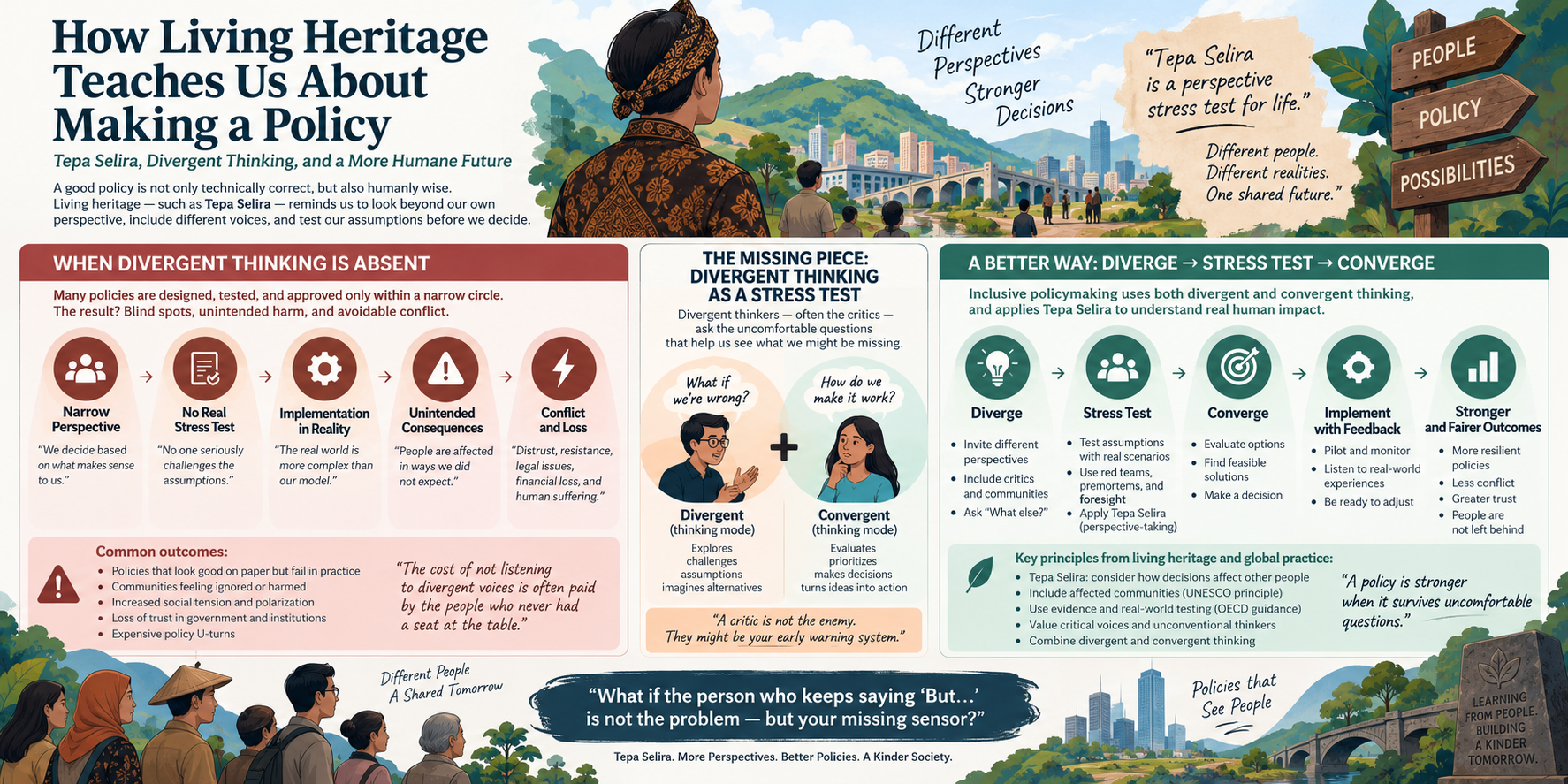
What can living heritage teach us about making a policy? More than we might expect.
We often talk about living heritage as something we should preserve. But living heritage can also be read as a repository of social intelligence: ways communities have learned to coordinate, restrain themselves, solve collective problems, interpret conflict, and live with difference.
Take Tepa Selira.
At a basic level, Tepa Selira asks us to place ourselves in another person's position — to compare our own parameter with the possible experience of somebody else before we act. Existing literature on Tepa Selira links the value to cognitive, affective and behavioural dimensions of empathy, while the UNESCO framework for living heritage emphasises that communities who create, maintain and transmit heritage must participate in safeguarding and managing it.
The shift
If Tepa Selira asks a person to compare their own perspective with another person's reality, why not apply the same logic to policy design?
Part I — A Policy Is Also a Point of View
Every policy contains assumptions.
Who is the “normal” citizen?
What resources do we assume they have?
What information do we assume they can access?
How fast do we assume they can respond?
What language do we assume they understand?
What behaviour do we assume they will have?
What happens to the person who does not fit the average?
Policy teams often become extremely good at answering these questions without explicitly saying that they are making assumptions.
Then the policy is launched.
And suddenly the edge cases become real people.
Perhaps many policy failures are not failures of intelligence. They are failures of perspective.
Part II — Why Do Some Policies Produce Conflict Even When They Look Rational?
Here is my deliberately provocative question:
What if a policy causes conflict because nobody was assigned to make the policy uncomfortable before it was implemented?
A room full of competent people can still produce a fragile decision when everyone is solving the same problem using the same assumptions.
The danger is not that convergent thinking is bad. It is essential for narrowing options, applying standards and making decisions.
The danger is convergence without adversarial testing.
Imagine a policy process like this:
The team agrees on what the problem is.
The team develops an intervention that matches that definition.
The same people review the same assumptions.
Reality becomes the first serious stress test.
That last step is expensive.
Because once reality becomes the reviewer, the cost is no longer a workshop.
It can become budget loss, public resistance, implementation failure, staff burnout, legal disputes, damaged trust, or social conflict.
OECD guidance published in 2025 explicitly recommends stress-testing public policies against multiple plausible disruptions and using tools such as red teams, premortems and structured dissent to challenge assumptions before implementation. The same guidance cautions that evidence for red teaming in public administration remains limited, so it should be treated as a promising practice rather than a magic solution.
Part III — The “Annoying Critic” May Be an Institutional Sensor
Now we arrive at the uncomfortable part.
In many workplaces, the person who keeps asking:
“But what if…?”
can become unpopular.
“Why are you making this complicated?”
“We already decided.”
“That's not how we usually do it.”
“You're always finding problems.”
“You're too negative.”
Sometimes the critic really is simply being unhelpful. Criticism is not automatically insight.
But there is another possibility:
What if the person who keeps saying “but…” is functioning as a missing sensor in the organization?
A divergent thinker often expands the possibility space rather than immediately collapsing it into one answer. In a policy environment, that can look like criticism because the job is partly to expose alternatives, contradictions, hidden assumptions and edge cases.
That does not make the divergent thinker automatically right.
It makes their dissent potentially useful data.
Part IV — The Real Asset We Keep Throwing Away
Organizations frequently talk about “talent” as if talent were a list of qualifications.
Degree.
Certification.
Years of experience.
Test score.
Interview score.
KPI.
Those things can be useful evidence.
But they are still proxies.
The dangerous moment comes when the proxy becomes the definition of ability itself.
If the instrument cannot detect a capability, the capability can start to look like it does not exist.
This is especially important for people whose strengths are exploratory, connective, systems-oriented, unusual or difficult to standardise.
They may not “fit” a single job family.
They may produce ideas before the organization has a category for them.
They may jump between disciplines.
They may challenge the framing before accepting the task.
They may be irritating in meetings.
They may also be exactly the person who sees the failure mode nobody else saw.
Part V — “Divergent” Is a Thinking Mode, Not a Personality Ranking
This distinction matters.
I am not arguing that divergent people are better humans, better employees, or better policy makers.
Nor does “divergent” provide a clinical diagnosis or an excuse for poor behaviour.
The useful distinction is functional:
Which option best satisfies the criteria?
What possibilities, variables, stakeholders or consequences have not yet been considered?
Can we generate alternatives, stress-test them, and then converge on a defensible decision?
We need all three.
Because divergence without convergence can become chaos.
But convergence without divergence can become institutional blindness.
Part VI — Tepa Selira as a Cognitive Stress Test
This is where the cultural principle becomes surprisingly practical.
Suppose a ministry proposes a new service requirement.
The convergent question is:
“Does the procedure achieve the intended administrative objective?”
Tepa Selira adds another layer:
“How does this procedure behave when experienced by someone who has a very different set of constraints from ours?”
Then divergent thinking pushes further:
What if the assumption is wrong?
What if the average case is misleading?
What if the user cannot comply?
What if the policy creates a new incentive that nobody intended?
What if people adapt their behaviour around the rule?
What if the “exception” is actually a large but invisible group?
What happens after six months?
What happens when another disruption occurs at the same time?
Now the policy is no longer being evaluated only for whether it works in theory.
It is being tested for whether it survives contact with different realities.
Part VII — Why Critical Dissent Matters
There is a subtle organizational mistake here:
We sometimes treat disagreement as friction instead of treating disagreement as information.
A useful critical voice does not have to be rewarded simply because it is critical.
Instead, the organization can ask:
What assumption is being challenged?
What evidence would prove the criticism wrong?
What evidence would prove it right?
What edge case is being exposed?
Does the criticism reveal a design weakness?
That is the difference between argument and stress testing.
OECD's recent public-administration guidance describes red teams as arms-length collaborators who challenge assumptions, evidence and decision-making through structured dissent. It even suggests techniques such as checking explicit and implicit assumptions and systematically attempting to disconfirm competing hypotheses.
So perhaps the question is not “How do we silence the critic?” but “Can we convert criticism into a testable hypothesis?”
Part VIII — The Most Dangerous Sentence in Policy?
“We have already decided.”
Because that sentence can quietly transform evidence into decoration.
Once a team becomes psychologically committed to a solution, contradictory information becomes inconvenient.
And the divergent thinker becomes even more annoying.
Which is precisely why they may be useful.
The best time to hear “this could fail” is before failure becomes expensive.
Part IX — Living Heritage and the Anti-Top-Down Lesson
This is where UNESCO's living-heritage framework becomes directly relevant to policymaking.
The 2003 Convention calls for communities, groups and relevant organisations to participate in identifying living heritage, and Article 15 calls for the widest possible participation of the communities, groups and individuals who create, maintain and transmit it. UNESCO decisions concerning policies that may affect intangible cultural heritage also stress active participation and warn against top-down approaches.
That is not merely a heritage-management lesson.
It is a policy-design lesson:
The people affected by a system are not merely “beneficiaries.” They are potential sources of intelligence about whether the system will work.
The community knows the loophole the policy designer never imagined.
The frontline worker knows where the workflow breaks.
The local practitioner knows what the spreadsheet cannot see.
The unusual employee knows which assumption everyone has quietly normalised.
The critic knows which sentence makes the whole thing uncomfortable.
And discomfort can be useful.
Part X — The Black Death / Cats Story: A Warning About the Metaphor
There is a famous story that Europe killed cats and thereby helped rats spread the Black Death.
It is a great metaphor.
It is also a poor historical fact to repeat without qualification. The popular story simplifies a much more complicated history, and the causal claim that mass cat killing drove the plague is disputed.
So I would use the story differently:
Imagine a society destroying a potentially useful asset simply because its value was invisible to the dominant belief system.
That mechanism is entirely plausible inside modern institutions.
We can discard a person because their value is not visible to our test.
We can discard a warning because it does not fit our narrative.
We can discard local knowledge because it does not look like formal expertise.
We can discard a critic because they are irritating.
And afterwards, we wonder why the system became less resilient.
Part XI — Google Is Actually a Useful Counterexample
And yes: Google is not a clean example of “one narrow test decides everything.”
Google has publicly described structured interviews, consistent evaluation criteria and efforts to reduce bias in hiring. Google has also described project-based assessments designed around real-world engineering work, rather than relying only on abstract technical puzzles.
That matters because the argument here should not become:
“All organizations are convergent and all tests are bad.”
That would itself be a convergent stereotype.
The stronger argument is:
Every organization should examine what its measurement system systematically makes visible — and what it systematically makes invisible.
Google is therefore a useful reminder that organizations can design broader assessment systems.
Part XII — A Better Architecture: Diverge → Stress-Test → Converge
Diverge. Expand the space of possibilities.
Stress-test. Invite structured dissent. Attack assumptions, not people.
Converge. Make the decision using evidence, explicit criteria and accountability.
Then repeat.
This resembles the logic of strategic foresight: explore disruptions, imagine interactions, build scenarios, test strategies and identify actions that remain robust across multiple possible futures.
Part XIII — So What Does Tepa Selira Actually Teach a Policymaker?
The policy translation
“Before I impose my parameter on society, I should test what happens when society does not share my parameter.”
That is Tepa Selira translated into policy language.
Not “be nice.”
Not “never disagree.”
Not “all perspectives are equally correct.”
Something much more operational:
Never confuse the parameter used to measure reality with reality itself.
Part XIV — The Provocation
So here is the question I would leave with policymakers, managers, recruiters and anyone who designs systems:
How many valuable people have we called “difficult” because our organization had no instrument for measuring what they were actually good at?
How many policies have failed because the only people allowed to validate them were the same people who designed them?
How many conflicts could have been prevented if someone had been paid to disagree before implementation rather than blamed for complaining afterwards?
And how many “exceptions” are actually signals that our definition of normal is too narrow?
Maybe the goal is not to make every person more convergent.
Maybe the goal is to build organizations that know when to converge and when to deliberately diverge.
Because a system without convergence cannot decide.
But a system without divergence cannot see what it is missing.
And a system without Tepa Selira may make a perfectly rational decision — from the wrong person's point of view.
One final thought
A critic is not automatically right. But an institution that never listens to critics may eventually discover that it has removed one of its own warning systems.
Living heritage is not only about remembering how people lived.
Sometimes it teaches us how systems should listen before they decide.
Key References & Reading
The popular claim that mass cat killing caused the Black Death by increasing rats is disputed and should not be presented as settled history. In this article the story is used only as a metaphor for the broader risk of discarding assets whose value a dominant measurement system cannot see.