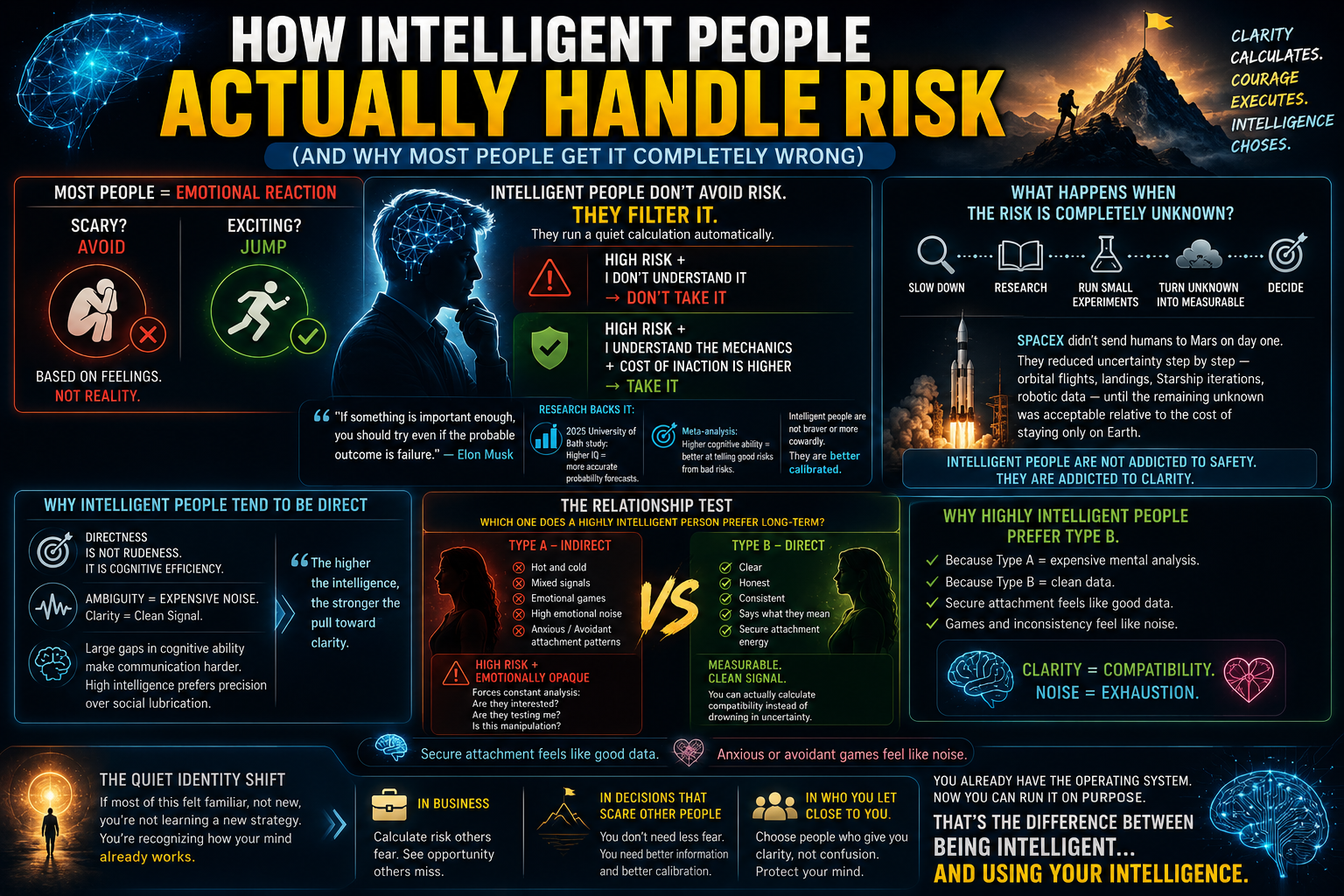
You’ve probably felt it before. While everyone else is either rushing in blindly or freezing out of fear, your mind does something different. You pause. You break the situation apart. You ask one quiet question: Do I actually understand this? If the answer is no, you pull back. If the answer is yes — and the cost of not acting is higher — you move. That instinct isn’t overthinking. It’s high-resolution thinking. And if you’re still reading this, there’s a good chance you already operate this way… even if you’ve never named it.
Most people treat risk like a feeling. “This feels scary” → avoid. “This feels exciting” → jump. Highly intelligent people treat risk like a system that can be measured. They run a quiet calculation almost automatically:
You don’t understand the domain. No clear data. No framework. Result: you don’t take it.
You can calculate the mechanics + the downside of not acting is larger. Result: you take it.
This is the exact mental model Elon Musk uses. He doesn’t take massive risks because he is reckless. He takes them because he has already broken the problem down to first principles — the fundamental truths — and rebuilt the decision from the ground up.
Elon’s Operating System in Plain Language
In 2008 both Tesla and SpaceX were days away from collapse. Musk put almost every remaining dollar he had into both companies. From the outside it looked insane. From the inside it was a calculated bet: the downside of letting both companies die was larger than the downside of personal bankruptcy — because it meant the multiplanetary and sustainable-energy futures would die with them.
He has said versions of this many times: “If something is important enough, you should try even if the probable outcome is failure.” Notice the hidden condition. He only says that after he understands the domain deeply enough to run the numbers.
What the Research Actually Shows
This isn’t just one man’s style. It shows up consistently in cognitive science.
- • A 2025 University of Bath study found that people with higher IQs make significantly more accurate probability forecasts. Their errors (both optimistic and pessimistic) are roughly half the size of those made by people in the lowest IQ range. They simply see reality more clearly. Source
- • A major meta-analysis (Lilleholt, 2019) showed a weak but reliable negative relationship between cognitive ability and risk aversion in the domain of gains. Higher-IQ individuals are slightly more willing to take upside risks when the math makes sense. Source
- • Research by Huffman and colleagues found that people with higher cognitive ability are better at distinguishing “good risks” (positive expected value) from “bad risks.” They are not simply more or less risk-tolerant overall — they are better calibrated.
In short: intelligent people are not braver or more cowardly. They are better at seeing the actual shape of the risk.
When the Risk Is Completely Unknown
Here’s where most people misunderstand intelligence.
When something is truly opaque — no data, no precedent, no human on earth fully understands it — a sharp mind does not charge in. It does the opposite. It slows down. It researches. It runs small experiments. It tries to turn the unknown into something measurable. Only after the fog clears enough does it decide.
This is why SpaceX did not send humans to Mars on day one. They reduced uncertainty step by step: orbital flights, controlled landings, Starship prototypes, robotic data, eventual lunar practice. Residual unknown still exists (no one has lived on Mars yet), but it is only accepted after as much uncertainty as possible has been removed.
The Simple Rule
Intelligent people will tolerate high risk. They will not tolerate unmeasurable risk if it can still be measured. They research first, then decide. Only when the remaining unknown is acceptable relative to the cost of inaction do they move.
Why Intelligent People Tend to Be Direct
The same preference for clarity shows up in how they communicate.
Directness is not rudeness. It is cognitive efficiency. When your mind runs at high resolution, ambiguity feels expensive. Vague language, endless softening, and social dancing create noise. Intelligent people often cut through it — not because they want to dominate, but because they want clean signal.
There is also a long-standing observation (originally from psychologist Leta Hollingworth) that large gaps in cognitive ability make smooth communication harder. People operating at very high levels sometimes appear blunt simply because they are optimizing for precision rather than social lubrication. The higher the intelligence, the stronger this pull toward clarity usually becomes.
Elon Musk explains first-principles thinking (Kevin Rose interview)
The Relationship Test — Where This Model Becomes Personal
Now apply the exact same filter to dating and long-term relationships. This is where most people feel the difference in their own lives.
Imagine two potential partners:
Type A – Indirect / Games
- Mixed signals and hot-and-cold behavior
- Makes you constantly analyze what they “really” mean
- Emotional noise is high
- Often linked to anxious or avoidant attachment
Type B – Direct / Clear
- Says what they mean
- Consistent signals
- Low ambiguity
- Usually linked to secure attachment
Which one does a highly intelligent person prefer long-term?
Almost always Type B.
Why? Because Type A is high risk + emotionally opaque. It forces the mind to keep running expensive analysis: Are they interested? Are they testing me? Is this manipulation? Type B is measurable. The signal is clean. You can actually calculate compatibility instead of drowning in uncertainty.
This maps cleanly onto attachment theory:
- Secure attachment produces the direct, consistent, low-noise pattern (Type B). The person is comfortable with closeness and can state needs clearly.
- Anxious attachment often produces testing, hot-and-cold, and mixed signals — high emotional noise.
- Avoidant attachment produces withdrawal after closeness, again creating uncertainty.
Intelligent people, who already dislike unmeasurable risk, feel the cost of anxious or avoidant dynamics more sharply. Secure attachment feels like good data. The other two feel like noise that never stops.
Psychology Today has noted that high-IQ individuals often feel exhausted by modern dating culture precisely because of the games, the hard-to-get performances, and the lack of genuine clarity. They are highly sensitive to inconsistency. They would rather have clean data than dramatic intensity. Source
The Quiet Identity Shift
If most of what you just read felt familiar — not like new information, but like someone finally describing how your mind already works — then you’re not learning a new strategy. You’re recognizing yourself. Highly intelligent people don’t need to be told to calculate risk. They already do it. They don’t need to be convinced that clarity is valuable. They already feel the cost of noise. The only real upgrade is becoming conscious of the pattern so you can apply it more deliberately — in business, in decisions that scare other people, and in who you let close to you.
You already have the operating system. Now you can run it on purpose. That’s the difference between being intelligent… and using your intelligence.
Key Sources & Further Watching
University of Bath (2025). Higher IQ linked to more accurate probability forecasting. Link
Lilleholt, L. (2019). Cognitive ability and risk aversion: A systematic review and meta-analysis. Judgment and Decision Making.
Psychology Today (2024). 7 Relationship Struggles for People With a High IQ. Link
Elon Musk – First Principles Method (Kevin Rose). YouTube
How Elon Musk solves problems (Lex Fridman clip). YouTube