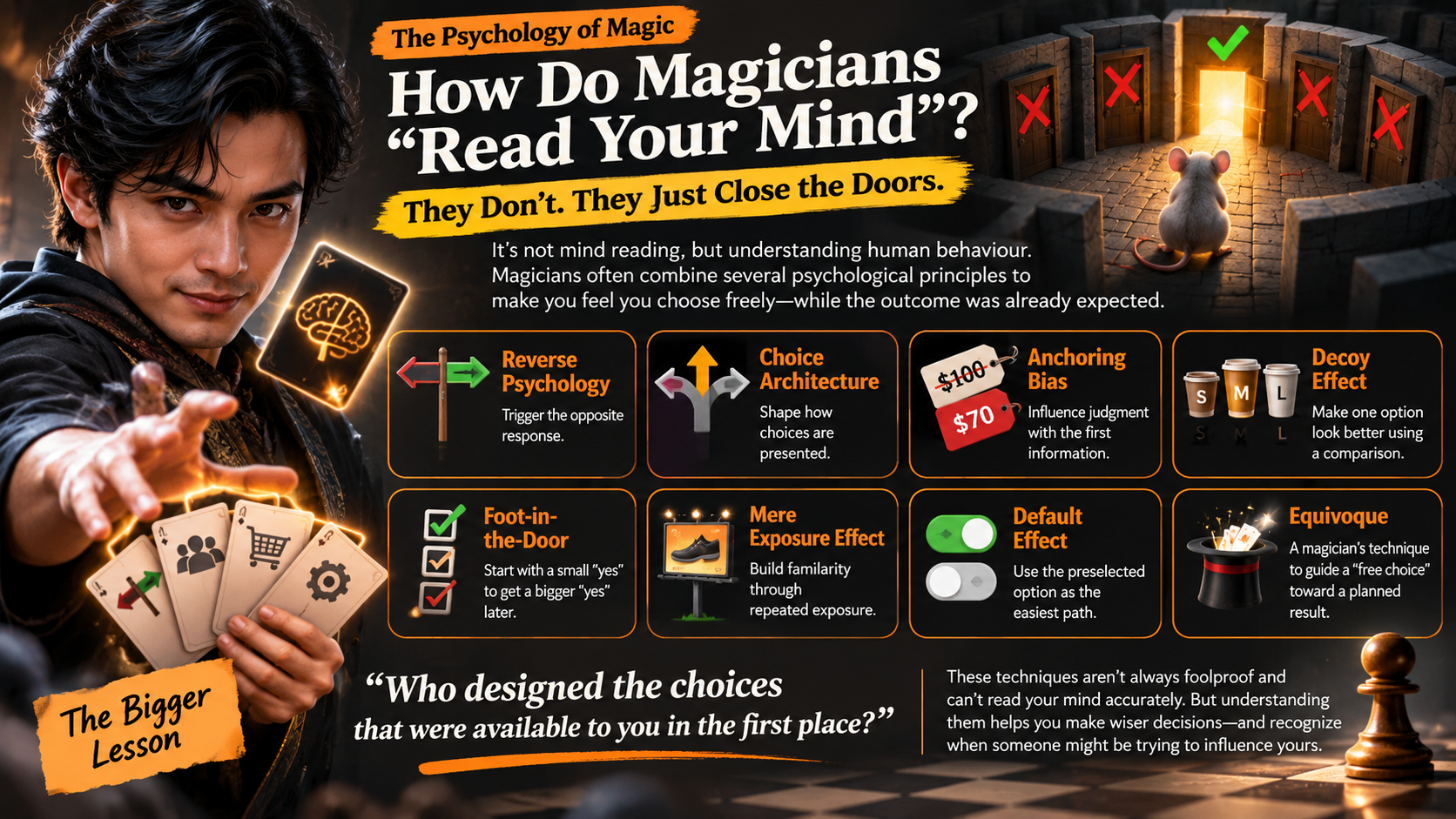
How Do Magicians “Read Your Mind”? They Don’t. They Just Close the Doors.
“Let’s meet over there. We’ll let them meet later.”
“Hmm… how did you even think of that?”
“Oh, that’s easy. You said from the start that you were too lazy to meet, so I deliberately arranged it. I figured you were afraid to admit it directly.”
“I said, ‘Ah, I don’t want to go through the front door.’ And of course, people start looking for the back door. If I say I don’t want to go right, you’ll go left.”
It looks like mind reading. It isn’t. It’s a smart way of closing doors.
The mouse and the five exits
Imagine a room with 5 exits and a mouse inside. You close 4 of them. You don’t need to read the mouse’s mind. You already know which exit it will take: the 5th.
So the trick is not to guess what’s in someone’s head. It’s to shape the options until only one makes sense.
Step 1 — Reverse psychology
Say one thing so the other person leans toward the opposite.
- “I’d never go through the front door.” ➜ they look for the back door.
- “Don’t open that box.” ➜ now the box is all they think about.
- “I don’t want to go right.” ➜ they go left.
Psychologists explain this through reactance: the urge to push back when we feel our freedom is being limited. It tends to work best on people who resist being told what to do, and it can backfire on people who are agreeable. Researchers have studied the mechanism much more than the tactic itself, so treat it as a gamble, not a guarantee (see sources).
Step 2 — Close the doors
This is the “5 exits, close 4” idea. Magicians use versions of it called a forced choice. The person feels they chose freely, but the options were limited beforehand. In each case, you don’t read minds. You control which doors are open.
“Would you like chicken or fish?”
Missing: “Anything else at all?” Two doors, no more.
“Brush your teeth before the story or after?”
The child thinks they’re choosing. Brushing is already settled.
“The blue one or the black one?”
Nobody asked, “Do you want one at all?”
“I only want a woman who is honest and doesn’t cheat.”
Try to object or set a condition, and the reply is ready: “So you’re a cheater? Shameless? The worst woman in the world?” A good standard was announced first, so any hesitation now looks like its opposite. The “I disagree” and “let’s talk about it” doors are shut. Only “yes” is left.
“Have you stopped lying to me?”
“Yes” admits you lied. “No” admits you still do. Escape by challenging the question: “I never lied.”
“You’re so generous. You’d never say no to someone in need, right?”
Saying no now means giving up the nice label you were just handed.
“Either you trust me or you don’t.”
What about “I trust you, and I still have questions”? That door was never mentioned.
“This price is only valid until midnight.”
The “go home and think about it” door just closed.
“I’ll count you in, unless you tell me otherwise.”
Doing nothing now counts as agreeing.
Step 3 — Shotgunning
This is the trick street magicians love most. Shotgunning means firing many guesses at once, like a shotgun spreading pellets, hoping some land.
“I’m sensing someone close to you… a family member? A name starting with ‘M’… or maybe ‘S’? Something about travel… a recent decision… a little worry about money or work.”
Why it feels like magic:
- We remember the hits (“How did he know that?!”) and forget the misses.
- Many statements fit almost everyone. These are called Barnum (or Forer) statements: they feel personal but apply to many people.
- The magician adjusts after every reaction: a gasp, a nod, a smile, a hesitation.
Your face is giving the answers. He’s just reading them.
“Today you may face a small challenge with someone close to you.”
Who doesn’t? It fits almost everyone, so it feels written for you.
Step 4 — Combine them all
- Shotgun many guesses to see what reacts.
- Close the doors so few options remain (“Think of a number from 1 to 10… not too small… not too big…”).
- Nudge with reverse psychology so you pick the door they expected.
- Let you feel you chose freely, then “reveal” the answer.
Ask people for a number between 1 and 10 and 7 is the most common answer. In a classic Yale study, about 28% of people asked for a number from 0 to 9 said 7, and a YouGov survey of Britons found about a third picked 7 from 1 to 10. It’s a tendency, not a rule, but a magician knows the most popular doors before you open one.
To you, it feels like mind reading. To the magician, it was a game of probabilities.
A simple everyday version. Ask a friend: “Where do you want to eat tonight? Not pizza, not burgers, not that noodle place we always go to.” The options are shrinking, yet your friend feels free. You didn’t read their mind. You removed the doors you didn’t want them to use.
Why this matters
For a magician it’s entertainment. But the same techniques show up in advertising, sales, and sometimes manipulation: limited-time offers close the “think about it” door, “only 2 left!” closes “wait until later,” and “everyone already agreed” closes “disagree.”
A quick check:
- Who decided which options exist?
- Is there a door I’m not being shown?
- Am I choosing, or am I being steered?
You can step outside the frame: “I don’t answer questions built like that,” or “I need time. I’ll tell you tomorrow.”
A fair caveat: someone can say “I want an honest partner” sincerely. The trap isn’t the sentence. It’s using the sentence as a weapon to shut down every question.
So are magicians really reading minds?
No. They read patterns, reactions, and probabilities. And when they can, they close every door except one.
#PsychologyOfMagic #ReversePsychology #ColdReading #CriticalThinking #HumanBehavior #Influence
Sources
- Verywell Mind, “What Is Reverse Psychology?” (reactance as the mechanism, works best on people who resist conformity, drawbacks): verywellmind.com
- Science of People, “Reverse Psychology” (evidence is stronger for the mechanism than for the tactic; can backfire): scienceofpeople.com
- Wikipedia, “Cold reading” (shotgunning, Barnum/Forer effect, hits remembered and misses forgotten): en.wikipedia.org
- Kubovy & Psotka (1976), “The predominance of seven and the apparent spontaneity of numerical choices”: PDF
- YouGov, “Seven is the most random number”: yougov.com
.....
