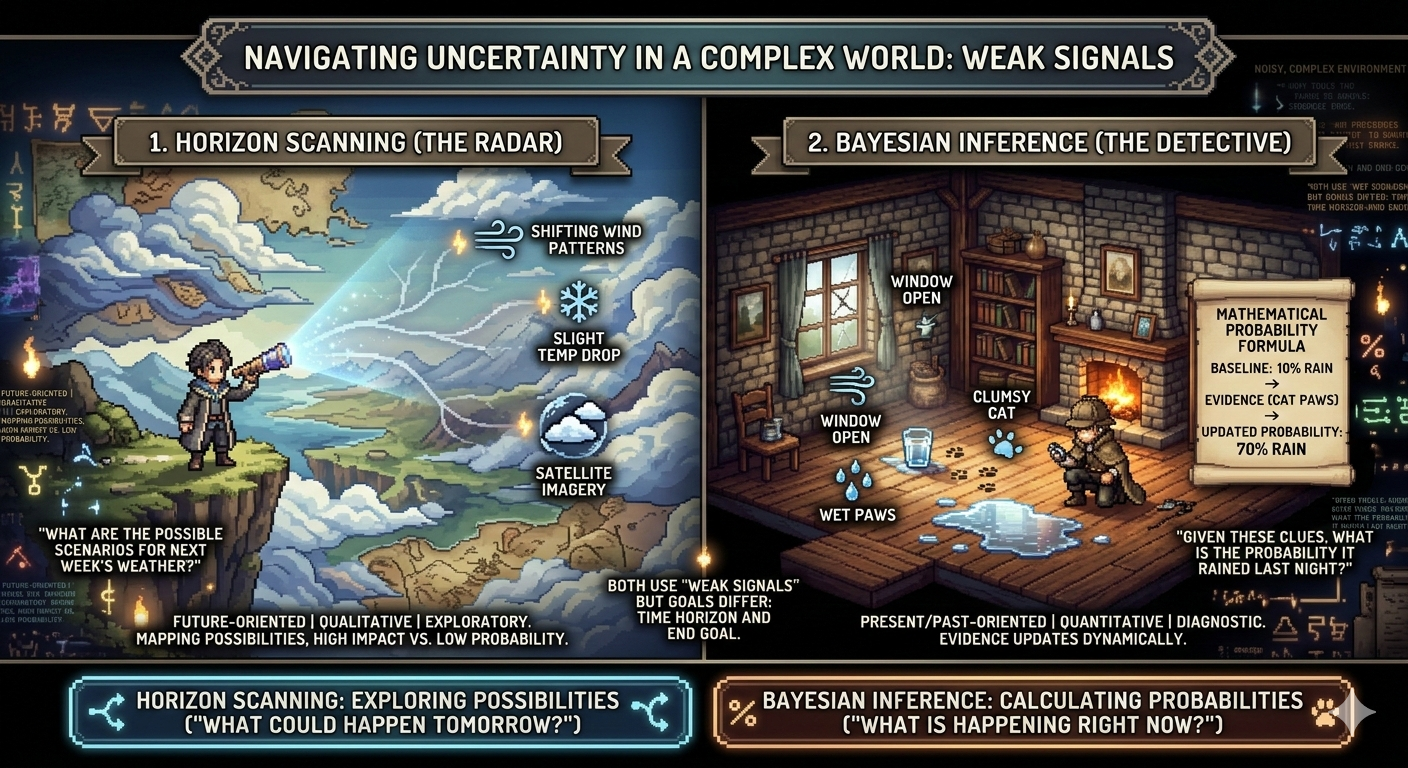
In the world of foresight, intelligence, and risk management, two powerful methodologies are often confused: Horizon Scanning and Bayesian Analysis.
The confusion is understandable. At a glance, they seem to share the same DNA. Both are designed to detect weak signals in noisy, complex environments. Both help us navigate uncertainty. Both are used by analysts, policymakers, and strategists.
But this is where the similarity ends.
If you want to know which one to use, it ultimately comes down to two things: your time horizon and your end goal.
The Core Difference
Horizon Scanning and Bayesian Analysis operate on fundamentally different logics.
Horizon Scanning is about exploring what could happen. It is future-oriented, qualitative, and expansive.
Bayesian Analysis, on the other hand, is about calculating what is most likely happening. It is present or past-oriented, quantitative, and precise.
To make this distinction clearer, consider a simple analogy: the weather versus the wet floor.
Horizon Scanning: The Radar
Imagine you are observing satellite imagery, shifting wind patterns, and a subtle drop in temperature.
The Question: What are the possible scenarios for next week's weather? Should we prepare for a storm?
This is the domain of Horizon Scanning.
You are not solving an exact equation. Instead, you are mapping possibilities, identifying emerging risks, and preparing for multiple futures. Some scenarios may be low probability but high impact—and those are often the ones that matter most.
The goal is not certainty. The goal is awareness and preparedness.
Bayesian Analysis: The Detective
Now imagine a different situation. You wake up and find a puddle of water on your living room floor. The window is slightly open—but you also have a very clumsy cat who enjoys knocking over water glasses.
The Question: Given these clues, what is the probability that it rained last night?
This is where Bayesian Analysis comes in.
You start with an initial assumption (a prior probability), and as you gather new evidence—such as wet paw prints—you update that probability dynamically using a mathematical formula.
Each new piece of evidence refines your understanding until you reach the most likely explanation.
This is not about exploring possibilities. It is about narrowing them down with precision.
Making Bayesian Thinking Practical
While Bayesian reasoning is powerful, it is often perceived as complex and mathematically intimidating. To make it more accessible, I built a lightweight tool that allows anyone to apply Bayesian logic without requiring advanced statistical knowledge:
https://anggaconni.github.io/Naive-Bayesian/
This application is designed as a practical decision-support tool. It applies a Naive Bayes framework to help users evaluate hypotheses using structured evidence.
Users start with an initial belief (prior probability), then update it as new evidence is added. The system uses likelihood ratios and user-defined confidence levels to calculate a revised probability (posterior).
The result is a transparent and computationally efficient approach to evidence-based reasoning—suitable for rapid assessments, policy evaluation, and field decision-making, without requiring complex models or server-side infrastructure.
In essence, it brings Bayesian thinking out of textbooks and into everyday decision-making.
Two Tools, Two Purposes
Both methodologies are essential—but they serve different purposes.
Horizon Scanning helps you anticipate change before it happens. It is ideal for strategic foresight, long-term planning, and resilience building.
Bayesian Analysis helps you interpret evidence in real time. It is ideal for diagnostics, anomaly detection, and decision-making under uncertainty with incomplete data.
Using one in place of the other can lead to poor decisions—either by over-speculating without evidence, or by over-calculating without seeing the bigger picture.
When to Use Each
Use Horizon Scanning when you are asking: What could happen next? What emerging risks should we prepare for?
Use Bayesian Analysis when you are asking: Given the evidence, what is most likely happening right now?
The distinction is subtle, but critical.
Conclusion: Sensemaking Across Time
In complex environments, no single method is sufficient. True strategic intelligence comes from knowing which tool to use—and when.
Horizon Scanning gives you the radar to see what is approaching. Bayesian Analysis gives you the logic to interpret what is already unfolding.
Together, they form a powerful system of sensemaking across time: one looking forward, the other grounding you in evidence.
TL;DR:
Horizon Scanning = Exploring Possibilities (What could happen tomorrow?)
Bayesian Analysis = Calculating Probabilities (What is happening right now?)
#HorizonScanning #BayesianInference #Foresight #RiskManagement #DataAnalytics #StrategicPlanning #Sensemaking