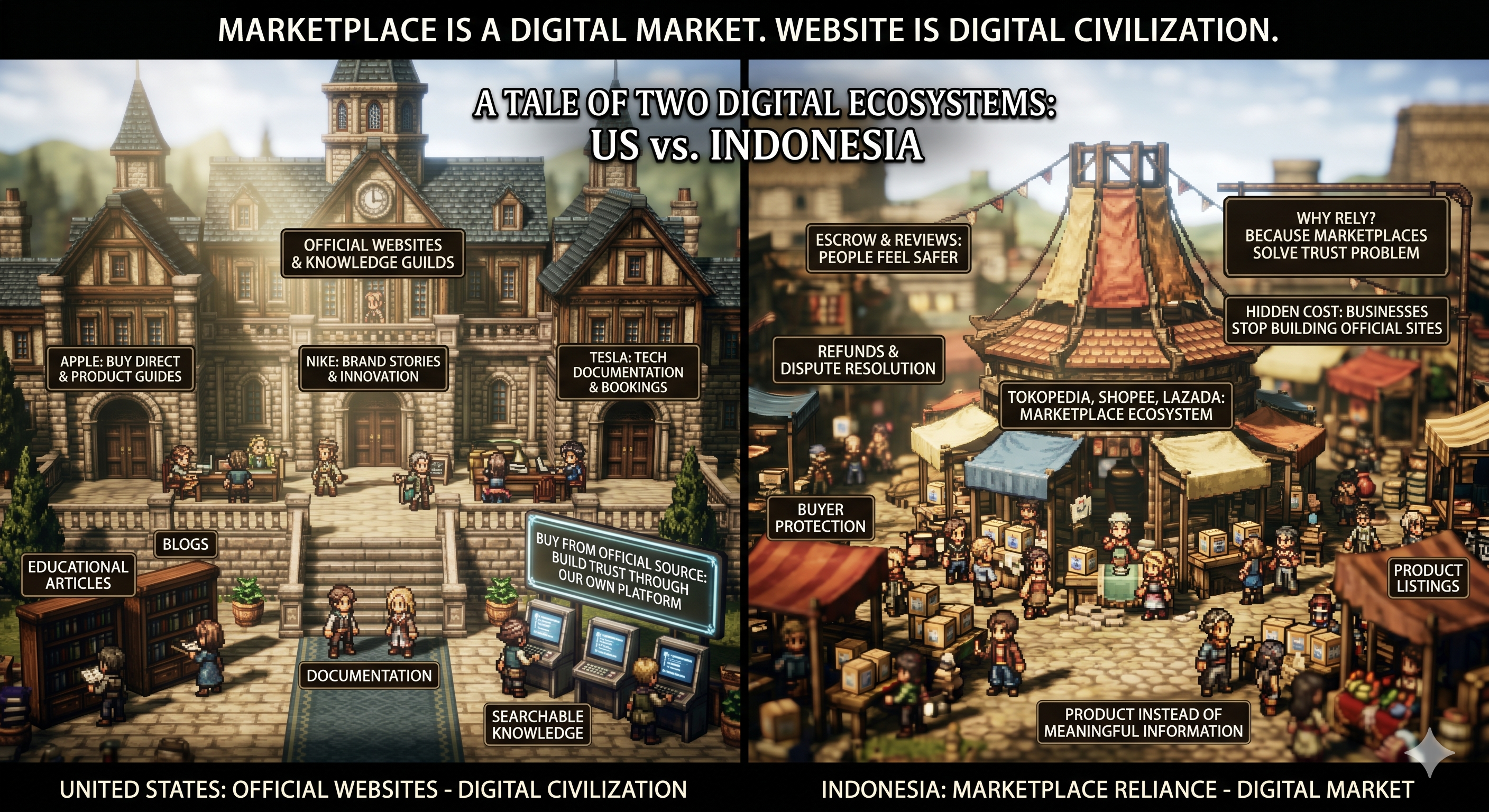
The observation is sharp, and the implications are massive. When we apply Horizon Scanning to Indonesia's digital market conditions, a disturbing macro-trend emerges: we are systematically trading our digital civilization for transaction convenience. The nation that hosts Southeast Asia's largest e-commerce market — projected to reach USD 94.5 billion in 2025 — is, paradoxically, building the least amount of sovereign digital knowledge infrastructure in the region. 📉
Let's dismantle this piece by piece. The current structure of Indonesia's digital economy is hiding a profound behavioral vulnerability. We are not just changing where we buy things; we are fundamentally altering the architecture of how knowledge, trust, and authority are indexed on the open internet. When three platforms — Shopee, TikTok-Tokopedia, and Lazada — collectively control more than 80% of the country's e-commerce market share, the gravitational pull on the entire digital ecosystem is not neutral. It is erosive.
1. The Divergence of Trust: Brand-First vs. Platform-First
To understand the depth of this issue, we must first examine the behavioral infrastructure that drives digital commerce — specifically, the architecture of trust.
In many Western markets, particularly the United States and Western Europe, the digital economy operates primarily on a Brand-First and Website-First logic. Consumers routinely purchase directly from Apple, Nike, Patagonia, or a niche Direct-to-Consumer (DTC) ecosystem. While Amazon is undeniably a monolith, a significant portion of the population actively seeks the "official source" over the "cheapest option." This is not mere brand loyalty; it is the result of decades of investment in domain authority, customer service infrastructure, legal frameworks around consumer protection, and genuine institutional credibility built through consistent content creation.
In Indonesia, the architecture is inverted. The market operates on an entrenched Marketplace-First model. Consumers overwhelmingly bypass independent brand websites in favor of Shopee, Tokopedia, or Lazada. The root cause of this is not merely a UI/UX preference or mobile-first habits — though both are contributing factors. It is a systemic Trust Deficit embedded in the cultural fabric of peer-to-peer digital transactions.
The data confirms the concentration is extreme. Shopee recorded 133.1 million monthly web visits in 2024, with 5.9 million monthly app downloads on Android alone. Tokopedia attracted approximately 71.7 million monthly web visits. Together, these two platforms, alongside TikTok Shop and Lazada, represent consumer attention at a scale that no independent brand website in Indonesia can realistically match organically. The December 2023 merger between TikTok and Tokopedia — backed by a USD 1.5 billion TikTok investment — has further consolidated this dominance by combining Tokopedia's marketplace backbone with TikTok's social engagement architecture, creating what analysts call the dominant "shoppertainment" platform with over 225 million monthly active users.
The Proxy Trust Phenomenon
When a society operates with high baseline risk aversion regarding peer-to-peer digital transactions — "If I transfer directly to an unknown seller, will I be scammed?" — the behavioral friction is too high for independent websites to compete. The marketplace solves this not by building the brand's trust, but by functioning as a Trust Proxy. Research by Gefen (2000) established that escrow mechanisms are a direct behavioral substitute for institutional trust in digital markets, a finding that has aged into structural prophecy in the Indonesian context.
What Platforms Provide
Escrow payment systems, centralized dispute resolution, verifiable seller ratings, Cash-on-Delivery options, BNPL through integrated fintech (GoPay, ShopeePay, OVO), and buyer protection guarantees. These mechanisms collectively absorb the risk that the consumer would otherwise place directly on the brand.
The Structural Flaw
Because the trust is "borrowed" from the platform, the individual business never accrues its own institutional legitimacy. Customer data, purchase history, behavioral insights, and loyalty signals all remain inside the platform's walled garden. If the platform alters its algorithm, increases seller fees, or shuts down operations entirely — as JD.ID demonstrated in March 2023 — the brand's equity and audience drop to zero.
This trust proxy dynamic is compounded by Indonesia's payment infrastructure revolution. QRIS transaction volumes surged 175% year-on-year in 2024, with over 30 million MSMEs now accepting QR payments. Digital wallets processed 40.6% of all e-commerce transactions in 2025. Buy Now, Pay Later (BNPL) is growing at 27.1% annually, expected to reach USD 8.59 billion in 2025. The irony is devastating: while Indonesia's payment infrastructure becomes increasingly sophisticated and trustworthy, this sophistication is overwhelmingly captured inside platform ecosystems, making independent direct-to-consumer channels relatively less attractive rather than more.
2. The Scale of Platform Capture: A Nation of 66 Million MSMEs at Risk
Indonesia has 66 million MSMEs. They contribute 61% of the national GDP and employ approximately 97% of the domestic workforce — over 117 million people. They are not a peripheral economic sector; they are the nation's economic spine. Yet according to research from Boston Consulting Group and Blibli, only 20% of these MSMEs were digitized as of 2022. The government's "UMKM Go Digital" initiative aimed to push 30 million MSMEs into digital ecosystems by 2023 — but the vast majority of this digitization has meant entry into marketplaces, not the construction of independent digital assets.
By 2025, 63% of Indonesian MSMEs are actively using digital tools to run their businesses. But "using digital tools" is almost exclusively defined as using Shopee, Tokopedia, Instagram, WhatsApp Business, and TikTok Shop — not building websites, not writing content, not establishing domain authority. Academic research published in 2025 found that while marketplace adoption has accelerated, these platforms create a measurable dependency structure that limits MSMEs' data-informed decision-making and creates reliance on informal, trial-and-error approaches because business intelligence remains trapped inside platform dashboards rather than in the business's own analytics infrastructure.
The Divergence of Digital Value
As transactional volume consolidates into platform ecosystems, independent knowledge creation, domain authority, and open-web SEO visibility suffer a systemic collapse.
Figure 1: The inverse correlation between enclosed platform transaction volume and open-web independent knowledge indexation in the Indonesian digital economy, 2015–2026.
3. The Brutal Side Effect: The Death of SEO and the Shallowing of the Open Web
This is where the horizon scan hits the nerve. Because all transactional energy has been funneled into enclosed marketplace ecosystems, the open web in this region has been systematically starved. The entities that grow are marketplace product catalog pages, not knowledge ecosystems. The URLs that accumulate backlinks, domain authority, and search engine trust are shopee.co.id and tokopedia.com — not the millions of independent Indonesian businesses that populate their storefronts.
When businesses adopt the mindset of "Why build articles and content? Just sell it directly on the marketplace," the internet undergoes a structural shallowing. A Google search for "top 10 best blenders" or "how to choose a water filter for Jakarta" no longer yields deep comparative analysis, independent engineering reviews, or educational brand blogs written by people with genuine expertise. It yields a wall of Shopee catalog links, Tokopedia product listings, and SEO-farmed aggregator sites. We are converting the internet from a living library of discoverability into a flat, transactional catalog indexed by platform algorithms rather than human intellectual contribution.
The State of SEO in Indonesia 2026 report reveals a structural crisis hidden beneath surface-level metrics: Indonesia's 66 million MSMEs contribute 61% of GDP yet remain drastically underserved by professional SEO. Only approximately 48% of mobile websites globally pass all Core Web Vitals thresholds — and the Indonesian rate is estimated to be lower still. Following Google's replacement of FID with INP in March 2024, approximately 600,000 websites that previously passed Core Web Vitals now fail, many of which are Indonesian SME sites that lack the technical resources to keep pace with evolving standards.
The global data on SEO viability makes the local neglect even more inexplicable. Analysis of 40,000 major websites found that organic search traffic declined only 2.5% between 2024 and 2025. Google still holds 90.83% of the global search market share as of December 2025. Organic results capture approximately 90% of all Google clicks. SEO is not dying. What is dying is the Indonesian independent web's capacity to participate in it.
The AI Horizon: A Window That Is Closing
AI-referred web traffic now converts at 4.4 times higher rates than standard organic search, because AI systems pre-qualify visitors before they click. But AI systems — Google's AI Overviews, ChatGPT, Claude, Perplexity — cite and surface content based on existing domain authority, E-E-A-T signals, and indexed institutional knowledge. If Indonesian businesses have built no independent content, no domain authority, no cited knowledge base, they will be categorically invisible in the AI-mediated search era. The shift from ten blue links to AI answer synthesis does not merely reduce the value of existing SEO — it eliminates the entry point for those who never built it to begin with.
4. Digital Civilization vs. The Digital Pasar: An Architectural Distinction
The core thesis is this: "A marketplace gives transaction convenience, but it systematically kills SEO, independent knowledge, and the long-term digital authority of the businesses it hosts."
When a nation lacks searchable, independent, sovereign digital knowledge, it builds a Consumer Internet, not a Knowledge Internet. Indonesia's digital sovereignty debate has reached institutional awareness. As one analysis put it: for decades, Indonesia has been positioned as a market — a fast-growing user base for global tech giants — providing scale, creativity, and cultural energy, while the platforms, infrastructure, and data generated remain largely owned, governed, and monetized by external powers. Shopee is owned by Sea Limited (Singapore). TikTok's parent is ByteDance (Beijing). Lazada is owned by Alibaba. The data, the customer relationships, the behavioral intelligence, and the transaction authority generated by Indonesian consumers and businesses flows upward and outward to foreign corporate structures.
A robust digital civilization requires architecture — the kind built on sovereign soil, in sovereign domains, with sovereign intent:
- Institutional Memory: Documented processes, product histories, technical specifications, and industry knowledge hosted on independent domains that persist regardless of platform policy changes.
- Searchable Legacies: Deep-dive articles, independent comparisons, original research, and educational content that rank globally — not just catalog pages inside a marketplace's walled garden.
- Brand Authority: Digital footprints that establish legitimacy without relying on a third-party escrow system or algorithmic favor to validate existence. Authority that compounds over years, not resets every time a platform re-tiers its seller algorithm.
- First-Party Data: Customer behavioral data, purchase histories, and preference signals owned and controlled by the business itself — not locked inside a platform's analytics dashboard that can be revoked.
The Strategic Risk of the Tenant Mindset — A Live Case Study
JD.ID — once a significant player backed by JD.com's USD 550 million investment — shut its Indonesian operations in March 2023. Every seller who had built their business exclusively on JD.ID's platform lost their storefront, their reviews, their ranking signals, and their customer relationship history overnight. Zero carry-over. Zero transferable equity. When you rely 100% on a marketplace, your business is inherently fragile. You do not own the customer data. You do not own the traffic. You do not control the algorithm. SEO and independent web presence, conversely, is compounding digital real estate. It requires higher initial capital expenditure, but yields sovereign, defensible, permanent territory that no platform can revoke.
5. The Systemic Feedback Loop: Why the Problem Compounds
The most dangerous aspect of marketplace dominance is not its current state — it is its feedback loop. Platform economics are self-reinforcing. As more consumers concentrate on Shopee and TikTok-Tokopedia, more sellers follow. As more sellers follow, platforms gain more data, improve their recommendation algorithms, and deliver better consumer experiences, attracting still more consumers. Shopee's Q1 2025 GMV grew 21.5% year-on-year. The TikTok-Tokopedia integration concluded in April 2025, embedding livestream checkout directly into Tokopedia's catalog, further collapsing the distance between content discovery and transaction completion.
The government's response has been well-intentioned but structurally misaligned. The "UMKM Go Digital" campaigns, the Digital Entrepreneurship Academy (DEA) targeting 500,000 MSMEs by 2025, the integration of GoPay, OVO, and DANA into platform ecosystems — all of this accelerates marketplace adoption, not digital sovereignty. Meanwhile, Shopee, TikTok-Tokopedia, and Lazada collectively held more than 80% of Indonesia's e-commerce market share as of early 2025, and that consolidation ratio continues to tighten.
Marketplace vs. Independent Web: The Strategic Ledger
Marketplace (Short-Term Efficiency)
- Immediate access to large, active buyer pool
- Built-in trust proxies (escrow, reviews, COD)
- Low setup friction and upfront CAPEX
- Zero ownership of customer data or relationships
- CPA rises 12–18% annually as competition grows
- Brand equity drops to zero if platform shuts down
- Zero contribution to open-web knowledge or AI indexability
Independent Web (Long-Term Sovereignty)
- Compounding domain authority and SEO equity
- Full first-party data ownership and CRM control
- CPA decreases over 24-month average
- Positions for AI-era discoverability (LLM citations)
- Contributes to national digital knowledge infrastructure
- Higher initial CAPEX: writing, development, SEO infrastructure
- Slower to generate initial transactional volume
Conclusion: The Revolution of Discoverability
We do not merely need another campaign proclaiming, "Come on, MSMEs, go digital." That is short-term survival dressed up as strategy. The Indonesian MSME ecosystem has been "going digital" for a decade — and the result has been an unprecedented concentration of digital power in the hands of three foreign-owned or foreign-influenced platforms, while the independent web fabric of 66 million Indonesian businesses has atrophied. The problem is not the pace of digitization; it is the architecture of digitization.
We need a structural Digital Sovereignty Revolution — one that advocates for building knowledge infrastructure with the same urgency that has been applied to marketplace adoption. This means:
Build the website. Not as a glorified digital business card, but as a living knowledge asset — with product documentation, buyer guides, industry analysis, and original research that earns domain authority over time.
Write the articles. Indonesia has some of the most dynamic small business ecosystems in Southeast Asia — in batik, in halal food technology, in sustainable fashion, in fintech. The expertise exists. It simply is not being published to the open web where it can be indexed, cited, and compounded.
Construct the knowledge. Every business that documents its processes, publishes its expertise, and creates original educational content is contributing to Indonesia's digital institutional memory — the sum total of knowledge that represents a nation on the global internet.
Engineer the trust. The trust deficit that drives marketplace dependency is not permanent. Every brand that builds transparent policies, independent reviews, responsive customer service, and clear legal frameworks on its own domain is directly reducing the structural dependence on platform escrow proxies.
The coming decade's digital economy will not belong exclusively to the entity that provides the cheapest product or the most frictionless checkout. It will belong to the entity that is most discoverable, most authoritative, and most trusted across the open web and the AI-mediated information landscape that is rapidly superseding it. SEO is not merely a marketing tactic. It is the digital history, footprint, and intellectual legacy of a nation's commercial and cultural output. And we are, systematically, choosing not to write it.
A marketplace is just a digital market. It is time we start building the civilization.
#DigitalEconomy #HorizonScanning #SEO #SystemsArchitecture #TechPolicy #ECommerce #BehavioralScience #DigitalSovereignty #Indonesia #MSME
Structural Citations & References
Srnicek, N. (2017). Platform Capitalism. Polity Press. (Foundational analysis of how technology platforms enclose data, markets, and competitive surfaces, creating structural monopolistic dependencies that are self-reinforcing through network effects.)
Zuboff, S. (2019). The Age of Surveillance Capitalism. PublicAffairs. (Explores the behavioral modification architecture and data extraction imperatives of dominant platform operators, and the systemic asymmetry between platform intelligence and individual business intelligence.)
Gefen, D. (2000). E-commerce: the role of familiarity and trust. Omega, 28(6), 725–737. (Foundational behavioral research establishing how escrow and centralized dispute resolution mechanisms function as direct behavioral substitutes for institutional trust in digital transaction environments.)
Arfadia. (2026). State of SEO in Indonesia 2026: Industry Report. Arfadia Digital. (Comprehensive analysis documenting MSME SEO under-penetration, Core Web Vitals technical deficits, AI-referred traffic conversion differentials, and the structural gap between Indonesia's digital economy scale and its open-web knowledge infrastructure investment.)
Wiweko, A., & Anggara, A.W. (2025). A Review of Digital Marketing Practices among SMEs in Indonesia. International Research Journal of Economics and Management Sciences, 4(5), 315–323. (Empirical synthesis of how Indonesian SMEs' digital marketing adoption creates structural platform dependency and inhibits data-informed decision-making.)
Gumati, M.R. (2025). Digital Sovereignty or Regulatory Overreach? The Case of Indonesia's Platform Registration Policy. Competition and Regulation in Network Industries. Sage Journals. (Examines the narrow conception of digital governance in Indonesia's regulatory framework and the unresolved tension between asserting digital sovereignty and enabling platform-driven economic growth.)
ALM Corp. (2026). SEO Traffic Declined Just 2.5% in 2025: Data from 40,000 Websites. ALM Corp Blog. (Data-driven analysis demonstrating Google's continued 90.83% global search dominance and the 90/10 organic-to-paid click ratio that makes independent SEO investment structurally compelling.)
Hamjen, H., Rumata, V.M., & Damanik, M.P. (2022). Understanding Digital Transformation: The Indonesian MSME Perspective. ResearchGate / MDPI. (Analyzes the structural barriers preventing Indonesian MSMEs from moving beyond surface-level platform adoption toward genuine digital infrastructure ownership and knowledge asset construction.)