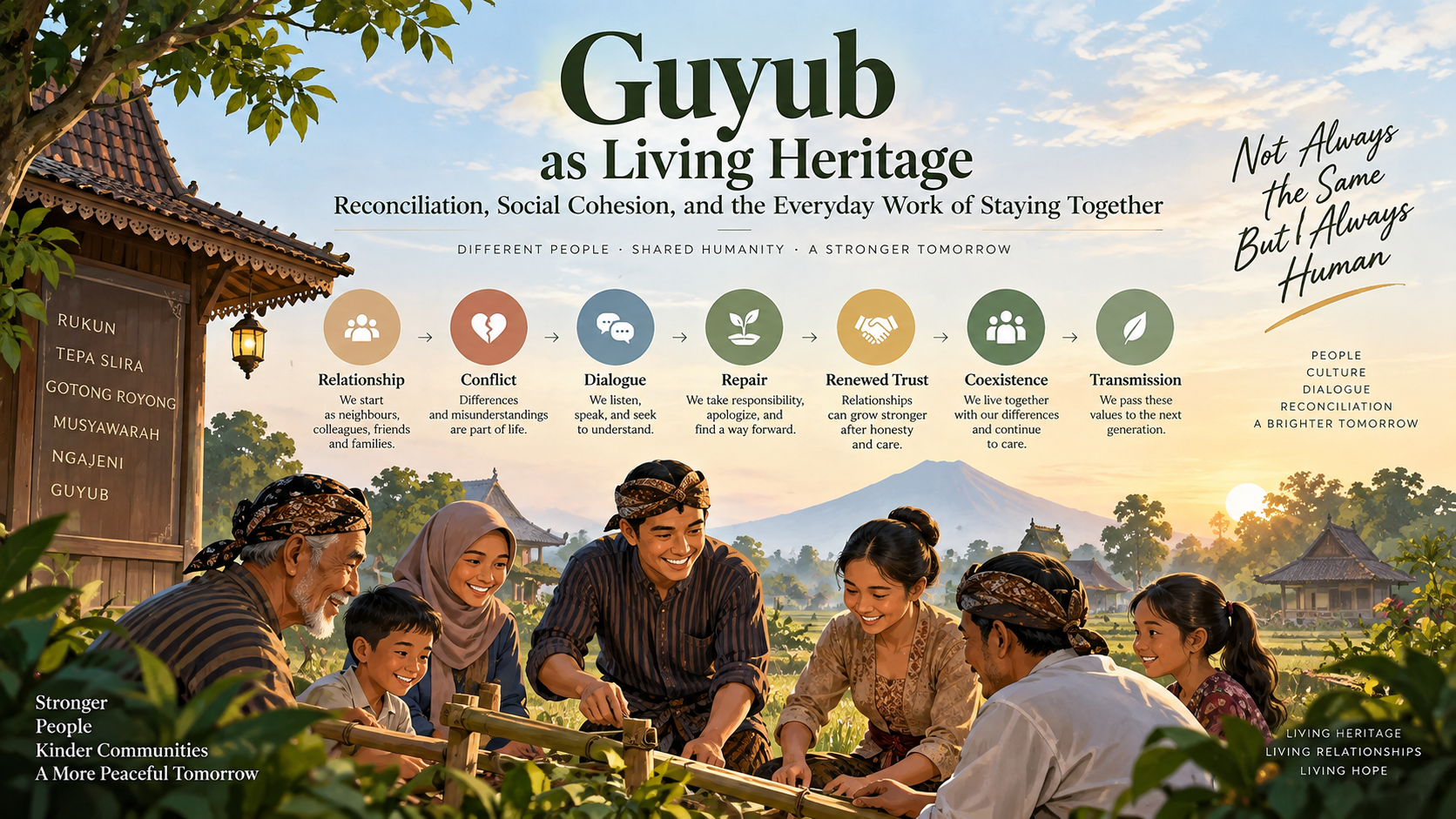
There is a kind of togetherness that can be seen from the outside: people gathering, working together, attending ceremonies, sitting in the same room, or appearing united. But there is another kind of togetherness that is much harder to see. It is the willingness to listen after disagreement, to apologise without losing dignity, to help someone after a difficult conversation, and to remain capable of cooperation when a relationship has been hurt.
In Javanese cultural language, guyub offers a powerful way to think about this. It is often translated as togetherness, communal solidarity, or social harmony. Yet the deeper question is not simply whether people are together. The question is whether the relationship that connects them is still alive.
This article explores a particular interpretation: guyub can be read as a living cultural practice that supports reconciliation—not because “guyub” is a formal peacebuilding mechanism, but because everyday practices associated with guyub can create social conditions in which relationships are repaired, trust is rebuilt, differences are negotiated, and collective life continues.
The Journey
- From Togetherness to Living Heritage
- Guyub Is a Relationship, Not a Crowd
- When Togetherness Breaks: The Space of Conflict
- Reconciliation as a Living Practice
- Rukun, Tepa Slira, Gotong Royong & Musyawarah
- What Guyub Is Not
- From Memory to Transmission
- Guyub in the Digital Age
- A Reconciliation Cycle for Everyday Life
- Conclusion: Keeping the Relationship Alive
1. From Togetherness to Living Heritage
Living heritage is not simply a collection of beautiful traditions from the past. UNESCO describes intangible cultural heritage as practices, knowledge, skills and expressions that communities recognize as part of their heritage and continue to recreate across generations. The point is not only preservation. The point is continuity through living practice.
That distinction matters for guyub. If guyub were only the memory of how people once lived together, it would belong to history. It becomes living heritage when people still enact it: helping neighbours, making space for elders and younger people, negotiating disagreement, maintaining relationships, sharing responsibility, and teaching others how to live together.
Seen this way, heritage is not frozen. The outward form can change. A community meeting can move from the village hall to a group chat. Gotong royong can involve digital coordination. A family conversation can happen across cities. What remains is the cultural logic: relationship has to be maintained through practice.
2. Guyub Is a Relationship, Not a Crowd
Not every gathering is guyub.
A room can be full and still feel lonely. A workplace can look harmonious while resentment accumulates. A family can eat at the same table while nobody feels heard. A community can repeat the language of “togetherness” while people are afraid to speak honestly.
Guyub points toward something deeper: a shared willingness to remain in relationship. There is a sense of belonging, mutual care, and responsibility. People do not merely occupy the same social space; they recognize that what happens to another person can affect the life of the whole.
This is why guyub sits naturally beside ideas such as rukun, tepa slira, gotong royong, ngajeni, and musyawarah. These are not identical concepts, but together they describe a social grammar for living with other people.
3. When Togetherness Breaks: The Space of Conflict
Every community experiences rupture. Someone says something hurtful. Trust is damaged. A misunderstanding becomes a personal accusation. A family member stops speaking. Colleagues become distant. A neighbour feels excluded. The problem is not the existence of disagreement; disagreement is ordinary social life.
The crucial question is what happens after the rupture.
There are at least two possible directions. The first is escalation: each side builds a story about the other, intent is assumed, dignity is threatened, and distance becomes identity. The second is repair: people create enough space to listen, acknowledge what happened, and find a way to relate differently.
This is where reconciliation becomes useful as a lens. Reconciliation does not mean pretending nothing happened. It does not require immediate forgiveness, and it does not erase accountability. It is better understood as a process through which a relationship—or the possibility of coexistence—is renegotiated after harm or serious disagreement.
4. Reconciliation as a Living Practice
Large-scale discussions of reconciliation often focus on war, political violence, transitional justice, or divided societies. Those contexts matter. But the social work of reconciliation also happens at ordinary scale.
It can begin with a simple sentence:
“Let us talk.”
Not to decide who wins, but to see whether the relationship can still carry the weight of truth.
From there, reconciliation may involve several practices: creating a pause before reacting; listening to another person's experience; naming harm without humiliation; taking responsibility where responsibility exists; apologising; changing behaviour; respecting boundaries; and slowly rebuilding trust through repeated interaction.
None of these practices is uniquely Javanese. What is culturally significant is the way Javanese concepts can provide a vocabulary for thinking about them. Guyub gives value to togetherness. Rukun gives value to relational order. Tepa slira encourages consideration of another person's feelings and position. Gotong royong turns solidarity into action. Musyawarah creates a social process for negotiating difference.
The important point is not to claim that these concepts automatically produce reconciliation. They do not. Rather, they can provide cultural resources that communities may draw upon when trying to repair relationships.
5. Rukun Does Not Mean Everyone Must Agree
One of the most dangerous misunderstandings of harmony is the idea that harmony requires sameness.
Healthy social cohesion does not require everyone to think alike. It requires people to develop ways of staying connected while differences remain visible.
That distinction is especially important in conversations about reconciliation. If “keeping the peace” means telling the hurt person to stay quiet, then the relationship may look peaceful while the wound remains active. If “guyub” means preventing criticism so that the group can maintain a good image, then the cultural value has been turned against the people who are supposed to carry it.
A more mature reading is different: rukun protects relationship without demanding silence. A person can say “I disagree.” Another can say “that hurt me.” Someone can ask for distance. A community can still create a path back to dialogue.
6. Tepa Slira: Learning to Measure from the Other Side
Tepa slira can be approached as a discipline of considering the experience of another person. Before judging behaviour, one tries to understand the social meaning it may carry for the other.
This becomes powerful in moments of cross-cultural or interpersonal misunderstanding. The same gesture, tone, silence, or directness may carry different meanings. A person may intend honesty while another experiences aggression. One person may intend humility while another reads avoidance.
Reconciliation becomes difficult when every side treats its own interpretation as objective reality. It becomes possible when people are willing to ask: “What did you experience when I did that?”
That question does not surrender truth. It expands truth from one person's intention to the relationship between intention and impact.
7. Gotong Royong: Repair Through Shared Action
Reconciliation is often imagined as conversation alone. Yet relationships are also repaired through action.
Gotong royong shows this clearly. People build, clean, carry, cook, prepare, restore, and help together. Shared work produces more than a practical result. It creates repeated opportunities for people to experience one another again in a different way.
A person you once misunderstood may become the neighbour who helps you lift something heavy. A colleague you argued with may become the person who quietly solves a problem with you. A family relationship may begin to heal through ordinary acts before either side is ready for a grand conversation.
In that sense, collective action can become a bridge between apology and trust. Trust is not repaired only by saying the right words. It is repaired when later behaviour becomes consistent with those words.
8. Musyawarah: Making Space for Difficult Truths
Musyawarah offers another useful dimension: reconciliation requires a process in which people can speak, listen, negotiate, and search for a way forward.
Musyawarah should not be reduced to “everyone agrees.” Its strength is that it treats difference as something that must be worked through socially. The goal is not always victory. The goal is a path that allows collective life to continue without forcing every person into the same position.
This is close to a central principle of living heritage: communities must not be treated merely as audiences for an externally designed cultural solution. UNESCO's 2003 Convention emphasizes the active participation of the communities, groups and individuals who create, maintain and transmit their heritage.
In other words, reconciliation cannot be designed entirely from outside the relationship. Those living the relationship must have agency in shaping how repair happens.
9. What Guyub Is Not
Guyub is not forced agreement.
A community can stay connected while people hold different views.
Guyub is not forced forgiveness.
A person can need time, distance, accountability, or boundaries.
Guyub is not silence.
Problems that cannot be discussed do not disappear.
Guyub is not permanent self-sacrifice.
Healthy togetherness leaves room for personal limits and dignity.
The distinction matters because cultural values can be used in contradictory ways. The same language of harmony can support care, but it can also be used to pressure people into tolerating harm. A living interpretation must remain capable of self-correction.
10. From Memory to Transmission
Living heritage survives because people transmit more than vocabulary. They transmit ways of behaving.
A child learns guyub by seeing how adults handle disagreement. They learn whether an apology is mocked or respected. They learn whether an elderly neighbour is helped. They learn whether criticism is a conversation or a humiliation ritual. They learn whether someone who made a mistake is permanently expelled from the social circle or given a path to repair.
This is why living heritage is especially powerful as an educational idea. The heritage lives in repeated social behaviour. Transmission is not only “telling young people what guyub means.” It is creating situations in which they can practice it.
A school can teach reconciliation through cooperative projects. A community can document oral histories of how local disputes were repaired. A family can teach children how to apologise and how to listen. A digital community can build norms that reward clarification rather than outrage.
11. Guyub in the Digital Age
The spaces have changed, but the relationship work remains.
Today a WhatsApp group can function like a neighbourhood. A social-media community can become a source of belonging. A single forwarded message can create suspicion within minutes. Public embarrassment can spread faster than a face-to-face apology ever could.
Digital guyub therefore asks for a modern version of old disciplines: pause before reacting, verify before forwarding, correct without humiliating, disagree without dehumanising, and remember that there is a person behind the screen.
Eling lan waspada becomes particularly relevant here: be aware, and remain careful. The technology is fast. The relationship is slower.
12. A Reconciliation Cycle for Everyday Life
We can now put the argument into a simple cycle. Not a universal formula, but a practical way of seeing how a living social value can become a reconciliation practice.
- Pause. Do not let the first emotional reaction become the permanent story.
- Listen. Find out how the other person experienced the situation.
- Acknowledge. Name the harm, misunderstanding, or difference without turning the person into the problem.
- Repair. Apologise when appropriate and change the behaviour that caused the rupture.
- Reconnect. Rebuild cooperation through small, consistent actions.
- Transmit. Teach the next generation what was learned so the community becomes better at repair over time.
This is where the idea of living heritage becomes especially meaningful. A tradition is not alive merely because its name survives. It is alive when its social intelligence continues to help people navigate the present.
Conclusion — Keeping the Relationship Alive
Guyub is often translated as togetherness. But perhaps the more interesting question is what kind of togetherness it asks us to practice.
Not a togetherness that demands everyone become the same.
Not a harmony that depends on silence.
Not a social ideal that requires people to ignore harm.
Instead, guyub can be read as a cultural vocabulary for maintaining relationship: caring, helping, listening, negotiating, repairing, and finding a way to remain human toward one another when life becomes difficult.
That is why the concept fits so naturally into conversations about living heritage. Living heritage is not only what a community remembers. It is what a community continues to do.
If people continue to use practices of mutual care, dialogue, respect, collective action, and relationship repair, then the heritage remains alive—not as a museum display, but as a social capability.
Perhaps that is one of the quietest forms of reconciliation: not a grand ceremony, not a declaration that all differences have disappeared, but the repeated decision to repair what can still be repaired—and to leave enough space for future generations to keep practicing the work of living together.
Selected Heritage References
UNESCO — Convention for the Safeguarding of the Intangible Cultural Heritage (2003). Article 15 emphasizes the widest possible participation of the communities, groups and individuals who create, maintain and transmit living heritage.
https://ich.unesco.org/en/convention
UNESCO — Intangible cultural heritage and peace. UNESCO's Operational Directives encourage recognition of ICH practices that contribute to social cohesion, dialogue, peaceful conflict resolution, restoration of peace, reconciliation and recovery.
https://ich.unesco.org/en/decisions/6.GA/7
UNESCO — Sustainable development and living heritage. UNESCO notes that locally rooted social practices of dialogue, conflict resolution and reconciliation can promote peace and social cohesion.
https://ich.unesco.org/en/sustainable-development-and-living-heritage
UNESCO — About living heritage and education. Communities are the primary actors in deciding what constitutes their living heritage and are responsible for its creation, maintenance and transmission.
https://ich.unesco.org/en/about-01159
Concept note: this article interprets selected Javanese relational values as possible resources for reconciliation. It does not claim that “guyub” is a formal conflict-resolution mechanism or that all Javanese communities interpret the concept identically.
Why This Matters for Living Heritage
The value of guyub is not located only in a word, a ceremony, or a remembered way of village life. It can also be found in the repeated social skills through which people maintain relationship: listening, helping, negotiating difference, repairing harm, and making space for another person to return to the conversation. That is what makes a cultural practice living: people continue to use, reinterpret, and transmit its social knowledge in changing circumstances.