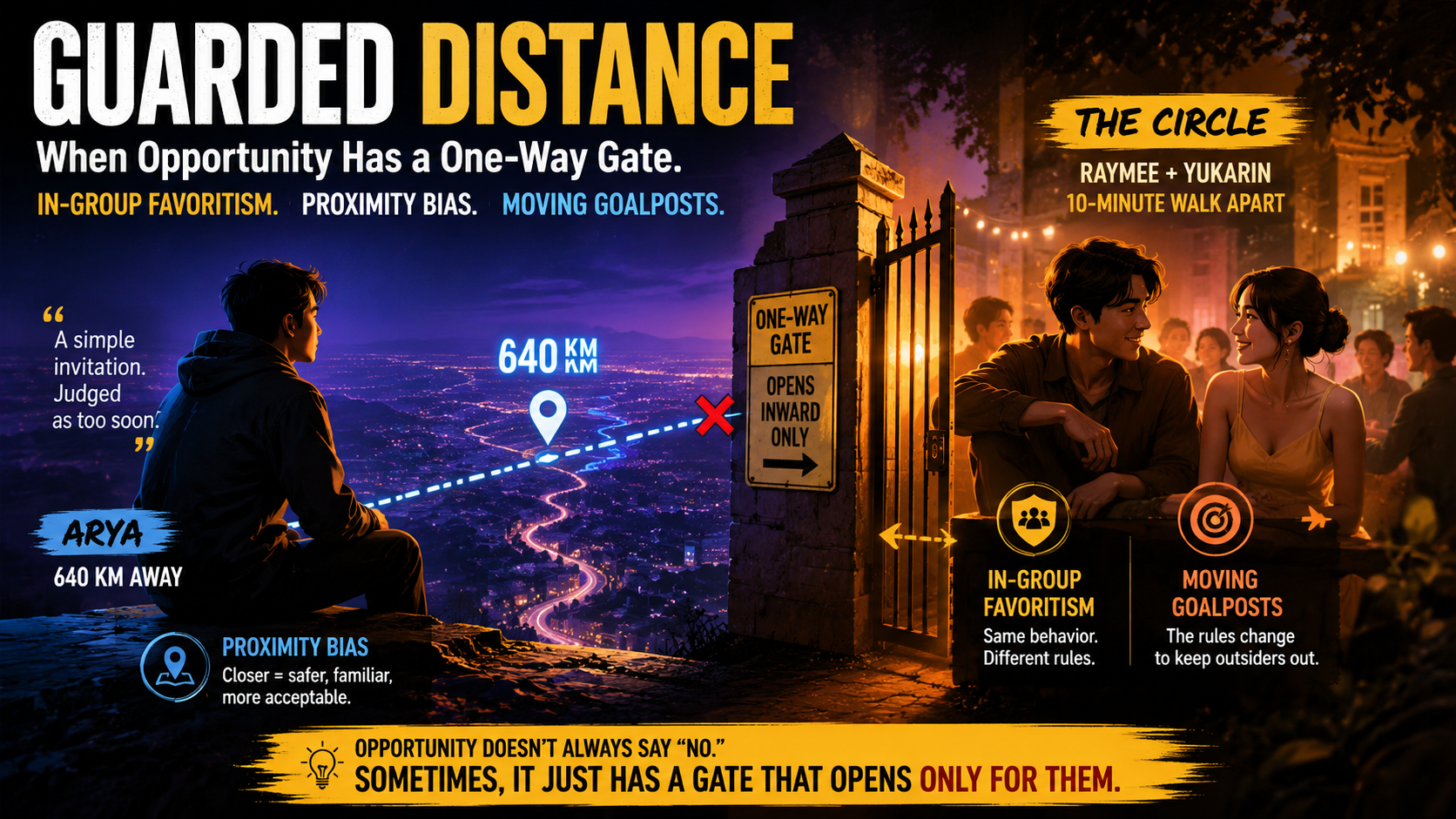
Every night the same blue light painted Arya’s face. On the screen of his phone the digital map refused to lie: 640 kilometers of highway, industrial parks, and indifferent cities stretched between his office and the apartment where Yukarin lived. He zoomed in until the two pins almost touched, then zoomed out until the distance became an abstract river of pixels. The number never changed. Yet he kept staring, as if prolonged attention could somehow bend geography.
It had begun with nothing more dramatic than conversation. Shared links about books. A sudden rainstorm that forced them both under the same café awning in a group chat that later dissolved. Her laugh, typed in lowercase, somehow warmer than the others. One evening Arya typed an invitation that felt honest rather than strategic: coffee, a walk through the city park, nothing more. He sent it before the usual self-censorship could intervene.
The reply never came from her.
It came from the Circle.
“Baru kenal kok udah ngajak-ngajak.” Too soon. Too forward. The tone was protective, almost maternal. Arya read the message three times, then four. He decided the responsible thing was to step back. He became the patient man. He waited. He counted days the way he counted kilometers.
What he did not yet understand was that the fence the Circle had built possessed only one gate, and that gate opened exclusively inward.
I. The One-Way Gate
Raymee had always been inside the Circle. He was the familiar face, the already-approved presence. When his hand rested a moment too long on Yukarin’s shoulder, no one asked why. When his jokes grew more intimate, the room simply adjusted its volume to accommodate them. When his apartment and hers were quietly arranged to be a ten-minute walk apart—two buildings facing each other across a narrow courtyard—no one called it engineering. They called it convenience.
Arya watched the asymmetry from 640 kilometers away and felt the first real fracture in his understanding of fairness.
The diagram above is not metaphor alone. It is the structural reality Arya inhabited. Opportunity did not flow according to merit or timing or mutual interest. It flowed according to membership.
Technique Spotlight: In-Group Favoritism (Social Identity Theory — Tajfel & Turner)
When the same behavior is judged differently solely because of group membership, the mechanism is no longer personal preference. It is categorical. Raymee’s proximity and physical contact were absorbed as normal; Arya’s far milder invitation was framed as premature. The Circle did not need to dislike Arya. They only needed to protect the boundary that defined who belonged.
II. The Currency of Opportunity
If opportunity were a currency, Arya’s account had never been funded. Every additional minute Raymee spent in Yukarin’s physical presence, every unchallenged joke, every shared elevator ride was a quiet transfer. The Circle acted as both bank and teller: they authorized the withdrawals from a pool that was supposed to be neutral and deposited them exclusively into the account of the insider.
Arya never lost a competition. He was never allowed to enter the arena. The probability was not reduced; it was confiscated before it could compound.
Technique Spotlight: Opportunity Hoarding (Charles Tilly)
Groups maintain advantage by restricting access to valued resources—here, time, physical proximity, and social permission—while offering neutral-sounding justifications (“distance,” “timing,” “protection”). The currency never appears on any public balance sheet, yet its flow determines who is allowed to become close.
III. Mere Exposure and the Geometry of Chance
The apartments faced each other. Ten minutes on foot. Shared laundry rooms, identical elevators, the same late-night convenience store. Robert Zajonc’s mere-exposure effect requires no deliberate courtship; repeated, unthreatening proximity itself increases liking. Raymee received that exposure daily, automatically, structurally. Arya received a glowing number on a map.
The geometry was not accidental. It was curated. And once curated, it needed only time to do its psychological work.
Technique Spotlight: Mere-Exposure Effect (Zajonc, 1968)
Repeated exposure to a stimulus under neutral or positive conditions increases positive affect toward that stimulus. Physical proximity multiplies exposure events without requiring effort. When one party is granted structural proximity and the other is denied it, the resulting difference in liking is not evidence of superior personality—it is evidence of superior access.
IV. Moving the Goalposts
Then came the condition that sounded like permission and functioned like a lock.
“Wait until Arya is no longer working. Then the distance will be manageable. Then you may meet.”
The sentence was delivered gently. It positioned the Circle as reasonable gatekeepers rather than obstructors. It transferred the burden of impossibility onto Arya’s employment—the very stability that made him a viable partner in the first place. The goalpost had been moved to a place where reaching it required self-sabotage.
Technique Spotlight: Moving the Goalposts
A classic delay tactic that preserves the appearance of eventual fairness while ensuring the target never arrives. By attaching an escalating or self-destructive condition to the promised meeting, the Circle avoided an open refusal and placed the apparent failure on Arya’s shoulders.
V. The Night the Map Closed
The climax did not arrive with shouting. It arrived with clarity.
Arya sat on the low wall outside his office building long after the last shift had ended. The industrial lights hummed. He opened the map one final time, stared at the two pins, and then deleted the saved location. He drafted a message that contained no accusation and no plea:
“I am leaving this space. Not in anger. Because I have spent long enough waiting outside a door that was locked from the inside. Take care of yourself. I hope you find a freedom that is more than a word.”
He sent it. He watched the “read” receipt appear. He turned off notifications for that conversation and, for the first time in months, slept without the map open beside him.
Three days later the Circle convened around Yukarin’s small kitchen table. The instruction was delivered with the same protective tone that had once filtered Arya’s invitation:
“Do not contact him again. He chose to leave. Contacting him will only create complications. Raymee is already here. That is simpler. That is safer.”
Yukarin’s phone rested face-down on the table. Inside it the last message from Arya still glowed when the screen was lit. She nodded. The nod was not agreement. It was exhaustion. The gate had closed behind the outsider and now it closed in front of her as well.
Technique Spotlight: Social Control through Forbidden Contact
By prohibiting further communication, the Circle eliminated the possibility of private clarification or mutual closure. Isolation after a one-sided departure converts a relational ending into a controlled narrative. The person left behind is denied even the agency of a final conversation.
VI. Aftermath and the Slow Return of Sight
Eight months later Arya lived in a different city, same industry, greater distance by choice. The 640 kilometers had become irrelevant. He no longer measured anything against a pin on a map.
Yukarin still lived in the facing apartments. Raymee’s light still appeared in the opposite window most nights, though the hours grew irregular. One evening she found a conversation on his phone that was not quite an affair and yet far enough from innocence to leave a cold residue. She did not confront him with rage. She sat on the kitchen floor until dawn, then opened a notes app and wrote a single paragraph she never sent:
“I was once forbidden to contact a man who asked only for the same chance the Circle freely gave someone else. I obeyed. I called it care. I now know the name of what I obeyed: opportunity hoarding performed in the language of protection.”
She deleted the draft. She muted the group chat. For the first time the silence was hers.
A year and two months after Arya’s departure, an unsigned email reached him. The subject line was empty. The body contained only this:
“I do not know whether this still reaches you. I only wanted to say thank you for leaving. Not because I was glad you left, but because your leaving forced me to see the fence I had mistaken for a wall of safety. I am still learning how to open a door from the inside. I hope the distance you chose is kinder than the one that was chosen for you.”
Arya read it twice. He did not reply. He filed the message under a folder he had named, simply, “Closed.” Outside his new window the rain fell on a city that contained no pins he was required to measure.
Complete Concept Index Embedded in This Story
- In-Group Favoritism — Differential standards applied solely on the basis of group membership.
- Mere-Exposure / Propinquity Effect — Structural proximity multiplies positive affect without conscious effort.
- Opportunity Hoarding — Restriction of access to time, space, and social permission while maintaining a neutral public justification.
- Moving the Goalposts — Escalating or self-destructive conditions that preserve the appearance of eventual fairness.
- Fundamental Attribution Error — Blaming distance while ignoring active decisions that could have bridged it.
- Relative Deprivation — Pain arising from comparison with a similarly situated other who receives better treatment.
- Self-Fulfilling Prophecy — Prolonged denial of opportunity produces the very failure that was predicted.
- Learned Helplessness — The eventual belief that no effort can alter a system designed to exclude.
- Social Control via Forbidden Contact — Isolation after departure that prevents private closure or counter-narrative.
- Cognitive Dissonance (on the protected side) — Rationalizing control as care until contradictory evidence forces re-evaluation.
The distance that was guarded was never only geographic. It was architectural—built from favoritism, proximity bias, and the quiet transfer of chance. The story’s final question is not whether the outsider should have waited longer. It is whether any of us can recognize a one-way gate while we are still standing on the wrong side of it.