
Psychology · Adaptive Thinking · Problem Solving
Goal-Oriented Thinking: Stop Worshipping the Method, Start Focusing on the Goal
Some people call me adaptable. Others might call me indecisive, inconsistent, or even ababil—someone who keeps changing their mind. Fair enough. Sometimes I do change my plans. But there is something I genuinely struggle to understand: why do some people abandon their entire goal when just one particular method becomes unavailable?
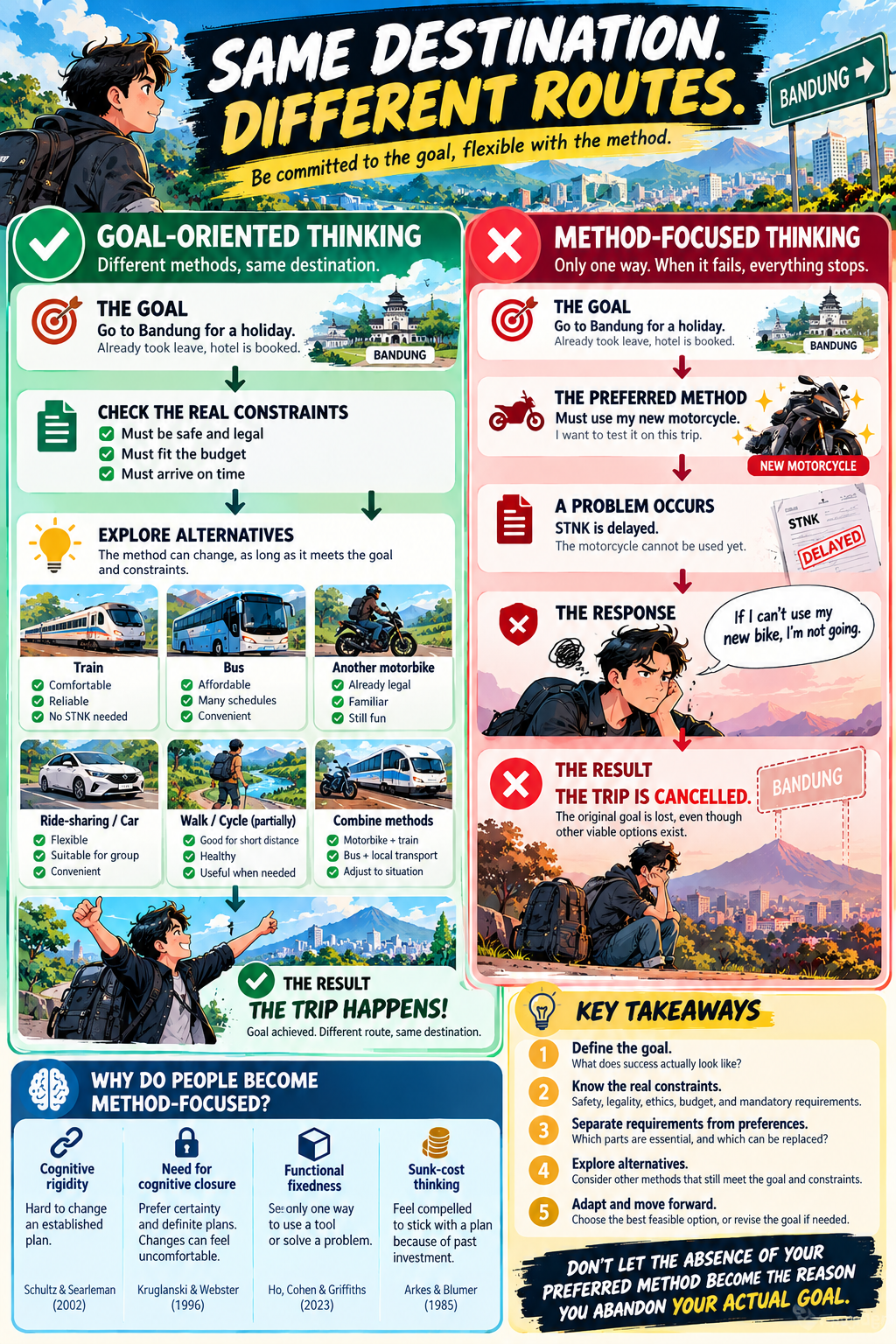
Different routes. Different methods. One destination.
1. A Simple Trip to Bandung
Imagine this.
You have planned a trip to Bandung. You have already taken time off work and booked a hotel. Everything is ready.
There is just one problem: your new motorcycle's registration document, the STNK, has not been issued yet.
What would you do?
Personally, I would look for another reasonable option. Use another roadworthy and legally compliant motorcycle. Take the train. Take a bus. Depending on the circumstances, perhaps even walk for part of the journey.
Why cancel an entire trip when the original vehicle is unavailable?
Of course, walking all the way to Bandung may be impractical, and not every alternative is safe, affordable, or feasible. The point is not that every method is interchangeable. The point is that we should evaluate alternatives against the actual goal and its real constraints.
Now imagine someone saying:
"If I cannot go with my new motorcycle, I am not going at all."
That might make sense if the purpose of the trip is specifically to test the new motorcycle. But if the purpose is to enjoy a holiday in Bandung, the motorcycle is a means—not the destination.
And that distinction changes everything.
2. Goal-Oriented vs. Method-Focused Thinking
The difference is not about being careless with plans. It is about distinguishing the destination from the route.
A goal-oriented person asks, "What am I actually trying to achieve, and what other viable routes could get me there?"
A method-focused person may instead ask, "How can I make this one particular plan work?" Even when that plan is no longer viable.
Planning is valuable. Standards matter. Procedures can protect people and ensure quality. But when we confuse a preferred method with the underlying objective, a useful plan can become an unnecessary obstacle.
3. Why Do People Become Attached to One Method?
Psychology offers several useful concepts for understanding this behaviour. They are possible explanations, not diagnoses of any particular person.
01. Cognitive rigidity
The tendency to persist with an established way of thinking or behaving, even when circumstances change. Generating or accepting alternatives can become difficult.
02. Need for cognitive closure
Some people strongly prefer certainty, predictability, order, and definite answers. An established plan can feel reassuring, while ambiguity and last-minute changes can feel uncomfortable.
03. Functional fixedness
We may see an object or resource only in its familiar role. More broadly, we can become mentally attached to one way of using a tool or solving a problem and overlook other possibilities.
04. Sunk-cost thinking
After investing time, money, or effort in a plan, people can feel compelled to stick with it. Past investment, however, does not automatically make continuing the best decision.
Need for cognitive closure: certainty can feel safer than flexibility
In their influential 1996 paper, Arie W. Kruglanski and Donna M. Webster described the need for cognitive closure through two tendencies: seizing on an answer and freezing on it. In everyday terms, a person may settle on a decision quickly and then resist reopening it when new information appears.
Imagine someone who has mentally committed to a trip on a new motorcycle. When the STNK is delayed, they may experience the change not as a small logistical problem, but as a disruption to the certainty and structure of their plan.
This concept does not mean that everyone who prefers a fixed plan has a high need for closure. Research describes tendencies and contexts, not a simple label that can explain every individual.
Cognitive rigidity: when the plan survives but the purpose disappears
A 2002 review by Wesley Schultz and Alan Searleman examined a century of research on rigidity in thought and behaviour. Rigidity is a broad, multidimensional construct; it can involve persisting with familiar mental or behavioural patterns.
In practical problem-solving, the warning sign is not simply having a preference. It is failing to reconsider that preference when the conditions that justified it have changed.
Research: Schultz & Searleman (2002), Rigidity of Thought and Behavior: 100 Years of Research.
Functional fixedness: seeing only one possible route
Research on human planning also explores why people can display conceptual inflexibility even when they are capable of planning flexibly. A 2023 paper by Mark K. Ho, Jonathan D. Cohen, and Thomas L. Griffiths examines rational simplification and rigidity in human planning, including the problem of functional fixedness.
In our example, the person may not literally believe that no other transport exists. They may simply be so focused on the original arrangement that alternatives never become serious candidates.
4. Being Adaptable Does Not Mean Having No Principles
There is an important distinction here. I am not arguing that we should abandon every rule, standard, or commitment whenever something becomes inconvenient.
Some requirements are essential. A vehicle must be legal and safe. A project may require a specific technical standard. A medical procedure may have non-negotiable safety requirements. In those cases, the constraint is part of what makes the goal legitimate or achievable.
The better question is:
Is this requirement essential to the outcome, or is it simply my preferred way of getting there?
Keep the essentials
Safety, legality, ethics, quality, budget limits, and any genuinely mandatory requirements.
Reconsider the preferences
The original vehicle, familiar workflow, favourite software, preferred schedule, or the first solution that came to mind.
Adaptability is not random change. It is the ability to preserve what matters while reconsidering what can change.
5. The Same Principle Applies at Work
Think about a project that depends on one software platform. The platform becomes unavailable. Do we stop the entire project immediately, or do we evaluate a safe alternative that can still meet the requirements?
Think about an event that requires a particular room. The room becomes unavailable. Is the event itself impossible, or could a different venue serve the same purpose?
Think about a team that insists on following an old process simply because it has always been done that way. If the process no longer serves the objective, should we preserve it unquestioningly—or review it against the outcome we need?
In each case, the same sequence helps:
1. Define the outcome. What does success actually mean?
2. Identify the real constraints. What must remain true for the result to be safe, ethical, valid, and useful?
3. Separate requirements from preferences. Which parts of the plan are essential, and which are replaceable?
4. Generate alternatives. What other routes could satisfy the same constraints?
5. Evaluate and adapt. Choose a feasible alternative, or revise the goal transparently if no viable option exists.
This is not an argument against planning. It is an argument for planning that remains responsive to reality.
6. A Small Question That Can Change the Way We Think
When a plan fails, pause before declaring the entire mission impossible.
Ask yourself:
- What was the original goal?
- Why did I choose this method in the first place?
- Has the method become impossible, or merely inconvenient?
- Can another method meet the essential requirements?
- Am I protecting the outcome—or protecting my attachment to the plan?
That final question is especially useful. Sometimes we defend a method because it is genuinely the best option. Other times, we defend it because we have already imagined success in one particular form.
Knowing the difference takes reflection, not just flexibility.
My takeaway:
Be committed to your goal, but flexible with your method.
If you want to reach Bandung, let's discuss the best feasible way to get there. Walking, taking a train, boarding a bus, or riding a different motorcycle may all be worth considering, depending on the circumstances.
But if the only acceptable outcome is to use one particular motorcycle, ask yourself whether reaching Bandung was ever the real goal—or whether the motorcycle was the goal all along.
Maybe I am adaptable. Maybe someone else would call that inconsistent. But I would rather reconsider a method and achieve a meaningful outcome than preserve a perfect plan that leads nowhere.
What do you think? Have you ever seen a project, trip, or opportunity fail simply because people insisted on one particular way of doing things?
References
- Kruglanski, A. W., & Webster, D. M. (1996). Motivated Closing of the Mind: “Seizing” and “Freezing.” Psychological Review, 103(2), 263–283.
- Schultz, P. W., & Searleman, A. (2002). Rigidity of Thought and Behavior: 100 Years of Research. Genetic, Social, and General Psychology Monographs, 128(2), 165–207.
- Ho, M. K., Cohen, J. D., & Griffiths, T. L. (2023). Rational Simplification and Rigidity in Human Planning. Psychological Science, 34(11), 1281–1292.
