Psychology • Open-Mindedness • Adaptability • Disaster Resilience
Hahaha, I just watched the anime Utawarerumono, and then listened to Suara’s song “Fuantei na Kami-sama.” Somehow, it got me thinking about psychology—and about why some people who appear unstable may actually be responding to a world that rarely feels predictable.
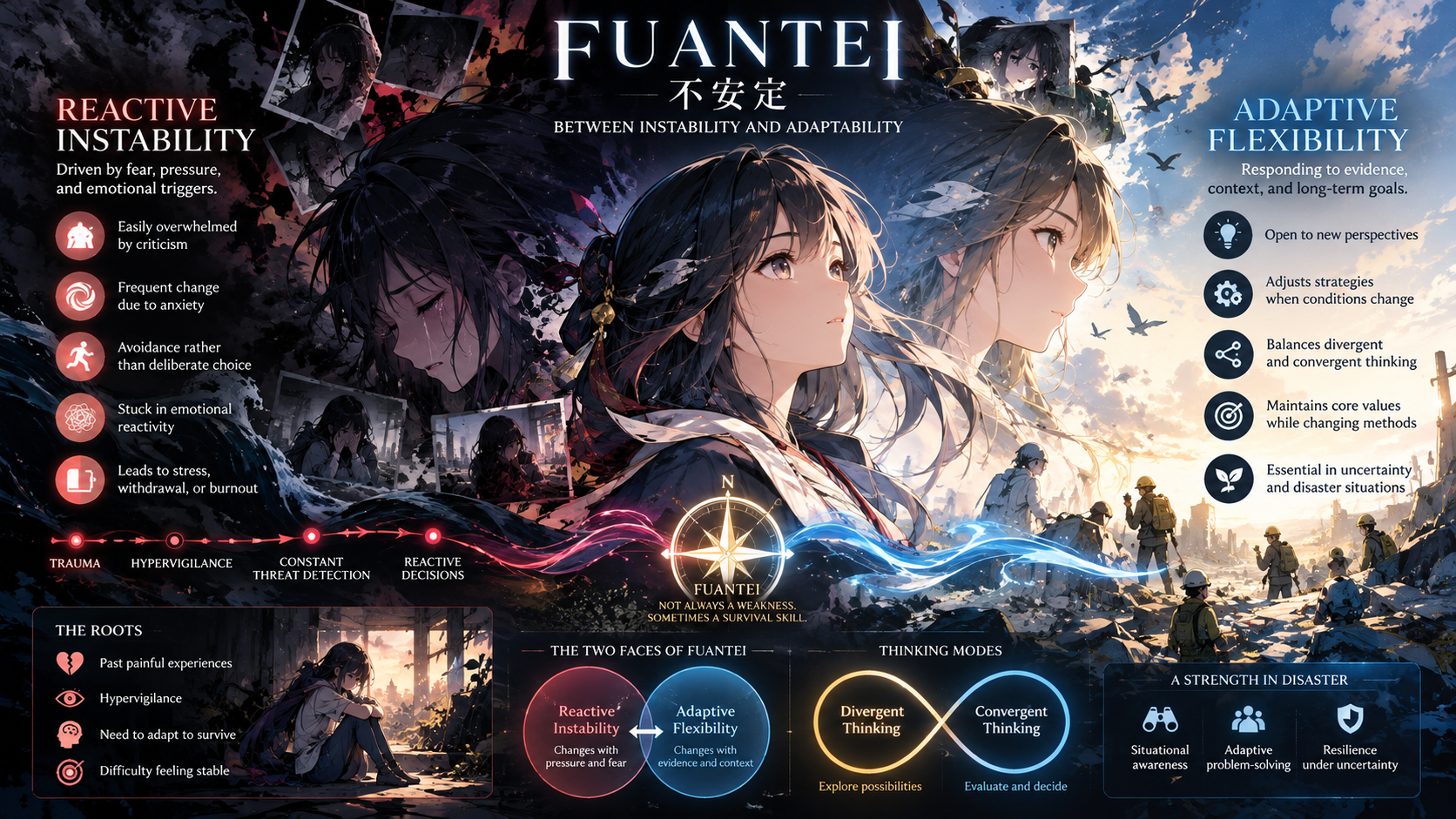
The word fuantei (不安定) means “unstable” or “unsettled” in Japanese. It is a useful starting point for a question that reaches far beyond anime: when someone keeps changing their mind, strategy, or behaviour, are we witnessing instability, adaptability, or a mixture of both?
From the outside, these patterns can look surprisingly similar. A person changes plans, questions a previous conclusion, prepares for another scenario, or responds differently when circumstances shift. We may label them inconsistent, unpredictable, difficult, or even unreliable. But the visible behaviour does not always reveal the process behind it.
This article proposes a practical distinction between reactive instability and adaptive flexibility. These are descriptive lenses for thinking about behaviour, not formal clinical diagnoses. They are also not fixed personality types: one person can show both patterns in different circumstances.
The important question is not simply, “How often does this person change?” It is, “What drives the change, how is it evaluated, and what happens afterward?”
1. Two Faces of Fuantei
Imagine two people who both abandon a plan at the last minute. One changes course because criticism makes them anxious and they urgently want the discomfort to stop. The other changes course because new information shows that the original plan is unsafe. The visible result is the same: the plan changes. The underlying reasoning is not.
This distinction matters because consistency is not automatically wisdom, and change is not automatically growth. Someone can remain stubbornly committed to a failing plan and call it “being consistent.” Someone else can abandon a good plan at every uncomfortable moment and call it “being flexible.” Both can be mistaken.
A useful way to evaluate a change is to ask whether it has a reason that can be examined. Did the evidence change? Did the goal change? Did the constraints change? Did the person learn something important? Or did an uncomfortable feeling become so urgent that it overrode reflection?
2. Reactive Instability: When Change Becomes an Escape Route
Reactive instability is not a synonym for being emotional, sensitive, or mentally ill. It describes a possible pattern in which decisions are repeatedly driven by immediate pressure rather than by a considered assessment of the situation.
Consider someone who starts a project with enthusiasm, receives one negative comment, and abandons the project. They later decide to start again, receive another criticism, and switch direction once more. Each individual change may feel understandable in the moment. Over time, however, the person may lose the ability to distinguish useful feedback from discomfort, or a real warning from a temporary fear.
A similar pattern can happen in relationships, workplaces, education, or personal goals. A difficult conversation may trigger withdrawal. Ambiguity may prompt an impulsive conclusion. A small setback may be interpreted as proof that the entire plan is doomed. The person may be trying to protect themselves, but their short-term relief can create long-term instability.
Common signs to look for—not labels to assign
A decision is repeatedly reversed, but the reasons for the reversal are unclear or change with the person's immediate emotional state.
Changing direction provides immediate relief from criticism, uncertainty, conflict, or fear, even when the underlying problem remains unresolved.
The method, goal, or commitment changes together, making it hard to tell whether the person is strategically adapting or abandoning what matters to them.
The person moves to the next response without reviewing what happened, what was learned, or whether the previous change helped.
None of these signs proves a disorder or reveals a person's character in full. Context matters. A person may need to leave an unsafe environment quickly; a sudden change can be entirely appropriate. The concern is a recurring pattern that creates harm and is difficult for the person to understand or regulate.
3. Adaptive Flexibility: When the Strategy Changes but the Purpose Remains
Adaptive flexibility is different. A flexible person does not necessarily have fewer convictions. Instead, they can distinguish between a principle, a goal, a hypothesis, and a method.
A principle may remain stable while a hypothesis is revised. A goal may remain important while the route toward it changes. A method may be abandoned because it no longer works. This is not necessarily inconsistency; it can be a sign that the person is responding to reality rather than demanding that reality conform to the plan.
Imagine a community team trying to restore a degraded mangrove area. The initial plan assumes that seedlings can be planted across the entire site. Field observations later reveal that some areas have unsuitable hydrology, exposed roots, or different ecological conditions. An adaptive team does not simply plant more seedlings to prove commitment to the original plan. It investigates the evidence, adjusts the site selection, consults local knowledge, and revises the intervention.
The purpose—ecological restoration—remains. The strategy changes because the conditions demand it.
Adaptive flexibility is related to cognitive flexibility, the ability to shift perspectives or strategies when circumstances change, and to adaptive expertise, the ability to apply existing knowledge while developing new approaches to unfamiliar problems. These concepts do not mean that every change is good. They describe capacities that can help people respond more intelligently to change.
4. Divergent and Convergent Thinking: Explore Widely, Decide Carefully
Divergent thinking generates multiple possibilities. Convergent thinking evaluates those possibilities and narrows them toward a defensible decision. Both are useful, and complex problem-solving often requires moving between them.
A highly open-minded person may be comfortable generating possibilities and considering views they previously rejected. But open-mindedness does not mean believing every idea, refusing to make a decision, or changing opinions simply to avoid disagreement. A useful open mind is willing to revise a conclusion when there are good reasons to do so—and willing to reject a claim when the evidence is weak.
Divergent thinking without convergence can become endless brainstorming. Convergence without divergence can lock a team into the first plausible answer. The strongest approach is iterative: open the space of possibilities, assess the options, act, observe the result, and reconsider when new evidence warrants it.
Open-mindedness is not the absence of conviction. It is the willingness to examine whether a conviction still deserves to be held.
5. Trauma and the Need to Adapt: A Possible Pathway, Not a Universal Story
Now comes the more sensitive part of the discussion. Some people experience environments in which safety, acceptance, or stability can change without warning. In such circumstances, paying close attention to other people's moods, shifts in tone, or small changes in the environment may become a way of anticipating what could happen next.
For some people, difficult experiences may contribute to heightened threat monitoring or hypervigilance. They may feel compelled to scan for possible danger, anticipate several outcomes, or prepare a response before a situation becomes clear. This can be exhausting, particularly when the person cannot easily switch off that vigilance.
However, trauma does not produce one universal response. Some people become more vigilant; others become avoidant, emotionally numb, rigid, accommodating, distrustful, or respond in other ways. Not everyone who is highly alert has experienced trauma, and not everyone who has experienced trauma becomes hypervigilant or open-minded.
It is therefore too strong to claim that the most open-minded people usually have deep trauma. A more careful possibility is that some people who have navigated unpredictable circumstances may develop certain useful habits—such as noticing changes, considering alternatives, or preparing for contingencies—while also carrying a burden of stress.
The distinction is important: a survival response is not the same thing as a well-calibrated skill. A person may learn to notice subtle signals, but the signals can also be misread. A strategy that once helped someone feel safer can become exhausting when it remains active in situations that are no longer dangerous.
6. Hypervigilance: Early Warning or False Alarm?
In a genuinely dangerous environment, noticing a meaningful change early can be valuable. But hypervigilance can also increase the chance of treating ambiguous information as a threat. The challenge is not merely to notice more; it is to evaluate what has been noticed.
| Dimension | Useful situational awareness | Possible hypervigilance burden |
|---|---|---|
| Attention | Notices relevant changes and checks whether they matter. | Scans continuously, including when there is little evidence of danger. |
| Interpretation | Considers several explanations and updates confidence. | May interpret ambiguous signals as warnings too quickly. |
| Action | Responds proportionately to the level of risk. | May over-prepare, avoid, or react before the situation is clear. |
| Recovery | Can stand down when the risk has passed. | May struggle to relax or feel safe even after the situation changes. |
This is not a diagnostic table. It is a practical distinction between a capacity that can support decisions and a state of alertness that may become costly. A person can be observant and still misinterpret a signal; a person can feel anxious and still assess a situation accurately. Emotion alone does not determine whether a judgement is correct.
Healthy adaptation includes the ability to calibrate attention: notice, check, decide, act, and—when appropriate—rest. A system that never stands down eventually exhausts the people operating it.
7. Why This Matters in Disaster Risk Reduction and Emergency Response
Disasters expose the limits of rigid plans. Roads become inaccessible, communication networks fail, supply chains are interrupted, weather changes, and information arrives incomplete or late. A plan is essential, but it is a model of expected conditions—not a guarantee that the conditions will remain as expected.
Consider a flood response. A team has selected an evacuation route, but rising water makes that route unsafe. Different capabilities now matter:
Field observations, community reports, maps, and official warnings indicate that the original route may no longer be viable.
Divergent thinking helps identify other routes, safe assembly points, transport options, and communication methods.
Convergent thinking checks current conditions, accessibility, exposure, capacity, and the needs of people requiring additional assistance.
The revised decision is shared clearly with responders and affected communities, including uncertainty and instructions.
The team checks whether the new route remains safe and adapts further when evidence changes.
Neither rigid consistency nor frantic improvisation is enough. Effective response combines procedures, local knowledge, training, situational awareness, communication, and the authority to revise a plan when the evidence warrants it.
People who are comfortable considering alternatives can be valuable in uncertain environments, but disaster response should never depend on assuming that someone with a traumatic history will perform better. Trauma can also affect concentration, sleep, decision-making, and recovery. Preparedness, role clarity, training, and supportive team practices matter more than romanticised personality labels.
The goal is not to find people who are permanently unstable. It is to build people and systems that can recognise when the situation has changed—and respond without losing judgement.
8. An SVG Map of the Two Patterns
The diagram below is a conceptual model, not a clinical assessment or a scientifically validated decision tool. Select a pathway to highlight how a change might be processed. In real life, the pathways can overlap, and context strongly influences the outcome.
Conceptual illustration by the author. It does not classify individuals, predict behaviour, or establish a causal relationship between trauma and adaptability.
9. Stable Purpose, Flexible Strategy
A useful metaphor is a sailor navigating changing weather. The sailor cannot command the wind to remain constant. They may need to change speed, adjust the sails, select another route, or wait for conditions to improve. Yet the destination can remain meaningful throughout the journey.
In human life, a stable purpose might be protecting a community, learning a skill, restoring an ecosystem, building a healthy relationship, or delivering a public service. The methods used to pursue that purpose can change as new information arrives.
This gives us a practical distinction:
Principles can also require reconsideration when they conflict or are based on mistaken assumptions, so they should not be treated as immune to reflection. Still, separating these layers helps prevent every tactical change from feeling like a loss of identity.
Be consistent enough to know what you are trying to protect, and flexible enough to change how you protect it.
10. When Adaptability Becomes Exhaustion
There is a cost to constantly adapting. A person who has learned to anticipate every possible problem may struggle to rest. They may feel responsible for noticing every shift, preparing every backup plan, and preventing every failure. When uncertainty becomes intolerable, planning can turn from a useful tool into a never-ending attempt to guarantee safety.
But no person can anticipate everything. A useful adaptive system needs limits: priorities, thresholds for action, trusted sources of information, a way to ask for help, and a way to stand down when the risk has passed.
In organisations, this means designing systems that do not rely on one permanently alert individual. Share information, document decisions, clarify roles, build redundancy, and make it safe to report a concern without requiring someone to read every subtle social signal. Resilience should be built into the system, not extracted from one person's exhaustion.
For individuals, it can mean noticing when vigilance is interfering with sleep, relationships, work, or the ability to feel safe. Support from trusted people or a qualified mental-health professional may help when distress is persistent or overwhelming. Seeking support is not a failure to adapt; it can be one of the most adaptive decisions available.
Severe distress and suicidal behaviour should never be reduced to “not being able to adapt.” Suicide is complex and can involve multiple interacting psychological, social, biological, and situational factors. It calls for compassion and appropriate support, not a simplistic judgement about strength or flexibility.
11. How to Tell Whether a Change Is Adaptive
Before judging another person—or yourself—as unstable, consider these questions. They are reflection prompts, not a psychological test.
Was there new evidence, a different constraint, a revised goal, or simply a surge of discomfort?
Is the person preserving a meaningful goal, avoiding a threat, protecting a boundary, or seeking immediate relief?
Did the person explore more than one response, or did the first available reaction dominate?
Does the action fit the evidence and the level of risk, or is uncertainty being treated as proof of danger?
A thoughtful explanation does not guarantee correctness, but it makes the reasoning open to review.
Was the outcome checked? Was anything learned? Is the same costly pattern repeating without reflection?
Can they stop monitoring, rest, accept support, and return to ordinary activity when the situation permits?
These questions shift the focus from a label to a process. Instead of deciding that someone is “unstable,” we can examine the conditions under which they change, the evidence they use, and the consequences of their choices.
12. What Teams and Leaders Can Learn From This
Teams often need both people who protect continuity and people who challenge assumptions. A team made up entirely of people who want to preserve existing procedures may miss emerging risks. A team made up entirely of people who want to reinvent everything may struggle to execute, maintain standards, or learn from previous work.
The answer is not to assign simplistic personality labels. It is to design a decision process that makes room for exploration and disciplined selection.
This is especially important in emergency management, public policy, health systems, environmental work, and other settings where conditions are dynamic and the consequences of error can be significant.
13. The Central Paradox
At first glance, stability and adaptability may seem like opposites. Yet effective adaptation often depends on having something stable enough to guide change: a clear goal, a shared protocol, a set of decision criteria, or an understanding of what must be protected.
Likewise, stability without learning can become rigidity. A plan that is never revised may preserve the appearance of order while allowing risk to grow. A person who never changes their mind may be consistent, but consistency alone does not prove that their conclusions are sound.
So perhaps the real contrast is not between stable people and unstable people. It is between different ways of responding to uncertainty—and between systems that learn from change and systems that either deny it or react without reflection.
Reactive instability changes because pressure feels unbearable. Adaptive flexibility changes because the context, evidence, or assessment has changed. Both can look unpredictable from the outside; the process behind the change makes the difference.
Conclusion: Not Unstable for the Sake of Instability
Hahaha, all of this started with an anime and a song. But “fuantei” became a useful prompt for thinking about a real distinction in human behaviour.
Some changes are impulsive reactions. Others are intelligent adjustments. Some people become highly alert because their circumstances have taught them to anticipate danger; that alertness may sometimes support situational awareness, but it can also become painful and exhausting. We should recognise the possible skill without romanticising the suffering.
For complex challenges, especially disasters, the ability to reconsider a plan is essential. But adaptability needs more than sensitivity to change. It requires evidence, judgement, communication, emotional regulation, feedback, and the ability to recover.
We should not celebrate every unpredictable person as secretly exceptional, nor condemn every change of mind as weakness. Instead, we can ask whether a change is reasoned, proportionate, connected to a meaningful goal, and reviewed against its consequences.
Perhaps the most useful form of adaptability is this: to remain grounded without becoming rigid, to stay open without becoming directionless, and to respond to uncertainty without allowing uncertainty to control every decision.
Stable enough to know what matters. Flexible enough to change what no longer works. Grounded enough to know when it is time to stop adapting and recover.
What do you think? Have you ever met someone who looked inconsistent because they kept changing their approach, only to realise that they were responding to changes others had overlooked? Or have you seen the opposite—a person who called themselves flexible but was actually reacting to every pressure around them?
Further Reading
- American Psychological Association — Trauma. Background on trauma and its possible psychological effects.
- National Institute of Mental Health — Post-Traumatic Stress Disorder. Information about PTSD symptoms, including heightened reactivity and vigilance, and available treatment.
- U.S. Centers for Disease Control and Prevention — About Mental Health. General background on mental health and factors that affect well-being.
- United Nations Office for Disaster Risk Reduction — Terminology. Reference terminology for disaster risk reduction and resilience.
- World Health Organization — Mental Health. General information on mental health and the importance of supportive environments.
Scope note: This is an analytical article, not a clinical assessment. “Reactive instability” and “adaptive flexibility” are used as explanatory descriptions, not as formal diagnoses. The diagram is conceptual and does not establish that trauma causes open-mindedness, divergent thinking, or superior disaster performance.