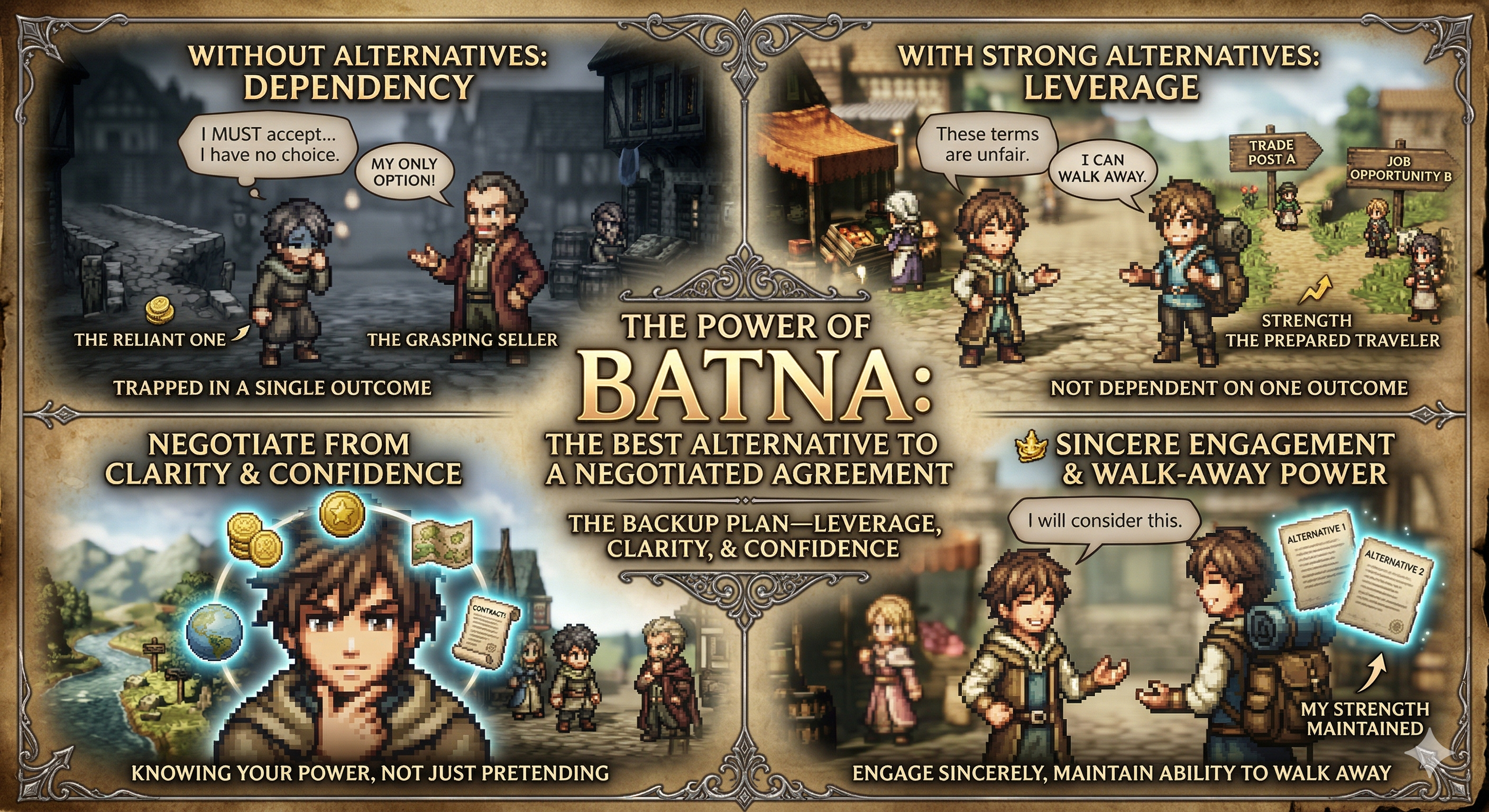
In negotiation theory, BATNA (Best Alternative to a Negotiated Agreement) is often described as the ultimate source of power. The stronger your alternative, the less dependent you are on any single deal.
But there is a critical limitation in how BATNA is commonly applied: it is often treated as static.
In reality, BATNA is dynamic. It evolves over time, influenced by shifting conditions, emerging risks, and unexpected opportunities.
This is where horizon scanning becomes essential.
Understanding BATNA in a Dynamic World
BATNA provides clarity. It answers a fundamental question: what will you do if no agreement is reached?
For stakeholders—whether in policy, business, or partnerships—this defines the baseline of decision-making. It determines when to walk away, when to push harder, and when to compromise.
However, a BATNA built on current conditions may quickly become outdated in a rapidly changing environment.
A strong BATNA today may weaken tomorrow. A weak BATNA may unexpectedly strengthen.
Without anticipating these shifts, stakeholders risk making decisions based on incomplete or outdated assumptions.
Horizon Scanning: Seeing Beyond the Negotiation Table
Horizon scanning extends the logic of BATNA into the future.
Instead of focusing only on present alternatives, it asks: how might these alternatives evolve?
By identifying emerging trends, weak signals, and potential disruptions, stakeholders can assess how their BATNA—and their counterpart’s BATNA—may change over time.
This transforms negotiation from a static assessment into a dynamic strategy.
Mapping Stakeholders with Foresight
In multi-stakeholder environments, each actor has their own BATNA, shaped by their constraints, incentives, and external pressures.
Horizon scanning allows you to map not only current positions, but future trajectories.
For example:
- A government agency may face upcoming regulatory pressure.
- A private sector partner may be vulnerable to technological disruption.
- A community group may gain influence due to shifting public sentiment.
These changes directly affect negotiating power.
Understanding them in advance allows you to anticipate shifts before they become visible to others.
From Static Power to Strategic Timing
The real advantage of combining BATNA with horizon scanning lies in timing.
If you know your BATNA will strengthen in the near future, you can delay agreement and negotiate from a stronger position.
If you anticipate your counterpart’s BATNA will weaken, you may accelerate discussions to capture favorable terms.
Conversely, if your own position is expected to deteriorate, early agreement may be the rational choice.
This is no longer just negotiation—it is strategic positioning across time.
Designing Adaptive Strategies
To operationalize this approach, stakeholders should:
1. Define current BATNA clearly.
2. Use horizon scanning to identify trends that may affect it.
3. Assess how these trends impact both your position and others.
4. Develop scenarios where BATNA strengthens, weakens, or remains stable.
5. Adjust negotiation strategy based on these scenarios.
This creates an adaptive strategy that evolves alongside the environment.
Beyond Negotiation: A Strategic Mindset
The integration of BATNA and horizon scanning reflects a broader shift—from reactive negotiation to anticipatory strategy.
It moves stakeholders away from short-term bargaining and toward long-term positioning.
It also reduces dependency on fixed outcomes, replacing it with flexibility and resilience.
In complex systems, this mindset is no longer optional—it is essential.
Conclusion: Negotiating Across Time
BATNA tells you where you stand today.
Horizon scanning tells you where you might stand tomorrow.
The true strategic advantage comes from combining both—understanding not only your alternatives, but how they evolve.
Because in the end, the strongest negotiators are not those with the best position now, but those who understand how positions change over time—and act accordingly.