Somewhere today, a farmer is making a decision that will determine whether a village eats or starves six months from now. The rainfall is unpredictable. Fertilizer prices are rising. A new pest has appeared—one that was never seen before in that region.
These are not isolated problems. They are signals—early indicators of stress within a global food system that is becoming increasingly fragile.
The challenge is not that these signals do not exist. The challenge is that they are often detected too late.
This is where Horizon Scanning, combined with Science, Technology, and Innovation (STI), becomes critical—not just for policy, but for survival.
1. The Food System as a Complex Adaptive Network
Global food systems are not linear. They are deeply interconnected networks influenced by climate, technology, economics, and geopolitics.
A drought in one region can affect global prices. A pest outbreak can disrupt supply chains. A conflict can restrict grain exports.
In such a system, small disruptions can cascade into large-scale crises.
Traditional approaches react to shortages. Horizon scanning aims to detect the signals before shortages happen.
2. WFP and Anticipatory Action
The World Food Programme (WFP) has been at the forefront of integrating foresight into humanitarian response. Through its Anticipatory Action Framework, WFP uses predictive analytics and horizon scanning to act before disasters fully unfold.
Instead of waiting for famine conditions to emerge, WFP monitors indicators such as rainfall anomalies, crop health, market prices, and conflict patterns.
When thresholds are reached, interventions are triggered early—cash transfers, food pre-positioning, and logistics mobilization.
This reduces both human suffering and operational costs.
3. STI as an Acceleration Layer
Horizon scanning identifies signals—but STI determines how we respond to them.
Innovations in agriculture are rapidly transforming how food systems adapt:
- Precision Agriculture: AI-driven irrigation and fertilizer optimization.
- Drought-Resistant Crops: Biotechnology enabling resilience to climate stress.
- Digital Advisory Systems: Mobile-based farmer guidance platforms.
- Decentralized Innovation: Grassroots solutions emerging from local communities.
However, innovation without visibility is ineffective. This is where scanning systems play a critical role—ensuring that emerging solutions are identified, evaluated, and scaled.
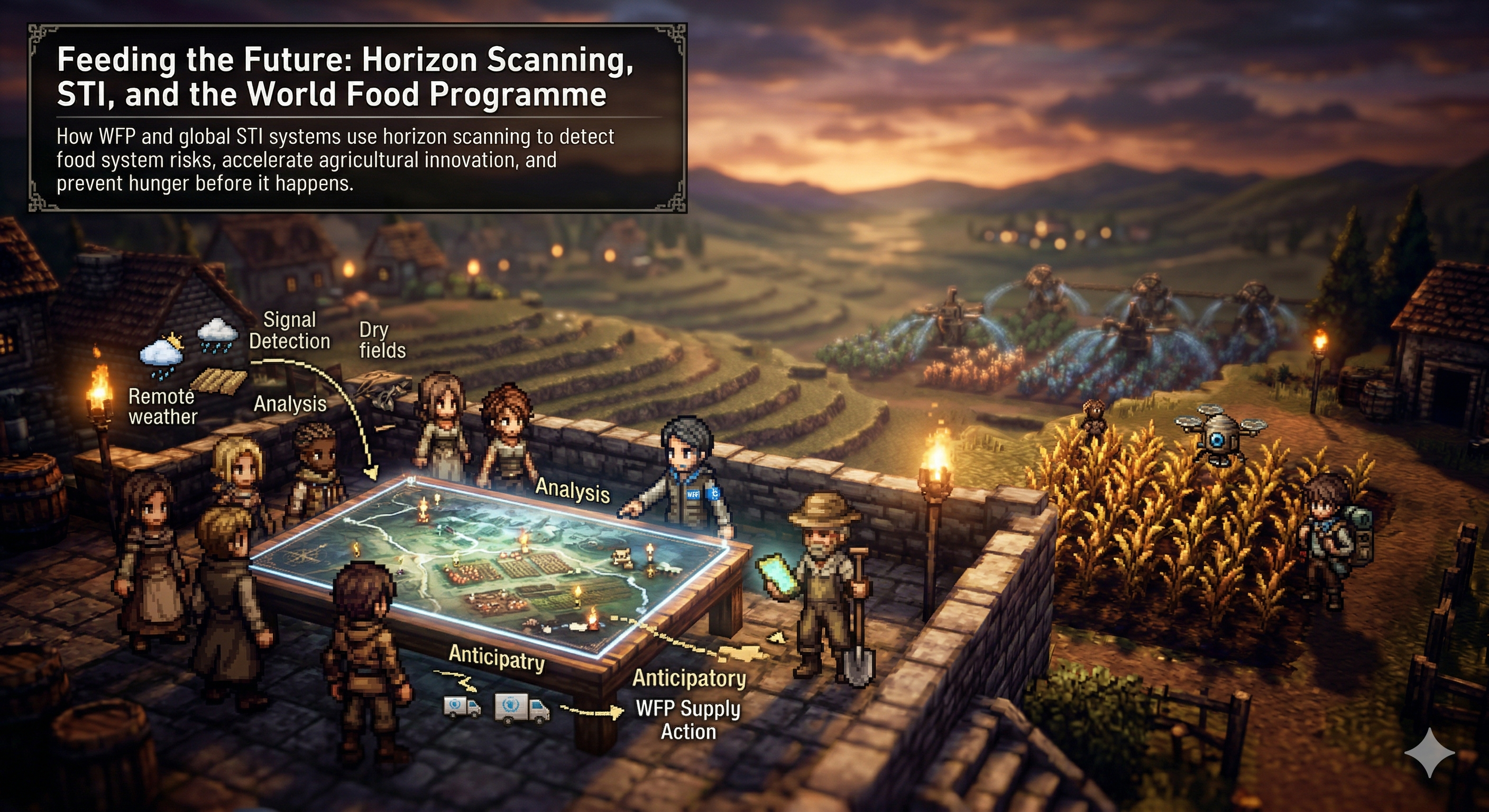
4. From Signals to Food Security: The Intelligence Pipeline
Food System Foresight Pipeline
Signal Detection
Crop anomalies, climate shifts, local innovations
Analysis
STI + data synthesis
Anticipatory Action
Early intervention & resource allocation
Impact
Food security & resilience
5. The Missing Layer: Grassroots Innovation
While global systems track macro-level risks, many solutions emerge locally.
Farmers adapt faster than institutions. Communities innovate without formal recognition.
Yet these innovations are often invisible—unrecorded, unsupported, and unscaled.
This creates a critical gap between innovation and impact.
Bridging this gap requires integrating grassroots intelligence into global foresight systems.
6. Why This Matters Now
Global food insecurity is no longer driven by a single factor. It is the result of overlapping crises: climate change, economic instability, and geopolitical disruption.
In such a landscape, reactive systems are too slow.
The ability to detect signals early—and act on them—is the difference between resilience and crisis.
Conclusion: From Hunger Response to Hunger Prevention
The future of global food systems will not be determined by how fast we respond to crises—but by how early we detect them.
Horizon scanning, powered by STI and operationalized through institutions like WFP, represents a shift from reaction to anticipation.
It is not just about feeding people today. It is about ensuring they never reach the point of hunger tomorrow.
The signals are already there—in the soil, in the climate, and in the quiet innovations of farmers around the world.
The question is: are we listening?