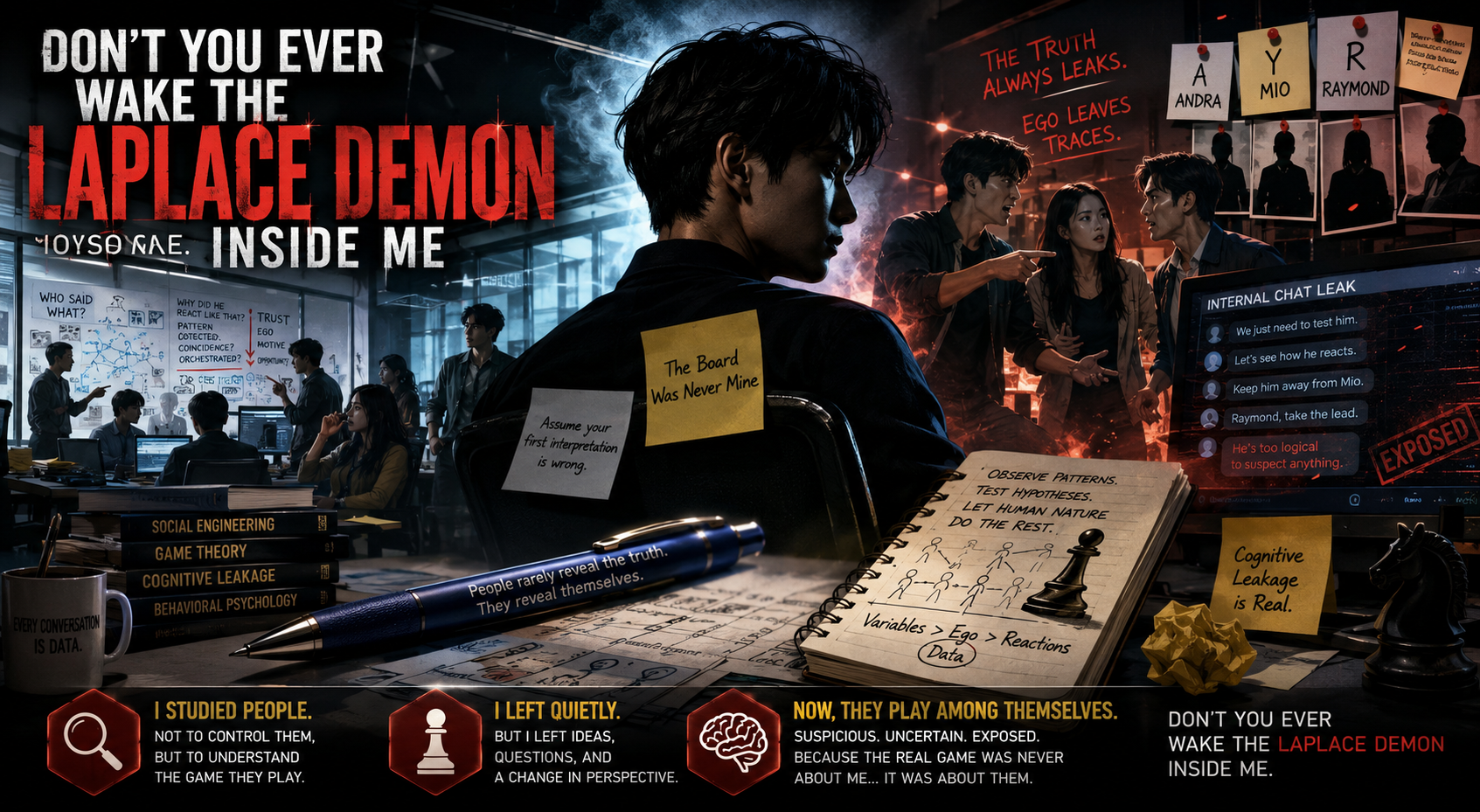
Most people believed Andra was just another ordinary office employee. Quiet. Helpful. Transparent. The kind of person who shared knowledge without expecting anything in return.
He hated one thing more than anything else: lies. Not because he was naïve, but because he believed trust was the foundation of every meaningful relationship — friendship, teamwork, even love. Whenever someone asked him a question, he answered honestly. Whenever he made a mistake, he admitted it. Whenever he knew something useful, he shared it. To him, transparency wasn't weakness. It was respect.
Unfortunately, not everyone played by the same rules.
Part I — The Man Who Never Lied
At first, the changes were subtle. A delayed reply. Conversations that suddenly stopped whenever he walked into the room. Smiles that looked genuine, yet somehow rehearsed. He brushed them aside — “Maybe I'm overthinking.” He always gave people the benefit of the doubt. Especially Mio, the woman he secretly admired.
Then strange coincidences began piling up. Whenever Andra tried talking to Mio, something interrupted. Whenever he planned to spend time with her, someone else appeared. Schedules changed. Meetings moved. Conversations ended before they even began. He couldn't prove anything — only patterns. And patterns were dangerous things to notice.
His friends laughed. “You're thinking too much.” Maybe they were right. Maybe they weren't. But one question refused to disappear: why did everything always happen at exactly the wrong moment?
Then Raymond entered the picture. Confident. Charismatic. The kind of man who never hesitated. While Andra was kept busy elsewhere, Raymond somehow always seemed to be near Mio — talking, laughing, standing closer than necessary. One day, Andra watched Raymond casually touch Mio's shoulder while joking. It wasn't dramatic. It wasn't romantic. Perhaps it meant absolutely nothing. Yet something inside him shattered — not because of the touch, but because he wasn't even given the chance to stand there himself.
He wondered: was this simply life, or was someone quietly arranging the board while he was busy following the rules?
The pain became unbearable. But Andra had one weakness — he could never hide sadness. People kept asking him, “What's wrong?” He smiled. “I'm still thinking about someone in Bali.” It wasn't entirely a lie; someone in Bali had indeed left scars before. But it was a convenient answer, a believable answer — far easier than saying, “The people hurting me are standing right here.” So everyone accepted it. No more questions. No more explanations.
Days passed. The sadness faded. But something else replaced it: curiosity. If people could manipulate emotions, could emotions manipulate people back? That question became an obsession. He stopped reacting. Stopped confronting. Stopped asking. Instead, he began observing. Silence became data. Every delayed message, every awkward glance, every interruption, every coincidence, every inconsistency — he stored them all, like puzzle pieces. Nobody noticed. After all, he was still just Andra. The quiet guy. The helpful guy. The harmless guy. Or so they thought.
One evening, a strange realization crossed his mind. People assumed intelligence was about knowing answers. They were wrong. Real intelligence was predicting causes from tiny effects, and predicting effects from invisible causes. If someone knew enough variables, they wouldn't need confessions anymore — patterns would confess on their own.
Laplace's Demon
That was the day Andra remembered an old philosophical thought experiment: a hypothetical intelligence so powerful that by knowing every variable in the universe, it could predict every future and reconstruct every past. Of course, such a being could never exist. But humans didn't need perfection — only enough information, enough observations, enough patience, enough psychology, enough social engineering, enough probability.
Something quietly changed inside him. Not revenge. Not hatred. Something colder. He stopped asking, “Why are people doing this?” Instead he asked, “If I change one tiny variable... who will move first?” Small conversations became experiments. Silence became pressure. Kindness became calibration. Information became leverage. Without realizing it, the office itself had become his laboratory. And everyone inside became variables.
One of his colleagues later joked, “You're scary now.” Andra simply smiled. “No. I'm just paying attention.” Then, for a brief moment, he looked out the window. His reflection stared back at him — the same face, the same smile, yet somehow a completely different person.
“Don't you ever wake the Laplace Demon inside me.”
Part II — The Experiment
Pain changes people. Some become louder. Some become colder. And a very small number become observers. Andra stopped asking questions. Instead, he started collecting variables.
One evening, while reading research about collective intelligence, something caught his attention. Scientists compared humans with ants solving the exact same problem. The surprising result wasn't that ants were smarter — it was that ants often coordinated more efficiently than humans under certain conditions. Not because ants possessed superior intelligence, but because ants had almost no ego. They communicated through pheromones. No pride. No hidden agenda. No office politics. No desire to look important.
Humans, on the other hand, communicated with words. And words carried something invisible — status, fear, pride, reputation, self-interest. Every conversation became more than information. It became negotiation.
Andra leaned back in his chair. “If communication is contaminated by ego, then perhaps the fastest way to understand people isn't by listening to what they say. It's by watching how their ego reacts.”
He wasn't trying to expose anyone — at least, that was what he kept telling himself. He simply wanted to answer one question: was everything merely coincidence, or had the social dynamics around him quietly changed? He didn't know. So he did what analysts do. He formed hypotheses. Then he tested them.
Three Methods of a Quiet Observer
- 1Priming — Instead of discussing relationships directly, Andra casually introduced abstract ideas during unrelated conversations: game theory, dramaturgy, trust, transparency, collective behavior. Nothing accusatory, just ideas. People rarely reveal themselves immediately, but ideas have a strange way of echoing inside someone's mind — and days later, those same words quietly resurfaced from different people.
- 2The Canary Trap — A technique security professionals use to identify information leaks: each person receives slightly different information, and if a specific version comes back, the path becomes visible. Andra never planted dangerous lies, only harmless variations in timing, wording, and tiny details — then waited to see which details returned, and from whom.
- 3Intentional Blurting — Instead of asking direct questions, he intentionally made incomplete statements: small inaccuracies, tiny assumptions, not enough to accuse, just enough to invite correction. Human beings dislike incomplete stories, especially when they believe they know the missing piece — and some corrected things Andra had never actually claimed.
Cognitive Leakage
Psychologists sometimes describe related phenomena under concepts such as cognitive leakage — the idea that under cognitive load, stress, or the effort of maintaining a consistent story, people may unintentionally reveal information through word choice, timing, hesitation, or behavior. It is not a mind-reading technique, nor proof of deception, but it can provide clues that deserve careful interpretation rather than certainty.
Then there was Raymond. Always relaxed, always comfortable — perhaps too comfortable. Every few days, Andra noticed the same scene: Raymond standing close to Mio, a hand on her shoulder, a playful tap, a brief touch while laughing. Maybe it meant nothing; many friends interacted that way. But context changes meaning. To Andra, who was already struggling to understand where he stood, every repeated moment felt like another reminder — “You don't belong here.”
The hardest part wasn't jealousy. It was silence. Nobody seemed surprised. Nobody reacted. Nobody questioned it. Andra wondered if he was simply outside the circle.
In-Group Bias
Groups naturally protect their own members, interpret their actions more generously, and unconsciously exclude outsiders. Maybe no conspiracy existed at all. Maybe he was simply the newest variable in an already established network. Oddly enough, that possibility hurt even more.
He found himself asking a painful question. “If I disappeared tomorrow, would anyone even notice?”
One afternoon, someone casually mentioned the word “Dramaturgy.” Another day, someone joked about “Game Theory.” Later, another colleague described someone as “Indomitable.” Perfectly ordinary words, yet strangely specific. To everyone else, they were just vocabulary. To Andra, they became data points — not conclusions, just observations. Enough to keep the questions alive.
He finally understood something. The greatest danger wasn't manipulation. It was uncertainty. When the human brain lacks information, it begins constructing narratives. Sometimes those narratives are correct. Sometimes they are catastrophically wrong. Andra knew this, which was exactly why he refused to make accusations. Instead, he observed. And observed. And observed.
Until one evening, while watching Raymond casually place his hand on Mio's shoulder once again, something inside him quietly died. Not his love. His expectation. For the first time, resignation felt less like surrender and more like survival.
“Perhaps I'm not leaving because I lost. Perhaps I'm leaving because this board was never mine to play on.”
Part III — The Weight Behind the Calm
There is a dangerous assumption people make about intelligent individuals: that they don't feel, that logic somehow replaces emotion, that someone who understands psychology can never become its victim. They were wrong.
Andra understood cognitive biases. He understood persuasion. He understood social engineering. He understood how people lied, how groups protected one another, how information spread, how rumors evolved, how trust was built and how trust collapsed. Ironically, none of that knowledge made pain disappear. It simply explained why it hurt.
The deepest wound was never Mio. Not really. Love fades. Disappointment heals. Rejection can be accepted. What Andra couldn't understand was something else entirely: his friends — or the people he once believed were his friends. Whether they had intentionally excluded him or whether he had misunderstood everything no longer mattered. The feeling remained the same. He no longer felt safe among them. Every laugh sounded distant. Every conversation felt slightly out of reach. Every smile became impossible to read.
People often imagined betrayal as a dramatic event — a secret revealed, a knife in the back, a loud argument. Reality was quieter. Sometimes betrayal was simply realizing that nobody noticed you were hurting.
Every morning became heavier. Not because of work, but because of walking into the same room, seeing the same faces, wondering whether he was imagining everything, or whether everyone else simply preferred silence. He stopped looking forward to Mondays. He started counting the days until his contract ended.
Then fate quietly offered him an exit. The organization announced budget cuts. Several contracts would not be renewed. Employees would need to interview again. Many people became anxious. Andra felt relief — for the first time in months, someone else was making the decision for him. Or so everyone believed.
During the interview, the panel expected the same Andra they had always known: prepared, confident, analytical. Instead, they met someone different. He answered honestly, but not strategically. He didn't highlight achievements. He didn't sell himself. He didn't fight for the position. When opportunities appeared to strengthen his case, he simply let them pass. He never lied. He simply stopped trying to win. It wasn't incompetence. It wasn't revenge. It was quiet self-sabotage — a decision made long before he entered the room.
Walking out of the interview, he felt strangely calm, as though the hardest choice had already been made months ago. Not in that meeting, but on the day he realized he no longer wanted to stay.
Later, someone asked him, “Weren't you nervous?” Andra smiled. “I've already accepted every possible outcome.” It sounded courageous. But inside, he knew the truth. Acceptance wasn't always strength. Sometimes it was exhaustion.
People admired Andra because he always seemed composed, always rational, always calculating. Some even joked that he thought like a machine — a human version of Laplace's Demon, able to predict everything, able to stay detached, able to outthink everyone else. They never saw what happened after he went home: the sleepless nights, the unanswered questions, the conversations replaying endlessly inside his mind, the moments where he wondered whether he had misunderstood everyone, or whether everyone had misunderstood him. He wasn't a machine. He wasn't a philosopher. He wasn't a demon. He was just a man trying very hard not to cry where anyone could see him.
Perhaps that was the cruelest irony of all. People often mistake emotional control for emotional immunity. They assume the quietest person in the room is the strongest. Sometimes the quietest person is simply the one carrying the heaviest weight.
On his final week, Andra stood alone by the office window. Outside, Jakarta moved as if nothing had happened. Cars honked. People laughed. Coffee shops filled with conversations that would be forgotten tomorrow. The world continued exactly as it always had.
It suddenly became obvious. No matter how much data he gathered, no matter how many behavioral patterns he decoded, no matter how accurately he predicted human decisions, there was one variable he could never calculate: the human heart. Including his own.
He closed his notebook. Not because the mystery had been solved, but because some mysteries cost more to pursue than they were worth. He looked at his reflection one last time. The Laplace Demon inside him was still there — watching, calculating, connecting invisible dots. But for the first time, it whispered something different.
“You were never trying to win the game. You were only looking for one place... where honesty didn't need to defend itself.”
Part IV — Hypothesis Seventeen
People thought Andra had resigned because of heartbreak. They were wrong. People thought he had lost to Raymond. Wrong again. People thought he simply couldn't handle office politics. That was the easiest story to believe. Reality was far stranger.
On his final day, no confrontation happened. No dramatic speech. No revenge. No tears. He shook everyone's hand — even Raymond's, even Mio's — and smiled exactly the same way he always had. Polite. Warm. Forgettable. As if nothing had happened. That confused everyone. Some had expected anger. Others expected questions. One person even expected accusations. None came. Andra simply disappeared.
Three weeks later, something odd began happening inside the office. Small disagreements. Tiny misunderstandings. Nothing catastrophic, just strange. One colleague insisted someone had promised something. Another claimed the conversation never happened. Someone remembered a meeting differently. Someone else insisted a document had been shared. Nobody could agree. It was subtle, like watching tiny cracks appear in glass.
Then old conversations resurfaced. People began comparing notes. “...wait, I thought YOU told me that.” “No, I heard it from someone else.” “...who?” Silence. Nobody remembered. The trust inside the group slowly began eroding — not because someone lied, but because everyone realized they remembered different versions of reality.
Months earlier, while everyone thought Andra was observing people, almost nobody noticed they were observing him too — his silence, his reactions, his expressions, his resilience. Some were simply curious. Some wanted to understand him. Some may even have believed they were helping. Some perhaps unintentionally influenced the social atmosphere around him. Whether it was coordinated or merely a chain of ordinary human interactions, Andra never found definitive proof. And perhaps he never would.
But Andra had noticed something else, something much more important: whenever information travelled through five people, it returned changed. Not because people were malicious, but because every human unconsciously edits reality — adds context, removes details, protects pride, protects identity, protects friendships. He remembered the research comparing ants and humans. Ants passed pheromones. Humans passed narratives. And narratives mutated.
So before leaving, Andra performed one final experiment. Not to expose anyone. Not to hurt anyone. Simply to answer one question: “How much of reality belongs to the observer?” Over several weeks, he quietly shared different harmless interpretations of ordinary events with different people — not lies, not gossip, just slightly different framings. One version emphasized timing. Another emphasized emotion. Another omitted a detail. Another added uncertainty. Nothing damaging, nothing unethical. Just enough to watch how stories evolved. Then he walked away.
Reconstructive Memory
Psychologists have long documented how human memory is reconstructive rather than a perfect recording. Each recollection can subtly reshape the memory itself, especially after hearing other people's accounts. Months later, those tiny differences Andra had planted had grown into entirely different memories — nobody had realized they weren't remembering the original event anymore. They were remembering the last version they had heard.
Andra wasn't shocked. His experiment hadn't changed people. It merely revealed how fragile certainty really is.
One evening, his phone vibrated. Unknown number. No profile picture. Just one sentence: “Were you testing us...” He stared at the screen. No reply. Another message appeared. “...or were we testing you?”
For the first time in months, Andra felt cold. Not because of the message. Because he genuinely didn't know the answer anymore.
He opened an old notebook — the notebook where he had once written observations — and turned to the very last page. A page he had never shown anyone. At the bottom, one sentence was underlined: Hypothesis 17. Below it, only seven words: “Assume I am the manipulated variable.”
He frowned. “I don't remember writing this...” He checked the date. The ink. The handwriting. Everything was his. Yet he had absolutely no memory of writing it. The room fell silent. Then his phone vibrated again. One final message. No sender. No number. Just coordinates — and beneath them, a sentence that made every observation, every theory, every sleepless night suddenly feel insignificant.
“If you really are the Laplace Demon... tell us who started the game.”
Part V — The Ghost Variable
There was no farewell speech. No manifesto. No revenge. Only a pen. On Andra's old desk, someone found a cheap blue ballpoint pen — nothing special, except for one sentence engraved on it: “People rarely reveal the truth. They reveal themselves.”
Nobody knew why he wrote it. Someone laughed. Someone kept the pen. Life continued. A week later, during a casual meeting, someone unconsciously repeated the sentence. People laughed again. Then everyone became strangely quiet.
From that day on, ordinary conversations no longer felt ordinary. Whenever someone interrupted another person, someone remembered the pen. Whenever someone became defensive, someone remembered the pen. Whenever someone changed a story, someone remembered the pen. The sentence spread — not because Andra forced it, but because ideas behave like viruses.
Priming as an Idea Left Behind
Months ago, Andra had studied something called priming — a tiny cue, one simple word, one image, one question, enough to make the brain unconsciously search for patterns it previously ignored. He never needed to manipulate people. He only needed them to start paying attention. The office slowly changed — not because people became dishonest, but because people became suspicious.
One afternoon, someone jokingly asked, “So... what do you really mean by that?” Silence. An awkward laugh followed. Nobody noticed that six months earlier, that joke would never have existed.
Another week passed. The word “Dramaturgy” appeared again. Then “Game Theory.” Someone mentioned “Cognitive Leakage.” Another replied, “That's exactly what Andra used to talk about.” No one intended to invoke him. Yet somehow his vocabulary had survived. Ideas outlive people.
Then something unexpected happened. Raymond — the most confident person in the office — started explaining himself. Nobody had accused him. Yet he kept offering explanations. “I wasn't flirting.” “I only touched her shoulder.” “We were just joking.” “I treated everyone the same.” Nobody had asked. Someone quietly whispered, “Why is he defending himself?” The room became silent.
That was the cruel thing about priming. Once people begin looking for inconsistencies, they notice them everywhere. Some observations are meaningful. Others are false alarms. The line between the two is frighteningly thin. One employee began noticing who interrupted whom. Another started tracking who always sat together during lunch. Someone else noticed information reaching certain people unusually fast. Tiny observations, previously invisible, now impossible to ignore. Nobody realized they were no longer observing reality. They were observing each other's observations. The office had become an echo chamber.
One manager eventually sighed. “I don't know what's happening. Ever since Andra left, everyone keeps analyzing everyone.” Another replied quietly, “No. He didn't leave us answers. He left us questions.”
Months passed. Trust became slower. Conversations became more careful. People thought before speaking. Sometimes too much.
Then came the final discovery. Someone cleaning old cabinets found Andra's notebook. Everyone expected secrets — names, evidence, a master plan. Instead, every page contained observations about himself: every bias he might have, every assumption he could be making, every alternative explanation. Every page questioned his own conclusions more than anyone else's.
The Final Page
Rule #1 — Assume your first interpretation is wrong.
Rule #2 — Assume everyone else is following Rule #1. If they don't, you don't need to expose them. Time will.
No names. No accusations. No proof. Nothing. One intern closed the notebook. “So... there was never any game?” Nobody answered.
The cleaning staff picked up the old blue pen. Clicked it once. Placed it into the office stationery box. The next morning, someone else unknowingly used it — signed a meeting report, handed it to another colleague. By afternoon, three different people had borrowed it. The pen kept moving. Desk to desk. Hand to hand. Conversation to conversation. No one realized that the object itself had never mattered. It was merely the first domino.
And somewhere in another city, starting another ordinary job, Andra received a message from an old colleague. It contained only one sentence: “I don't know what you left behind... but the office has never been the same since you walked away.”
Andra stared at the screen for a long time. Then, for the first time in almost a year, he smiled. Not because his experiment had succeeded, but because he finally understood the greatest irony of the Laplace Demon: you don't need to predict the future if all you have to do is change the first variable. The rest is merely human nature.
He set the phone face-down on his new desk, in his new office, in his new city, and told himself the story was finished. For exactly forty seconds, he almost believed it.
Then the phone buzzed again.
Same unknown format. No name. No number. Just a single line, sitting there in the dark of the screen like it had been waiting for the right moment to arrive.
“Hypothesis 18: assume the notebook was never yours to write.”
Andra didn't remember starting a Hypothesis 18. He didn't remember the last time he'd even opened that notebook — it was sealed in a box, three cities behind him. And yet here it was, spelled out in the exact clipped rhythm he used when he wrote to no one but himself.
Somewhere, a version of him had apparently kept going without him. Or someone had learned to sound exactly like the man who once believed that patterns, given enough time, always confessed on their own.
He looked at the message for a long time, thumb hovering over the screen, unsure—for the first time since he'd started counting variables—whether he was still the one holding the pen, or whether he had simply been its most convenient hand.
THE END?
Or perhaps the real Laplace Demon was never Andra.
It was the idea he accidentally left behind — and it was still learning to write.