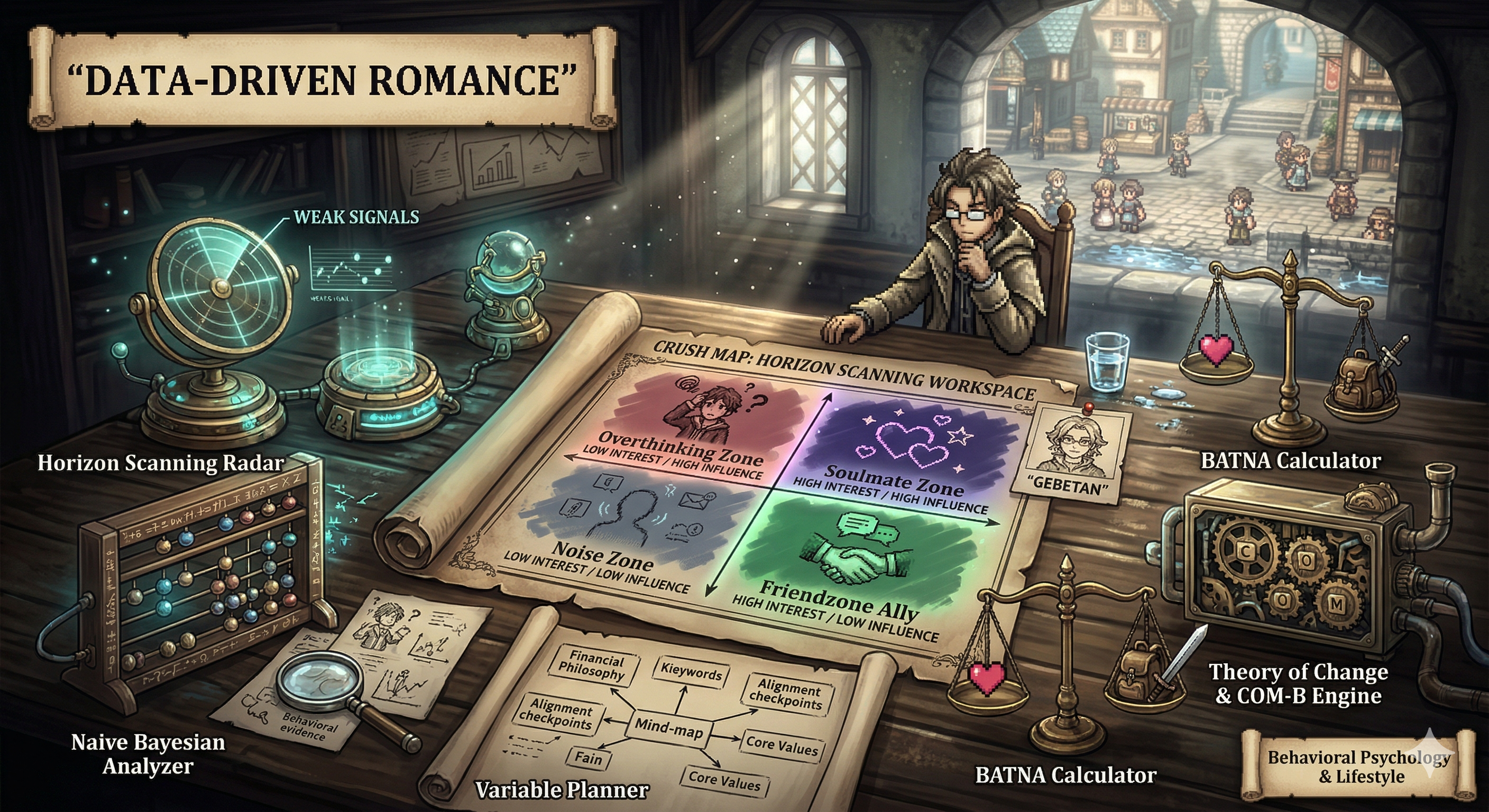
Dating in the modern era is an exercise in extreme uncertainty. Mixed signals, "ghosting," "breadcrumbing," and unspoken intentions dominate the landscape. Most people navigate this chaos using emotion, hope, and terrible advice from friends. But what if we treated romance like a complex systemic environment? What if we applied the exact same intelligence frameworks used by foresight analysts, negotiators, and behavioral scientists?
Who says Horizon Scanning and strategic foresight are only for governments, NGOs, or corporate risk analysis? You can apply the exact same architecture to something far more unpredictable: your gebetan (crush). Welcome to data-driven romance — where intuition is upgraded by intelligence, and heartbreak is just a risk you finally know how to mitigate.
The Intelligence Stack for Romance
5 Tools. 1 Relationship. Zero Guessing.
Each tool in this framework was built to help you move from emotional chaos to structured clarity. Used together, they form a complete intelligence pipeline — from your first interaction to a lasting, aligned relationship.
Horizon Scanning
Map weak signals & red flags before they become crises.
Naive Bayesian
Update your beliefs with evidence. Cut through the noise.
Variable Planner
Mindmap your values, goals, and alignment checkpoints.
BATNA Calculator
Know your walk-away power. Never negotiate your worth.
Theory of Change & COM-B
Architect the behavior change needed for lasting impact.
Phase 1: Horizon Scanning — The Radar of Romance
In foresight, we scan environments for "weak signals" — early indicators of emerging trends before they become obvious. In dating, every interaction is a weak signal. A late-night voice note, a deliberately slow reply, an overly casual "lol" when the conversation gets deep — all of it is data. The problem? Our emotions act as poor signal processors. We amplify what we want to see and suppress what we don't.
This is exactly the gap that the Horizon Scanning Workspace was built to close. Instead of journaling about your feelings, you feed behavioral patterns into a structured foresight canvas built around an Influence vs. Interest Matrix.
How the Matrix Works
Map the Signals: The Four Quadrants of Romance
By plotting their behavior on this matrix, you move from reactive emotional spiraling to structured, defensible insight. Here is your full Crush Mapping diagnostic:
💜 Soulmate Zone
High Interest / High Influence"They initiated a deep conversation at 2 AM and remembered your favorite book." "They cleared their schedule without being asked."
This is a high-yield signal. Engage actively and reciprocate transparently. This pattern, if consistent over 3–4 weeks, is a statistically strong predictor of mutual intent.
🔴 Overthinking Zone
Low Interest / High Influence"Left you on read for 12 hours, but you can't stop checking your phone." "Hot and cold behavior that keeps you permanently anxious."
Maximum emotional hazard, minimum return. This is the most dangerous quadrant for your mental health. Withdraw emotional investment immediately. Activate BATNA.
🟢 Friendzone Ally
High Interest / Low Influence"Replies instantly, highly supportive, checks on you regularly — but zero romantic tension exists on either side."
Stable and reliable. Value the connection. But do not manufacture romantic signals that aren't there — misreading this quadrant is a leading cause of unnecessary heartbreak.
⬜ Noise Zone
Low Interest / Low Influence"Liked your Instagram story from 2021 at 3 AM. Watched your entire highlights. Never DMed."
Background noise. Passive monitoring only. Do not invest cognitive resources here. The scanner registers it, logs it, and moves on.
Scanning for Critical Red Flags
In foresight, failing to identify systemic risk early leads to collapse. In romance, it leads to a slow, expensive emotional crash. These anomalies must be flagged before you invest further:
- The Asymmetric Openness: They are expressive, vulnerable, and warm with others — but consistently closed off and guarded with you specifically. Analysis: Deliberate signal suppression. Walk away before you invest more.
- The Toxic Flirt: They send strong romantic signals, but they are already partnered — or they behave this way universally with everyone in their social circle. Analysis: Massive systemic instability. High posterior probability of duplicity. Abort mission.
- The Inconsistency Pattern: Intense engagement one week, complete disappearance the next — on a repeating cycle. Analysis: Intermittent reinforcement. A well-documented psychological trap. Your scanner should flag this as a feedback loop designed to keep you hooked.
- The Public vs. Private Persona: Warm and attentive in private, cold or dismissive around their social group. Analysis: Social signal asymmetry. Indicates either shame or lack of genuine interest. Either way — proceed with extreme caution.
The Horizon Scanning Workspace lets you log these behaviors systematically, connect signal chains, and generate a structured trend report — so your pattern recognition is driven by data, not by what you desperately want to be true.
Tool #1
Horizon Scanning Workspace
Map weak signals, plot the influence matrix, and generate your first Crush Report. Free to use, no login required.
Phase 2: Bayesian Analysis — The Detective Work
Your Horizon Scan is complete. The overall trend is positive — but one anomaly has flagged: They are extremely close to a particular "guy friend" or "girl friend." They hang out alone. Regularly.
Your gut tightens. Your mind fills the gap with the worst possible narratives. This is the exact moment most people either explode into irrational confrontation or go completely silent and spiral inward. Both are poor analytical responses.
A trained intelligence analyst does neither. They apply Naive Bayesian Probability — a framework for updating beliefs rationally as new evidence arrives.
The Bayesian Romance Formula
Set Your Prior Probability
Before looking at any specific evidence, what is the base rate? For example: "Based on general social patterns, there is approximately a 25–30% chance that two people who hang out alone regularly are more than friends." This is your starting point — not 0%, not 100%.
Feed in the Evidence
Each behavioral observation updates your probability. Do they go quiet when this person texts? Do they guard their phone screen? Do overnight trips happen? Do they get defensive, deflecting, or disproportionately angry when you ask reasonable questions? Every "yes" is a likelihood multiplier that pushes your posterior probability upward.
Read the Posterior Probability
If after feeding your evidence the tool outputs a posterior of 80%+, you now have a mathematically grounded reason to act — not a feeling. You are no longer paranoid. You are informed. That is the difference between a breakdown and a breakthrough.
The key insight of Bayesian thinking is that you are not proving guilt or innocence — you are calibrating your confidence level to match the available evidence. It stops you from both catastrophizing on thin evidence and from gaslighting yourself into ignoring clear patterns.
Tool #2
Naive Bayesian Analyzer
Input your evidence, calibrate your priors, and get a probability-backed reading on the situation. Stop guessing. Start computing.
Phase 3: Variable Planner — Mapping Alignment
Your Horizon Scan is green. Your Bayesian analysis cleared the anomaly. Now comes the work that most couples skip entirely — and pay for years down the road: alignment mapping.
Attraction is easy. Compatibility is engineered. Two people can be intensely drawn to each other and still be fundamentally misaligned on the variables that actually determine long-term relationship success: financial philosophy, family expectations, career ambition, religious practice, lifestyle pace, and core values.
The Variable Planner is a mindmapping tool that forces this conversation into structured, visual clarity. You map out your own non-negotiables, your partner's stated priorities, and the overlap — or the gaps.
Values & Beliefs
Religious alignment, ethical principles, family structures, and long-term purpose. Are you building toward the same kind of life?
Financial Philosophy
Spending habits, savings goals, risk tolerance, and financial ambitions. This is one of the top three causes of relationship breakdown — map it early.
Lifestyle & Location
City vs. hometown, travel frequency, social habits, health priorities, and career trajectory. Do your daily realities point in the same direction?
Tool #3
Variable Planner (Mindmap Engine)
Visually map your values, goals, and relationship variables side-by-side. Identify alignment gaps before they become relationship crises.
Phase 4: BATNA — Your Walk-Away Power
Here is where most people collapse the entire framework. They scan, they analyze, they align — and then, when the other person shows reluctance, plays games, or refuses to clearly commit, they abandon everything they learned and accept scraps.
In negotiation theory, your BATNA (Best Alternative to a Negotiated Agreement) is the single most important source of power in any negotiation. You cannot negotiate well if you desperately need the deal. The same is true in romance.
The Fundamental Rule of Romance BATNA
In business, both parties negotiate until a middle ground is found — because both parties need something the other has. In romance, mutual desire is not negotiable. You cannot negotiate someone into wanting you enthusiastically. If one party is enggan (reluctant), that is not a negotiation — that is a signal. Your BATNA is walking away with your dignity intact. And if they do not enthusiastically choose you, your Best Alternative is being powerfully, intentionally single — which is not a consolation prize. It is the position from which all future, better choices are made.
The BATNA Calculator helps you quantify your alternatives. What does your life, your social life, your mental health, and your growth trajectory look like if this particular relationship does not happen? Most people have never sat down to genuinely answer that question — and as a result, they dramatically undervalue their own alternatives.
What BATNA Calculation Reveals
- Your actual cost of walking away — often far lower than your anxiety is telling you right now.
- Your opportunity cost of staying — the relationships, experiences, and growth you are forfeiting by chasing the wrong signal.
- Your leverage in the current situation — knowing your BATNA is strong makes you calmer, less reactive, and paradoxically more attractive.
Tool #4
BATNA Calculator
Calculate your walk-away value, map your alternatives, and enter every conversation from a position of genuine power — not desperation.
Phase 5: Theory of Change & COM-B — Architecting the Relationship
You have scanned the horizon. Investigated the anomalies. Aligned your core variables. And you have held your BATNA power throughout. The final phase is where strategy becomes structure: building the relationship itself as a deliberate system.
The Theory of Change framework asks: to reach your desired Impact (a healthy, committed, long-term relationship), what outputs, outcomes, and interventions must be in place? The COM-B model then diagnoses the behavioral architecture required to sustain those interventions:
C — Capability
Are both of you emotionally mature enough to handle conflict without stonewalling, contempt, or deflection? Do you have the communication skills to navigate disagreement productively? Psychological capability is the bedrock. Without it, no amount of attraction survives sustained friction.
O — Opportunity
Are the physical and social conditions in place to actually support the relationship? Do you live close enough to meet consistently? Do your schedules align? Is your social environment supportive — or actively hostile — to this partnership? Physical opportunity is often overlooked, and it quietly kills more relationships than incompatibility does.
M — Motivation
Do they actively and consistently prioritize you — not just when it is convenient, but especially when it is inconvenient? Automatic motivation shows up in habits (they text first, they remember, they initiate). Reflective motivation shows up in choices (they choose you over competing priorities when it actually costs something). Both are required.
When you feed your complete intelligence stack — the Horizon Scan results, the Bayesian posterior, and the BATNA score — into the Theory of Change & COM-B engine, the tool generates a behavioral diagnosis: exactly which COM-B component is the bottleneck, and precisely what intervention will address it. It converts emotional intuition into an actionable relationship design plan.
Tool #5 — The Capstone
Theory of Change & COM-B Engine
Input your complete relationship data. Get a behavioral diagnosis, identify the bottleneck, and receive a targeted intervention plan. The only tool that synthesizes everything into a clear path forward.
Conclusion: Engineering Serendipity
Love is an emotion. But relationships are systems — and systems can be designed, diagnosed, and improved. By relying purely on "vibes" and "fate," you expose your mental health to massive, preventable systemic risk.
The Five-Phase Intelligence Stack
Phase 1: Horizon Scanning
See the red flags early. Don't invest in a collapsing system.
Phase 2: Bayesian Analysis
Cut through the lies and the wishful thinking with evidence-based probability.
Phase 3: Variable Planner
Map your alignment. Don't discover incompatibility two years in.
Phase 4: BATNA
Never settle. Hold your walk-away power and never negotiate basic respect.
Phase 5: Theory of Change & COM-B
Architect the relationship. Build the behavioral foundation for lasting impact.
Stop guessing. Start scanning. Because the best romances aren't just found by accident — they are intelligently designed by people who understood what they were building before they started building it.
Each tool in this stack is free, standalone, and built precisely to give you the analytical edge that most people in your position simply don't have. Use them in sequence, trust the output, and protect your peace.