Foresight is often framed as a technical or analytical discipline, supported by data, frameworks, and increasingly, artificial intelligence. Yet at its core, foresight remains a profoundly human endeavor—and therefore, inherently shaped and limited by human psychology.
No matter how advanced the tools, models, or datasets, the quality of Horizon Scanning ultimately depends on how humans interpret signals, assign meaning, evaluate uncertainty, and make decisions. This introduces a critical vulnerability: cognitive bias.
Among the many biases that influence decision-making, two stand out as particularly dangerous in the context of Horizon Scanning: Confirmation Bias and the Availability Heuristic. Understanding these biases is not merely an academic exercise. It is essential to building foresight processes that can challenge assumptions rather than reinforce them.
The Invisible Filters of Perception
Confirmation Bias leads individuals and teams to favor information that aligns with their existing beliefs, while dismissing or undervaluing information that challenges them. In a foresight context, analysts may unconsciously filter out weak signals that contradict dominant narratives.
For example, an analyst who believes that a particular technology will fail may repeatedly collect evidence of technical limitations while overlooking signals of adoption, investment, regulatory adaptation, or unexpected innovation.
The Availability Heuristic, on the other hand, causes people to overestimate the importance or likelihood of information that is recent, vivid, emotionally striking, or frequently discussed. Signals that are less visible—but potentially more transformative—may be ignored simply because they are not immediately accessible or prominent.
For example, a recent geopolitical crisis may dominate an organization's risk assessment, while a gradual demographic shift receives little attention despite its potentially significant long-term consequences.
Together, these biases create invisible filters that distort how the future is perceived. The problem is not necessarily an absence of information, but the selective attention through which information is collected and interpreted.
When Bias Becomes Structural
The real danger emerges when individual biases align with organizational culture. If leadership holds a strong belief—for example, that a new technology is overhyped or irrelevant—this belief can cascade through the system.
Scanning teams may, often unintentionally, begin to prioritize signals that reinforce this narrative. Reports become skewed, not because of deliberate manipulation, but because of subtle, cumulative bias in selection and interpretation.
Over time, this creates a false sense of certainty. Weak signals that indicate alternative futures are systematically overlooked, leaving the organization exposed to strategic surprise.
This is how blind spots are formed—not necessarily from a lack of data, but from selective attention, shared assumptions, and insufficient challenge.
Guarding the Gates: Challenge Your Own Assumptions
To mitigate these risks, foresight must be designed not only as a technical process, but as a psychologically aware system. One effective strategy is to introduce structured friction into the scanning process.
For every major trend or hypothesis identified, analysts should deliberately seek out and document counter-signals—evidence that suggests an alternative trajectory may be unfolding.
This practice, often referred to as playing Devil's Advocate, forces teams to confront uncertainty and expand their perspective beyond dominant narratives.
Instead of asking only, 'Where is the evidence that supports our prediction?', analysts should also ask, 'What evidence could prove our prediction wrong?'
Rather than weakening analysis, this structured tension strengthens it by exposing assumptions, identifying missing information, and producing more resilient insights.
From Signals to Branching Futures
One practical way to reduce confirmation bias is to distinguish historical observations from interpretations, hypotheses, and forecasts. These are not interchangeable.
A signal describes an observation or development. A hypothesis proposes a possible explanation or future development. A scenario explores how events might unfold under a particular set of conditions. A forecast assesses the plausibility of those developments based on available evidence.
Consider a hypothetical relationship scenario. Two people have experienced a relationship breakdown following reported pressure from third parties, repeated avoidance, public humiliation, communication breakdown, and a loss of trust. The historical case is treated as fixed for the purpose of this exercise. We do not rewrite the events or erase their consequences.
However, the future remains uncertain. The central question is: if the woman later wishes to return, could reconciliation become possible?
Rather than deciding in advance that reconciliation must succeed or fail, we construct two alternative timelines based on different possible actions.
Visualizing the Two Possible Futures
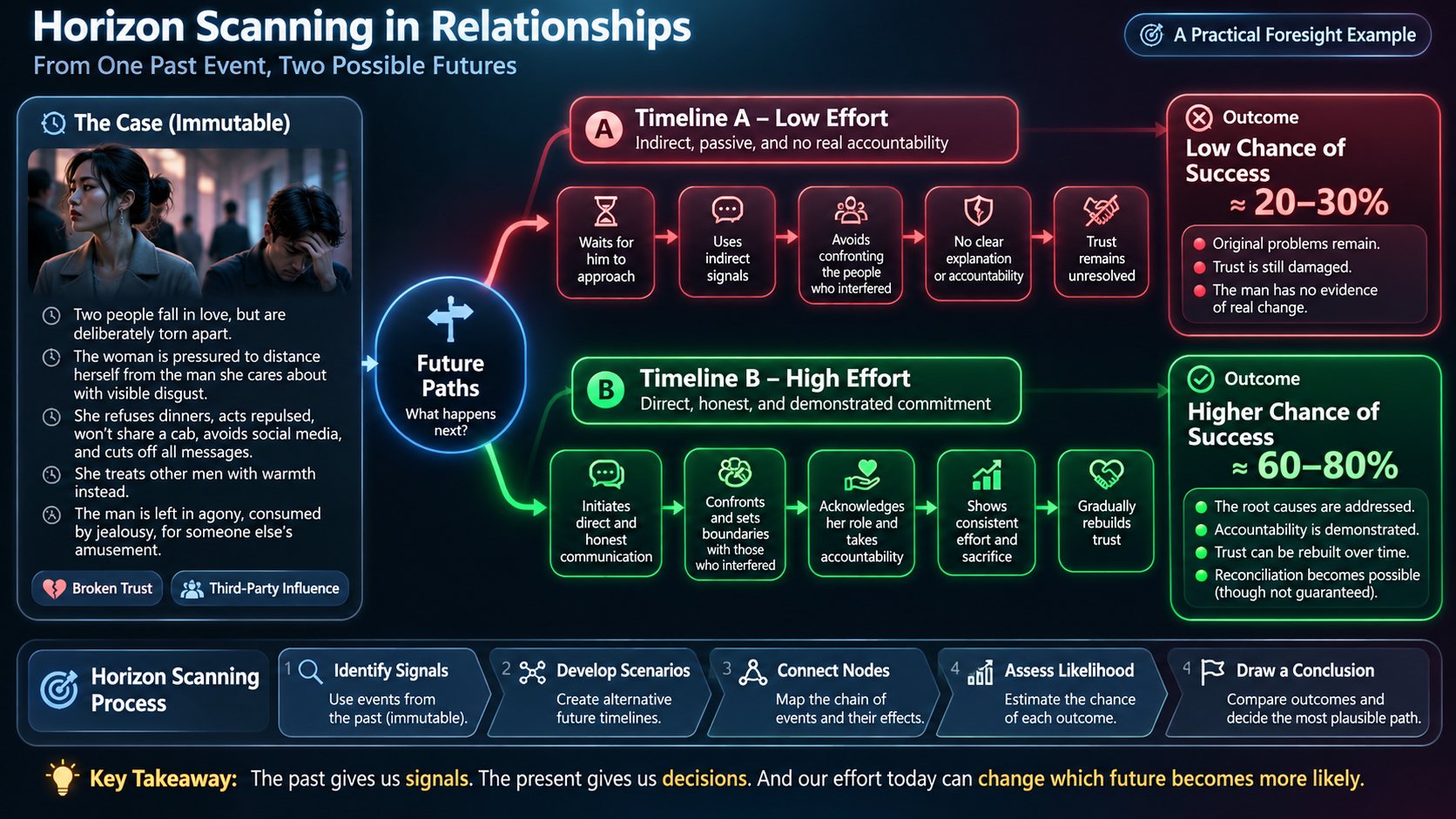
The following diagram illustrates how one immutable historical case can lead to two alternative future trajectories, depending on the actions taken.
Interpretation: Both branches begin with the same historical signals. The divergence occurs when different future actions are introduced. The resulting outcomes are conditional possibilities, not certainties.
Timeline A: Low Effort and Continued Avoidance
In the first scenario, the woman wants to reconnect but makes little direct effort. She relies on indirect signals, accidental encounters, mutual friends, or ambiguous gestures. She avoids discussing the original events, does not clearly address third-party interference, and expects the man to understand her intentions without an honest conversation.
The possible chain of developments is:
Indirect communication → Unresolved misunderstandings → Lack of accountability → Continued distrust → Limited prospects for reconciliation.
Each node represents a possible development. The connecting lines represent hypothesized relationships between those developments, not automatically proven causal links.
Under these assumed conditions, the scenario suggests a lower likelihood of reconciliation. The historical damage remains unresolved, and the man receives little evidence that the circumstances have genuinely changed.
However, this is not a certainty. Unexpected communication, independent personal change, or other developments could alter the trajectory. A responsible analyst must remain open to such possibilities.
Timeline B: High Effort, Honesty, and Accountability
In the second scenario, the woman genuinely wishes to rebuild the relationship and chooses a different approach. She initiates direct communication, acknowledges the impact of past events, explains her perspective honestly, and establishes boundaries with people who may have interfered.
She demonstrates consistency through actions rather than relying solely on promises. She also recognizes that the man may need time, may request clarification, or may decide that reconciliation is not acceptable.
The possible chain of developments is:
Direct communication → Honest disclosure → Accountability → Demonstrated effort → Gradual trust repair → Possibility of reconciliation.
Under these assumed conditions, the scenario creates more favorable conditions for reconciliation. The original problems are being addressed rather than ignored, and the man has an opportunity to evaluate whether meaningful change has occurred.
Nevertheless, high effort does not guarantee success. Reconciliation requires the voluntary participation of both individuals. The man retains the right to decline, regardless of how sincere or substantial the woman's efforts may be.
Comparing the Two Timelines Without Bias
Both timelines begin with exactly the same historical case. The past is unchanged. What differs is the set of possible future actions and the conditions that follow from them.
Timeline A explores the consequences of indirect communication, unresolved issues, and limited accountability. Timeline B explores the consequences of direct communication, demonstrated effort, and attempts to repair trust.
The purpose is not to prove that one individual is good or bad, nor to guarantee that one scenario will happen. The purpose is to understand how different decisions may influence the probability of different outcomes.
Importantly, these scenarios are illustrative, not empirically validated predictions. No numerical probability should be assigned without relevant evidence, a defined assessment method, and sufficient observations. Terms such as lower likelihood and more favorable conditions are more appropriate when reliable quantitative data are unavailable.
We must also consider alternative explanations. What if the woman remains silent because she fears further humiliation? What if the man no longer wants reconciliation? What if third-party interference continues? What if both individuals change their expectations independently? These possibilities challenge the assumption that the two timelines are exhaustive.
This is where structured dissent becomes essential. A robust foresight exercise should actively search for evidence that challenges both scenarios, not just the one we personally dislike.
Connecting Nodes: Understanding Interdependencies
In a Horizon Scanning matrix or radar, a node can represent a signal, trend, risk, hypothesis, or possible future development. Nodes become more valuable when their relationships are examined.
For example, in Timeline A, indirect communication may contribute to unresolved misunderstandings, which may reinforce distrust. In Timeline B, direct communication may create opportunities for accountability, which may support gradual trust repair.
These connections help analysts explore:
- Interdependencies: How different developments relate to one another.
- Potential causal relationships: Whether one development may contribute to another.
- Cascading effects: How an initial event could trigger additional consequences.
- Feedback loops: How the consequences of an event may reinforce or weaken the original conditions.
- Alternative pathways: How different decisions or external interventions may redirect a future trajectory.
A connecting line is not proof of causation. Analysts should document the rationale, evidence, assumptions, and uncertainty behind each relationship. Some connections may be strong, others tentative, and some may need to be removed as new evidence emerges.
How to Draw a Balanced Conclusion
After identifying signals, developing hypotheses, connecting nodes, and constructing alternative timelines, analysts must synthesize their findings.
A useful set of questions includes:
- What has actually happened, and which observations can be verified?
- What patterns are supported by repeated evidence?
- Which assumptions are influencing our interpretation?
- What conditions could make each scenario more or less likely?
- What evidence would challenge our preferred scenario?
- What external developments or decisions could change the trajectory?
- What actions can be taken now to prepare for different possible outcomes?
In a probability-impact matrix, analysts can then assess the relative likelihood and consequences of each identified development. High probability and high impact may indicate a critical risk. Low probability and high impact may indicate a low-probability, high-impact scenario that deserves attention. These classifications should be based on explicit criteria rather than emotional reactions or personal preferences.
The final conclusion should distinguish what is known, what is inferred, what remains uncertain, and what actions are recommended. A good forecast does not hide uncertainty. It makes uncertainty visible and useful for decision-making.
Designing Bias-Resilient Systems
Beyond individual practices, organizations must embed safeguards into their foresight systems. This includes diversifying teams to incorporate multiple perspectives, rotating analysts to prevent cognitive stagnation, and creating safe spaces where dissenting views can be expressed without penalty.
It also involves separating signal detection from interpretation, ensuring that raw observations are not prematurely filtered through existing assumptions.
Scenario planning should include more than one plausible future. Teams should test alternative assumptions, consider unexpected developments, and periodically revisit their assessments as new evidence emerges.
Combining human judgment with algorithmic support can help identify patterns and broaden information coverage. However, algorithms themselves can inherit bias from their training data, selection criteria, and design assumptions. AI should therefore support critical thinking rather than replace it.
Ultimately, the goal is not to eliminate bias entirely—an impossible task—but to make it visible, manageable, and less influential.
Conclusion: Clarity Through Friction
The effectiveness of Horizon Scanning does not depend solely on the volume of data collected, but on the clarity, discipline, and openness with which that data is interpreted.
Without deliberate safeguards, cognitive biases can quietly undermine even the most sophisticated foresight systems. Confirmation Bias can make us defend what we already believe. The Availability Heuristic can make us mistake visibility for significance. Organizational blind spots can turn these individual tendencies into systemic vulnerabilities.
Branching scenarios provide one practical way to challenge these tendencies. By keeping historical observations distinct from assumptions and exploring alternative future pathways, analysts can examine how different actions and conditions may influence outcomes.
The objective is not to select the future we personally prefer and then build an argument to justify it. It is to examine multiple plausible futures, identify what could make each one more likely, and remain prepared to revise our conclusions when new evidence appears.
In the end, foresight is not just about seeing the future—it is about seeing beyond ourselves.
