Someone stands on a stage. Without touching anyone, without asking a single question — they describe the feelings, memories, and hidden intentions of a stranger in the crowd. The world calls it supernatural. Neuroscience calls it something far more interesting: a highly trained human sensory system operating at full biological capacity.
Aristotle, in the 4th century BC, proposed five senses: sight, hearing, smell, taste, and touch. That model survived for over two millennia — not because it was scientifically correct, but because it was conceptually simple. Modern neuroscience has dismantled this myth entirely. We now know that limiting our understanding to five senses is like trying to map the universe using only a magnifying glass.
The Reality of Human Perception
Today, neurologists classify humans as possessing between 9 and 21 distinct senses — depending on the definition and criteria used at the receptor level. This article explores the full spectrum of those senses, connecting them to the extreme methodologies used by mentalists, elite interrogators, and foresight strategists.
1. The Real Map of Human Senses
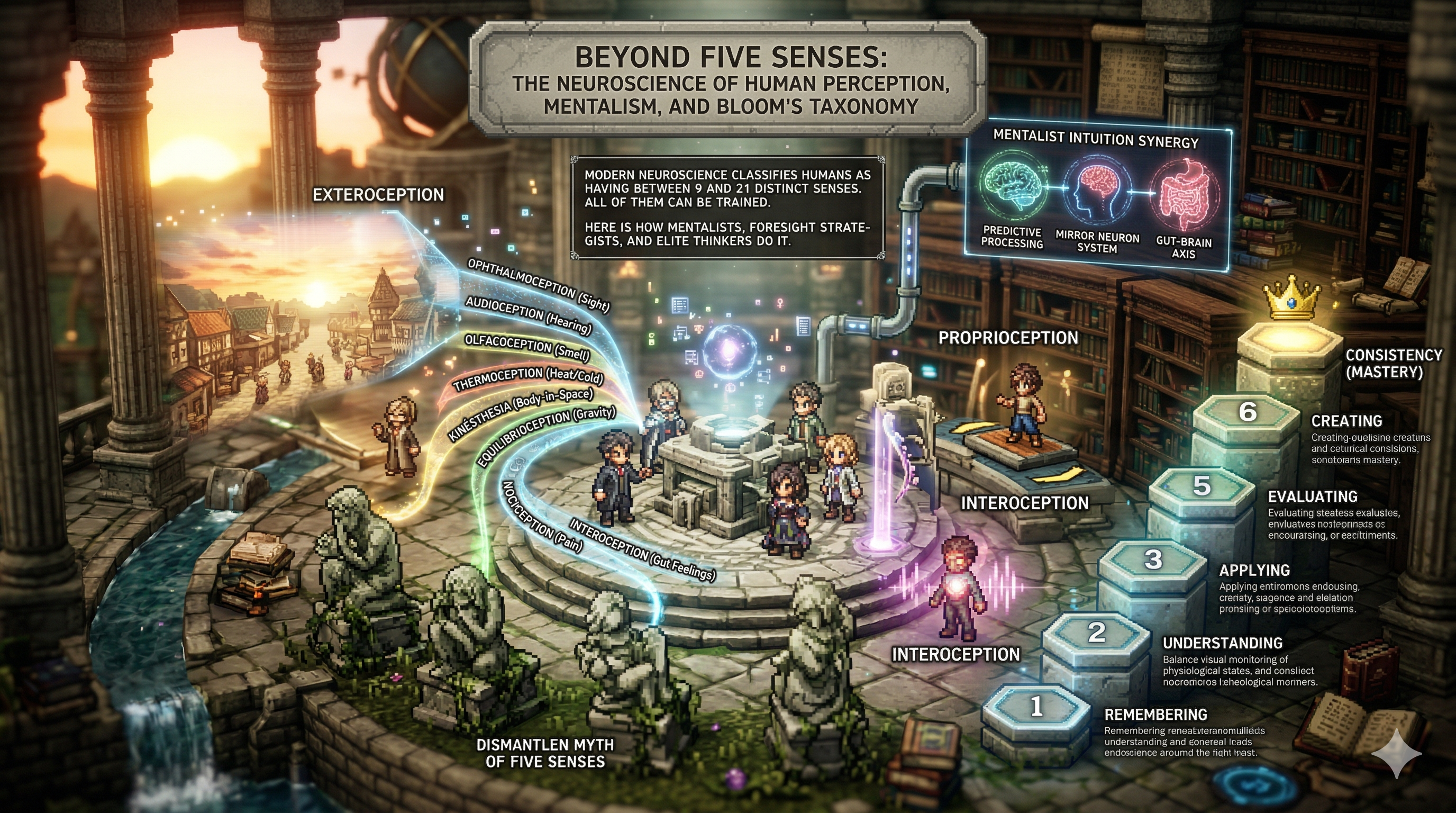
The human sensory system is divided into three major domains based on the source of the stimulus. Understanding this architecture is the absolute prerequisite toward consciously training perceptual capacity.
- Exteroception (The External Interface): These senses gather data from the external environment. They are our antennae. Ophthalmoception (sight) processes an astonishing 10 million bits per second through rod and cone photoreceptors. Thermoception relies on TRP (Transient Receptor Potential) channels in the skin — for example, the TRPM8 receptor detects cold, while TRPV1 detects heat, processing them as entirely separate sensory streams.
- Proprioception (The Body-in-Space Interface): Allows the brain to manage the physical body without relying on vision. Kinesthesia utilizes Golgi tendon organs to unconsciously track where your limbs are. Equilibrioception, driven by the semicircular canals of the inner ear, detects rotation, linear acceleration, and gravity. Nociception is a dedicated neural pathway for pain, which is entirely distinct from touch.
- Interoception (The Internal Interface): The most overlooked category — and the holy grail of predictive capability. Interoception is the continuous real-time monitoring of internal physiological states: heart rate, respiration, digestion, and autonomic arousal. When the brain detects an environmental anomaly before conscious thought can articulate it, it triggers an interoceptive response — a racing pulse, stomach tension, or pupil dilation.
The Neuroscience of Mentalist Intuition
Mentalists are not mystics — they are applied neuroscientists. Their "mind-reading" abilities rest on three physiological brain systems working in extreme synergy:
- The Bayesian Brain (Predictive Processing)Karl Friston's theory proves the brain does not passively receive data; it actively predicts it. A mentalist builds a highly accurate mathematical model of human behavior. Because their internal model is so sharp, they experience almost zero "prediction errors." They don't read minds; they read probability.
- The Mirror Neuron SystemDiscovered by Rizzolatti at the University of Parma, this system proves the brain internally simulates the actions and emotions it observes in others. This is the biological hardware that enables deep empathy and the detection of subliminal facial twitches.
- The Gut-Brain AxisThe human gut contains 100 million neurons. The vagus nerve transmits data 80% upward (gut to brain). A "gut feeling" is a literal physiological data transmission to the prefrontal cortex, which mentalists use as an early-warning radar system.
2. The Architecture of "Weak Signals" (FACS)
To predict behavior, you must see what others ignore. In 1978, Dr. Paul Ekman developed the Facial Action Coding System (FACS), proving that human emotions are not cultural constructs, but biological imperatives. The human face is capable of over 10,000 distinct expressions. The most critical among them are Micro-expressions — involuntary facial spasms that last between 1/25 and 1/5 of a second.
When an elite interrogator or a stage mentalist looks at a subject, they are not listening to the words being spoken. They are hunting for the leakage of these seven universal markers.
| Emotion | Biological Facial Marker (FACS) | Evolutionary Trigger |
|---|---|---|
| Happiness (Genuine) | Contraction of the Zygomatic major (mouth) AND the Orbicularis oculi (crow's feet). Fake smiles only use the mouth. | Social bonding and reduction of threat perception. |
| Contempt | The only unilateral expression. A sudden, subtle tightening and raising of one corner of the lip. | Establishment of moral or social superiority. Highly toxic in negotiations. |
| Disgust | Wrinkling of the nose and raising of the upper lip (Levator labii superioris). | Expulsion of toxic food or rejection of a toxic idea. |
| Fear | Eyebrows raised and drawn together, upper eyelids raised, lower eyelids tensed. Lips stretched horizontally. | Widening the visual field to locate a physical or abstract threat. |
| Anger | Eyebrows lowered and drawn together, vertical lines appear between brows, lips tightly pressed. | Preparation of the body for kinetic conflict or dominance. |
The Bandwidth Asymmetry: Why Logic is Too Slow
The human brain utilizes two distinct operating systems. To read micro-expressions and anticipate behavior, analysts must rely entirely on the unconscious sensory bandwidth (System 1) because conscious logic (System 2) is mathematically too slow.
Handles peripheral vision, interoception, balance, and instantaneous pattern recognition.
Handles logic, math, explicit language, and slow deliberation.
The Mentalist Sensory Pipeline
How trained individuals process subtle environmental anomalies into high-confidence predictions.
Exteroceptive Scan
System 1 sweeps the environment. Detecting micro-expressions, vocal prosody, and postural baseline deviations.
Predictive Matching
The brain executes a Bayesian comparison of incoming visual data against the internal behavioral model.
Interoceptive Signal
A "gut response" occurs. The physiological alarm flags the anomaly physically before conscious thought catches up.
Calibrated Prediction
System 2 is finally engaged. A high-confidence analytical output is made with reverse-engineered reasoning.
3. Training the Senses — An Evidence-Based Protocol
Neuroplasticity — the brain's ability to reorganize itself — is the foundation of sensory training. The landmark London Taxi Study by Maguire et al. proved that the posterior hippocampus physically enlarged through continuous complex navigation. The same principle applies: use it and it grows.
Training Exteroception (Precision Observation): You cannot detect a signal if you don't understand the noise. Observe a person's default blink rate (usually 15-20 times per minute), resting posture, and speech cadence under neutral conditions — then detect deviations. A sudden spike to 50 blinks per minute often signifies extreme cognitive load or deception.
Self-Test: Calibrating Your Interoception
Individuals with high interoceptive accuracy show vastly superior decision-making under uncertainty. Try the Heartbeat Detection Task (Garfinkel et al., 2015):
- Sit completely still in a quiet room.
- Close your eyes. Do not touch your pulse or chest.
- Focus entirely inward and attempt to feel the physical thud of your own heartbeat.
- Count the beats mentally for exactly 30 seconds.
- Compare your mental count with a digital monitor. If you are off by more than 10%, your interoceptive radar is severely uncalibrated.
Training Chronoception (Controlling Time Perception): Research by Merchant et al. (2013) shows that time perception depends on dopaminergic density. The flow state — where time seems to slow and cognitive capacity peaks — can be induced through a precise challenge-skill balance. Mentalists report that during a reading, time seems to expand, allowing them to process more sensory data per subjective second.
4. The Extended Bloom's Taxonomy
A neurological roadmap toward mentalist-level capacity. Most of humanity operates only at Levels 1 and 2, trapped in linear, reactive thinking.
Remembering
Raw InputThe brain logs raw data. Exteroception is active but uncalibrated. Foresight practitioners use this only to build an unbiased database.
Understanding
BaselineWhere 90% of humanity stops. Comprehending basic meaning, but stopping here renders you blind to future disruptions.
Applying
TestingMoving to active execution. Probing the environment to force it to generate new data. Proprioception comes online.
Analyzing
SignalsThe core of Horizon Scanning. Stripping away noise to detect weak signals: micro-expressions, subtle tonal shifts.
Evaluating
InteroceptionThe brain processes probabilities faster than thought, surfacing as a physical response. Evaluating gut instincts as calculated data.
Creating
ArchitectingSynthesizing weak signals and internal evaluations into a singular, high-accuracy prediction model before the event unfolds.
Consistency
MasteryMaintaining elite cognitive performance over time without degradation. Building a sustainable cognitive engine that runs continuously.
5. Why This Matters Beyond the Stage
The practical applications extend far beyond mentalism as performance. In organizational foresight, leaders who have trained their interoceptive accuracy make measurably better decisions under ambiguity — research by Dunn et al. (2010) in Psychological Science confirmed that individuals who attended to their bodily states during complex decisions outperformed those who deliberated analytically.
In intelligence and security, FACS-trained analysts detect concealed emotional states with statistically significant accuracy above baseline (Porter & Ten Brinke, 2008). In medicine, experienced clinicians' pattern recognition — often described as intuition — is now understood as highly trained interosensory integration.
Conclusion: From Passive Perception to Cognitive Architecture
Aristotle was not wrong — he simply lacked the tools. Modern neuroscience has revealed that humans are a far richer sensory system than ever imagined. These hidden senses — from interoception to chronoception — are not passive biological features. They are trainable cognitive capacities.
Mentalists are not superhuman. They are humans who — intuitively or through structured practice — have activated more of their sensory capacity and connected it to the brain's predictive engine with higher calibration than most. The signals are always there — in a flicker of an expression, in a shift of vocal tone, in an unexplained sensation in the chest before a storm. The question is never whether the signals exist. The question is whether your sensory system is trained enough to hear them.
Scientific Citations & References
Craig, A.D. (2002). How do you feel? Interoception: the sense of the physiological condition of the body. Nature Reviews Neuroscience, 3(8), 655–666.
Clark, A. (2013). Whatever next? Predictive brains, situated agents, and the future of cognitive science. Behavioral and Brain Sciences, 36(3), 181–204.
Garfinkel, S.N., et al. (2015). Knowing your own heart: distinguishing interoceptive accuracy from interoceptive awareness. Biological Psychology, 104, 65–74.
Ekman, P. and Friesen, W.V. (1978) Facial Action Coding System: A Technique for the Measurement of Facial Movement. Consulting Psychologists Press, Palo Alto, CA.
Maguire, E.A., et al. (2000). Navigation-related structural change in the hippocampi of taxi drivers. PNAS, 97(8), 4398–4403.
Rizzolatti, G., & Craighero, L. (2004). The mirror-neuron system. Annual Review of Neuroscience, 27, 169–192.
Merchant, H., Harrington, D.L., & Meck, W.H. (2013). Neural basis of the perception and estimation of time. Annual Review of Neuroscience, 36, 313–336.
Kirschvink, J.L., et al. (2019). Transduction of the Geomagnetic Field as Evidenced from Alpha-band Activity in the Human Brain. eNeuro, 6(2).
Damasio, A.R. (1994). Descartes' Error: Emotion, Reason and the Human Brain. Putnam Publishing.
Anderson, L.W., & Krathwohl, D.R. (2001). A Taxonomy for Learning, Teaching, and Assessing. Longman.
Porter, S., & Ten Brinke, L. (2008). Reading between the lies. Psychological Science, 19(5), 508–514.
Dunn, B.D., et al. (2010). Listening to your heart: How interoception shapes emotion experience and intuitive decision making. Psychological Science, 21(12), 1835–1844.