Social Change • Education • Cognition • Systems Thinking
Are people actually becoming less intelligent—or are modern systems making fragmented thinking more visible, more profitable, and more consequential?
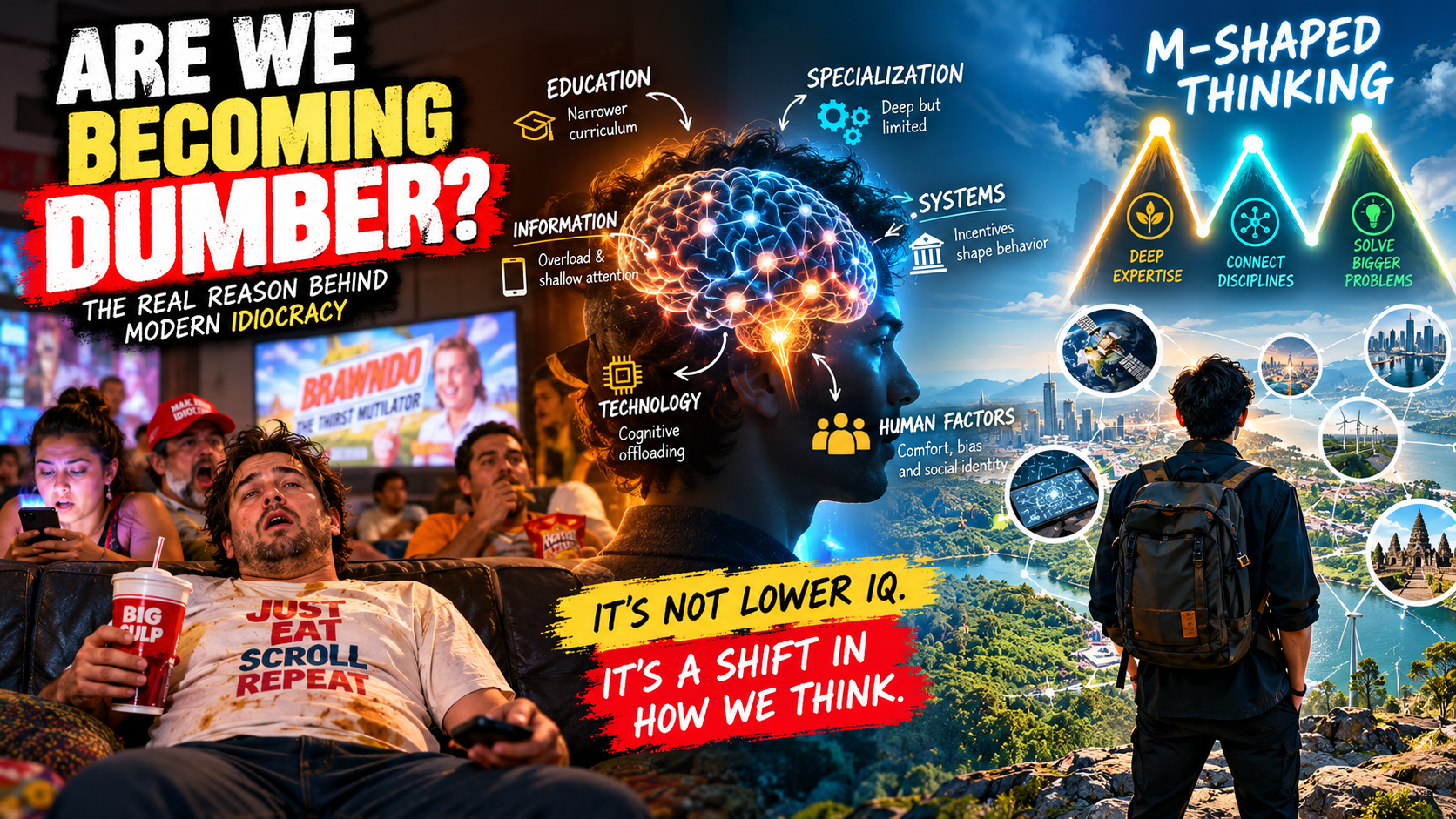
There is a familiar cultural image for this question: Idiocracy, the 2006 satirical film in which a society appears to have drifted into collective stupidity. Its exaggerated world is funny precisely because some of its patterns feel uncomfortably recognisable: public debate reduced to slogans, institutions rewarded for spectacle, and complex problems answered with embarrassingly simple solutions.
Look at public discourse today—including the statements of some politicians, executives, commentators, and online influencers—and a similar question may arise: Why does so much public reasoning sometimes look shallow? Are people less intelligent? Has IQ declined? Or are we confusing the ability to solve a narrow problem with the ability to understand a wider system?
My argument is not that modern people are universally becoming stupid. That would be too broad a claim for the available evidence. Instead, I propose a more useful question: could changes in education, work, information environments, incentives, and everyday habits be encouraging forms of thinking that are highly specialised but poorly integrated?
The problem may not always be a lack of intelligence. It may be a mismatch between the complexity of the world and the way we are trained, rewarded, and equipped to think about it.
1. Before Calling Anyone “Dumb,” Ask What Shapes Human Thinking
Thinking does not develop in isolation. It is shaped by biology, health, family life, language, education, culture, economic pressure, workplace design, technology, and the incentives surrounding a decision. These factors do not determine every individual's thinking, but they influence which habits are practised, which questions feel safe to ask, and which kinds of reasoning receive rewards.
These are interacting influences, not a ranked list of proven causes of societal decline. The same educational system can nurture curiosity in one classroom and rote compliance in another. The same technology can support a researcher who verifies sources and mislead a user who accepts every fluent answer. Context matters.
2. Is IQ Declining? The Evidence Is More Complicated Than a Meme
IQ is not a complete measure of human worth, wisdom, judgement, creativity, moral character, or practical competence. It measures performance on particular cognitive tasks under particular testing conditions. It can be informative, but it does not directly tell us whether someone understands institutions, recognises a feedback loop, navigates a conflict ethically, or makes a sound political decision.
Research on generational IQ-test performance illustrates why sweeping claims are risky. The Flynn effect describes substantial rises in average intelligence-test scores across many populations during much of the twentieth century. Later research also found that these gains slowed or reversed in some countries and cohorts. For example, a Norwegian study using conscription records found a rise and later decline in test scores within the same family lineages, supporting an important role for environmental factors rather than a simple story about changing parental composition. These findings do not establish that everyone is getting smarter or dumber everywhere; results vary by place, period, test, and cognitive domain.
The careful conclusion is therefore narrower: IQ trends are real research questions, but a film, a political speech, a viral post, or a frustrating meeting cannot diagnose population intelligence. We need representative data and clear definitions—not impressions alone.
3. Education: Are We Teaching People to Think, or Mainly to Reproduce Answers?
Education is one of the first places to examine—not because schools everywhere fail, but because education shapes habits of attention and reasoning at scale. A learner can memorise a definition, reproduce a formula, pass an examination, and still struggle to apply the knowledge to a different setting. Knowledge acquisition and knowledge transfer are related, but they are not identical.
Consider a student who learns the definition of supply and demand. The student may correctly explain a textbook graph. But can they connect a fuel subsidy to price signals, state expenditure, transport costs, household behaviour, and possible unintended consequences? Can they distinguish a short-term relief measure from a long-term structural policy? That requires moving between concepts and analysing relationships, not merely remembering one concept well.
OECD reporting on PISA 2022 learning strategies offers a useful, limited illustration. Across OECD countries, fewer than 60% of students reported using critical-thinking or perspective-taking strategies, and fewer than half reported regularly connecting newly learned material to what they already knew during mathematics lessons. These are self-reported strategies in a specific educational context—not proof that young people are unintelligent. They do, however, point to the importance of actively teaching learners how to question, connect, and transfer knowledge.
Higher education deserves scrutiny too. An OECD comparative study of critical-thinking assessment across six higher-education systems found that students' average performance improved between entry and exit, but the measured gain was relatively small. The report also cautions that a degree is not, by itself, a reliable guarantee of generic skills such as critical thinking, problem-solving, analytic reasoning, and communication.
The practical question for education is not simply, “How much content did the learner cover?” It is also: What can the learner do with that knowledge when the problem changes?
4. Specialisation: Deep Knowledge Can Coexist With a Narrow View
Modern economies depend on specialisation. We need people who know medicine, engineering, law, economics, education, cybersecurity, logistics, and countless other fields in depth. Specialisation allows societies to develop knowledge that no individual could master in full.
The risk appears when specialisation turns into intellectual isolation. A specialist may understand one component exceptionally well but lack the vocabulary, incentive, or opportunity to consider what happens at the boundaries between components. This is not necessarily personal failure. Organisations often divide work into departments, allocate budgets by function, measure employees through narrow indicators, and schedule so little shared reflection that the whole problem becomes nobody's responsibility.
Imagine a city transport agency. One team is rewarded for reducing operating costs, another for keeping vehicles moving, and another for meeting passenger-service targets. Each team may hit its own KPI while the overall system becomes less reliable: maintenance gets postponed, passenger transfers become worse, and costs are merely shifted elsewhere. The local numbers can look good while the public outcome deteriorates.
This is a classic systems problem: optimising a part does not always optimise the whole. What looks like stupidity from outside may sometimes be a predictable result of fragmented responsibility and badly aligned incentives. That explanation does not remove accountability; it helps identify what actually needs to change.
A system can be full of capable people and still produce an outcome that nobody would have chosen if they had understood the whole system.
5. Linear Thinking Is Useful—Until the Problem Stops Being Linear
Linear thinking is not inherently inferior. Step-by-step reasoning is indispensable for calculations, procedures, troubleshooting, and tasks where a clear sequence is appropriate. The problem is treating every problem as if it had one cause, one solution, and one predictable consequence.
Complex public problems rarely work that way. Housing, education, public health, climate adaptation, poverty, and political trust involve interacting variables, delayed effects, feedback loops, competing goals, and uncertainty. A policy can solve one immediate problem while creating another later. A successful intervention in one community may not transfer unchanged to another community with different institutions and incentives.
Systems thinking adds several questions to the conventional “What should we do?”
Look beyond the most visible or politically convenient cause. Ask which social, economic, technical, and institutional variables matter.
People adapt. Incentives shift. A rule may produce workarounds, unintended consequences, or new pressures elsewhere.
Separate immediate effects from delayed effects. Short-term success can conceal long-term costs.
Ask which actors, communities, costs, and consequences are missing from the picture.
Donella Meadows' work on systems and leverage points is a useful introduction to the idea that changing a system's rules, information flows, goals, or underlying assumptions may matter more than tweaking a visible parameter. The wider lesson is intellectual humility: a solution should be judged by the behaviour of the whole system, not by the elegance of its slogan.
6. Information Overload, Attention, and Cognitive Offloading
Our information environment has changed dramatically. Many people now encounter news, commentary, advertising, entertainment, work messages, and algorithmically recommended content through the same devices. The issue is not simply that there is “too much information.” It is that information arrives at different speeds, with different levels of credibility, context, and emotional intensity.
Short-form content can be useful: it introduces unfamiliar topics and makes ideas accessible. But fragments can also remove the conditions needed for careful judgement. A 20-second clip may show a politician saying something outrageous while omitting the question, previous exchange, policy details, or later clarification. A chart can be technically accurate yet misleading when its time window, denominator, or comparison group is hidden. Repetition may create familiarity without establishing truth.
Digital tools also change how we remember and reason. Cognitive scientists use the term cognitive offloading for strategies that shift some mental work onto the environment—for example, writing a reminder, using a calculator, or asking a search engine to retrieve a fact. Offloading can be adaptive; nobody should need to memorise everything. But a tool's convenience can become a liability when people stop checking what it has returned, forget how to evaluate it, or outsource the judgement rather than just the memory task.
AI makes this tension more visible. It can help compare perspectives, summarise long material, generate hypotheses, and identify relationships a user might miss. It can also produce fluent but false claims. The productive question is not “Should we use tools?” It is: Which parts of thinking should we delegate, and which parts must remain under human scrutiny?
7. Why Politicians and Public Institutions Can Look Irrational
Political communication is an especially revealing case because elected officials often speak under competing pressures: they need to persuade supporters, survive news cycles, negotiate with allies, respond to crises, and appear decisive. A complete explanation may be intellectually honest but difficult to compress into a memorable message. A slogan may travel further than a qualified analysis.
Several mechanisms can make public reasoning look shallow: strategic simplification, short electoral horizons, party discipline, reward for attention, selective use of evidence, motivated reasoning, and weak feedback between a policy decision and the people experiencing its consequences. In some cases, the problem may be a lack of knowledge or poor judgement. In others, the speaker may understand the complexity but choose not to communicate it—or may be responding rationally to incentives that produce socially damaging outcomes.
That is why we should be careful about inferring IQ from a politician's public performance. A person can be intellectually capable and still behave opportunistically. A person can be confident and still be wrong. A person can be technically correct about one detail and misunderstand the wider consequences. These are different failures and require different remedies.
Explaining incentives is not the same as excusing misconduct. Leaders remain accountable for claims, decisions, and consequences. But if the same shallow behaviour repeatedly emerges across different people, the institutional design deserves scrutiny as well as the individual.
8. An Interactive Model: Which Conditions Are Shaping the Thinking?
The diagram below is a conceptual map, not a causal model estimated from data. Select a lens to highlight how one set of conditions may influence thinking habits. In real life, the pathways overlap and can reinforce one another.
Conceptual illustration by the author. The arrows represent plausible influences, not measured effect sizes or proof that every pathway operates in every person.
9. From T-Shaped Skills to M-Shaped Thinking
Professional development often uses the metaphor of T-shaped skills: the vertical stroke represents depth in one domain, while the horizontal stroke represents breadth across other domains. UNESCO-UNEVOC's TVETipedia glossary describes the model in terms of deep ability combined with broader knowledge and experience across domains.
For the argument developed here, I propose M-shaped thinking as a useful metaphor. Imagine more than one vertical pillar of depth, connected by a horizontal ability to move between domains and relate them to a wider system. The aim is not to become an expert in everything. It is to cultivate several meaningful areas of depth, enough cross-domain literacy to communicate with other specialists, and the habit of asking how the pieces interact.
Important terminology note: “M-shaped thinking” is used here as an authorial framework, not presented as a universally standardised scientific construct with one agreed definition or validated measurement scale. Its value should be judged by whether it helps people describe and practise a useful set of skills—not by the shape of the letter alone.
M-shaped thinking is therefore not a rejection of specialisation. It is a proposal for making specialisation more connected. A public-policy professional might combine policy analysis, monitoring and evaluation, and digital systems; a public-health specialist might connect clinical knowledge, logistics, behavioural science, and data; an engineer might integrate technical design, safety, economics, and environmental impact. The point is not to claim mastery of all these domains, but to understand enough of their relationships to ask better questions.
10. How to Practise M-Shaped Thinking Without Becoming a Superficial Generalist
Build a strong core of knowledge and methods. Breadth without depth can turn into confident but shallow generalisation.
Choose a field that explains something your core field routinely struggles with—for example, behavioural science alongside policy, or data literacy alongside programme management.
Ask what counts as evidence, what assumptions a method makes, and what it cannot tell you.
Describe it economically, socially, institutionally, technically, and ethically. Then identify where the explanations agree or conflict.
List major variables, possible feedback loops, affected groups, time delays, and unintended consequences. Mark uncertainty instead of pretending every link is proven.
Interdisciplinary thinking is not solitary omniscience. It depends on asking specialists good questions and respecting evidence outside one's expertise.
Compare the predicted outcome with what actually happened. A useful thinker updates the model when the world disagrees.
Organisations can support these habits by rewarding cross-functional outcomes, creating space for constructive disagreement, sharing data across boundaries, and reviewing whether indicators are distorting behaviour. Training a staff member to think critically will not solve an institutional problem if the organisation punishes them for raising inconvenient evidence.
11. A Practical Test: Is This a Knowledge Gap, a Reasoning Gap, or a System Problem?
When someone makes a poor decision, avoid jumping immediately to a character judgement. Ask what kind of failure you are observing. The categories below overlap, but distinguishing them helps determine the response.
This framework avoids two mistakes. The first is blaming individuals for failures produced by the system around them. The second is blaming “the system” so broadly that nobody is held accountable for choices they could reasonably have made differently.
12. A Short Self-Audit for Complex Thinking
Use these questions before making a confident judgement about a person, policy, or public controversy. They are not an IQ test. They are prompts for checking the quality of your own reasoning.
1. What do I know directly, and what am I merely assuming?
2. What evidence would change my mind?
3. Which variables or affected groups are missing from my explanation?
4. Am I confusing a visible symptom with the underlying cause?
5. What incentives could make a capable person behave this way?
6. What second-order or long-term consequence might follow my proposed solution?
7. Have I checked the original source, context, timeframe, and denominator behind a claim?
8. Can I explain the strongest reasonable alternative view without caricaturing it?
Conclusion: Perhaps the Crisis Is Not Stupidity, but Fragmentation
Idiocracy offers a comic image of collective decline. Real societies are more complicated. Intelligence-test trends vary; education systems have different strengths and weaknesses; digital tools can help or hinder; and political behaviour reflects a mixture of capability, incentives, identity, institutions, and choice. There is no responsible basis for reducing all of this to “everyone is becoming dumb.”
Yet the concern beneath the joke is worth taking seriously. We can produce highly educated specialists who struggle to transfer their knowledge, institutions that reward local success while neglecting collective outcomes, and public conversations that reward speed and certainty more than careful explanation. Such outcomes can look like stupidity even when the underlying problem is more structural.
The answer is not to abandon expertise, romanticise the past, or demand that everyone become an expert in everything. It is to connect depth with breadth, evidence with context, and individual competence with systems understanding. Education should cultivate questioning and transfer; organisations should align incentives with whole-system outcomes; technology should support verification rather than replace judgement; and public leaders should be evaluated on the quality and consequences of their reasoning—not merely their confidence or performance.
Maybe the modern challenge is not that people have stopped thinking. It is that many systems train them to think deeply about one slice of reality while giving them too little practice in seeing how the slices fit together.
That is the case for M-shaped thinking: not an official diagnosis of society, but a practical invitation to build multiple areas of depth, connect them responsibly, and learn to see beyond the boundaries of our own expertise.
Further Reading and Research
- Bratsberg & Rogeberg (2018), “Flynn effect and its reversal are both environmentally caused,” Proceedings of the National Academy of Sciences. A large Norwegian conscription-record study on rising and later declining cognitive test scores, including within-family analyses.
- Pietschnig & Voracek (2015), “The Flynn Effect: A Meta-analysis,” Perspectives on Psychological Science. A meta-analysis of historical changes in IQ test scores and the interpretive challenges involved.
- OECD, PISA 2022 Results, Volume V: Learning Strategies. Findings on critical-thinking strategies, perspective-taking, connecting new and prior knowledge, motivation, and learning environments.
- OECD (2022), “Does Higher Education Teach Students to Think Critically?” Comparative assessment and discussion of critical thinking and other generic academic skills in higher education.
- UNESCO-UNEVOC TVETipedia: “T-shaped skills.” A concise glossary definition of depth in one domain combined with breadth across domains.
- The Donella Meadows Project: “A Visual Approach to Leverage Points.” An accessible introduction to systems thinking and interventions that can change system behaviour.
- Risko & Gilbert (2016), “Cognitive Offloading,” Trends in Cognitive Sciences. A review of how people use external tools and environments to reduce internal cognitive demands.
Scope note: This article is an analytical argument and conceptual framework, not a claim that all people are less intelligent, a clinical assessment, or a validated measurement of “M-shaped thinking.” Empirical findings cited above concern specific populations, measures, and periods; they should not be generalised beyond what those studies support.