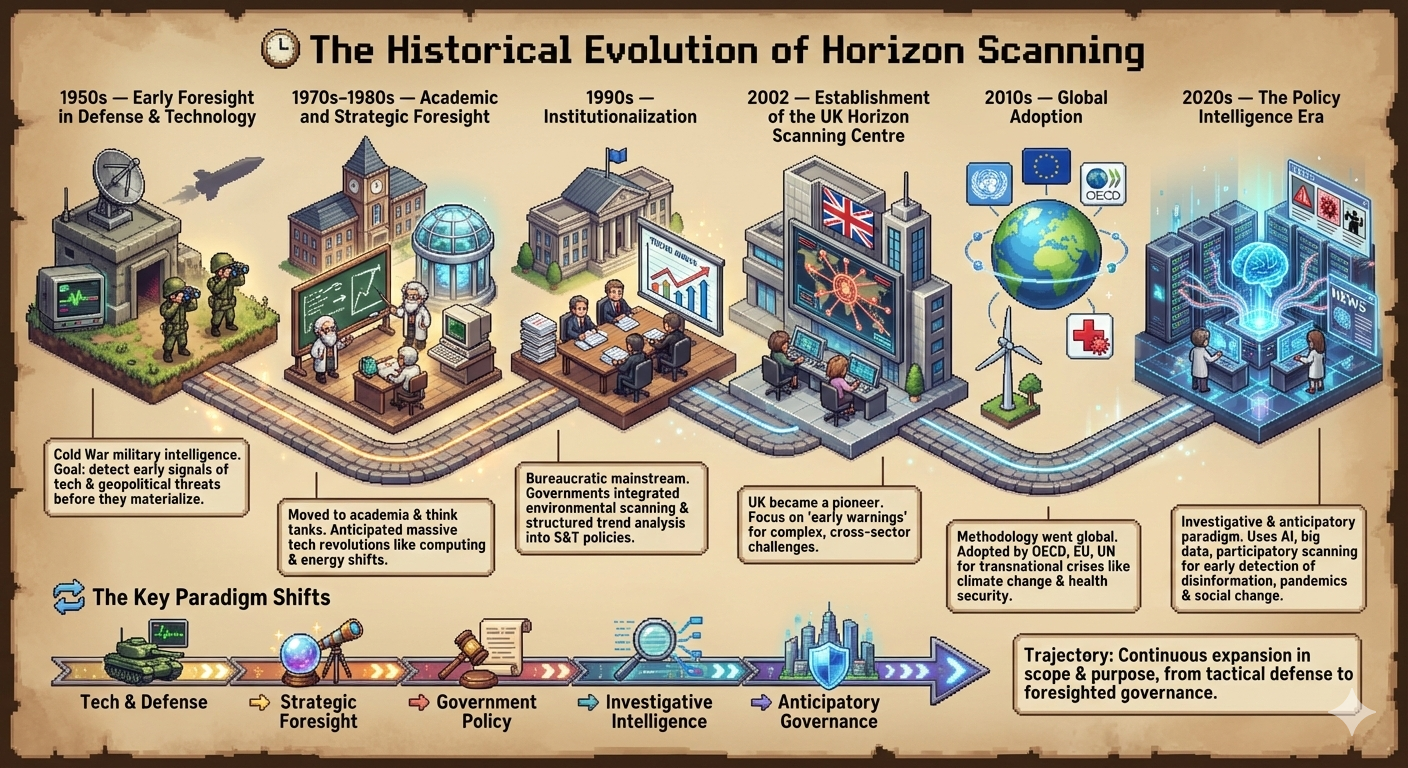
In an era defined by cascading and interconnected crises—from global pandemics and geopolitical tensions to exponential technological disruption—traditional risk management frameworks are increasingly proving inadequate. These systems were designed for a world that is far more predictable than the one we inhabit today.
Conventional approaches to risk management rely heavily on historical data, linear projections, and known variables. While effective in stable environments, they struggle to respond to complexity, uncertainty, and rapid change. In practice, this often results in institutions that are perpetually reactive—responding to crises only after they have materialized, rather than preventing or shaping them.
This reactive posture creates a structural disadvantage. By the time a risk is fully visible and measurable, it has often already evolved into a crisis.
The Limits of Reactive Systems
Reactive governance systems tend to operate within several constraints. First, they depend heavily on historical data, assuming that the future will behave similarly to the past—an assumption that often fails in complex systems. Second, they struggle to detect weak signals, early indicators of disruption that are subtle, fragmented, and frequently dismissed as noise. Third, institutional inertia slows down response time, even when emerging risks are identified.
The result is a repeating cycle: crisis, response, recovery, complacency, and then the next crisis.
The Shift to Anticipation
Anticipatory governance represents a fundamental shift in how institutions perceive and engage with the future. Rather than asking how to respond to risk, it asks how to detect, interpret, and act on change before it becomes risk.
At its core, anticipatory governance is a system of institutions, processes, and norms that integrates foresight into decision-making. It enhances the ability to identify emerging trends early, interpret their implications, and act proactively to shape outcomes. This is not about predicting the future with certainty, but about building the capacity to navigate uncertainty intelligently.
From Fire-Fighting to Fire-Proofing
One of the most practical ways to operationalize anticipatory governance is through Horizon Scanning. This involves the systematic exploration of emerging signals, trends, and uncertainties. These signals—often weak and ambiguous—can serve as early warnings of significant change.
By institutionalizing Horizon Scanning, organizations can detect disruptions before they fully emerge, reduce strategic blind spots, improve preparedness across multiple future scenarios, and enable faster, more informed decision-making.
In essence, organizations shift from fire-fighting—reactive response—to fire-proofing—proactive resilience.
Embedding Foresight into Decision-Making
However, tools alone are not enough. The real value of anticipatory governance lies in integration, not just adoption. Foresight must be embedded into the DNA of institutions.
This includes integrating foresight into policy and planning cycles, creating feedback loops between data and decision-makers, encouraging cross-sector collaboration, and fostering a culture that values long-term thinking over short-term fixes.
It also requires a mindset shift—from seeking certainty to navigating uncertainty.
Why It Matters Now More Than Ever
The accelerating pace of change means that risks are no longer isolated. They are systemic, interconnected, and often exponential. A technological shift can trigger economic disruption, which can lead to social instability, and quickly escalate into broader crises.
In such an environment, the cost of delayed response is no longer incremental—it is compounding.
Anticipatory governance provides a structural advantage by enabling institutions to act earlier, adapt faster, reduce long-term costs, and shape outcomes instead of merely reacting to them.
Conclusion: Designing for the Future
The question is no longer whether crises will occur, but how prepared institutions are to face what they cannot yet fully see.
Traditional risk management still has a role, but it is no longer sufficient on its own. Institutions must evolve into anticipatory systems—capable not only of managing risk, but of anticipating and shaping the future itself.