
Living Heritage • Dialogue • Intellectual Humility
和而不同 (Hé ér bù tóng): The Courage to Disagree Without Becoming Enemies
Different opinions do not have to divide us. What matters is whether we are trying to understand one another—or simply trying to win.
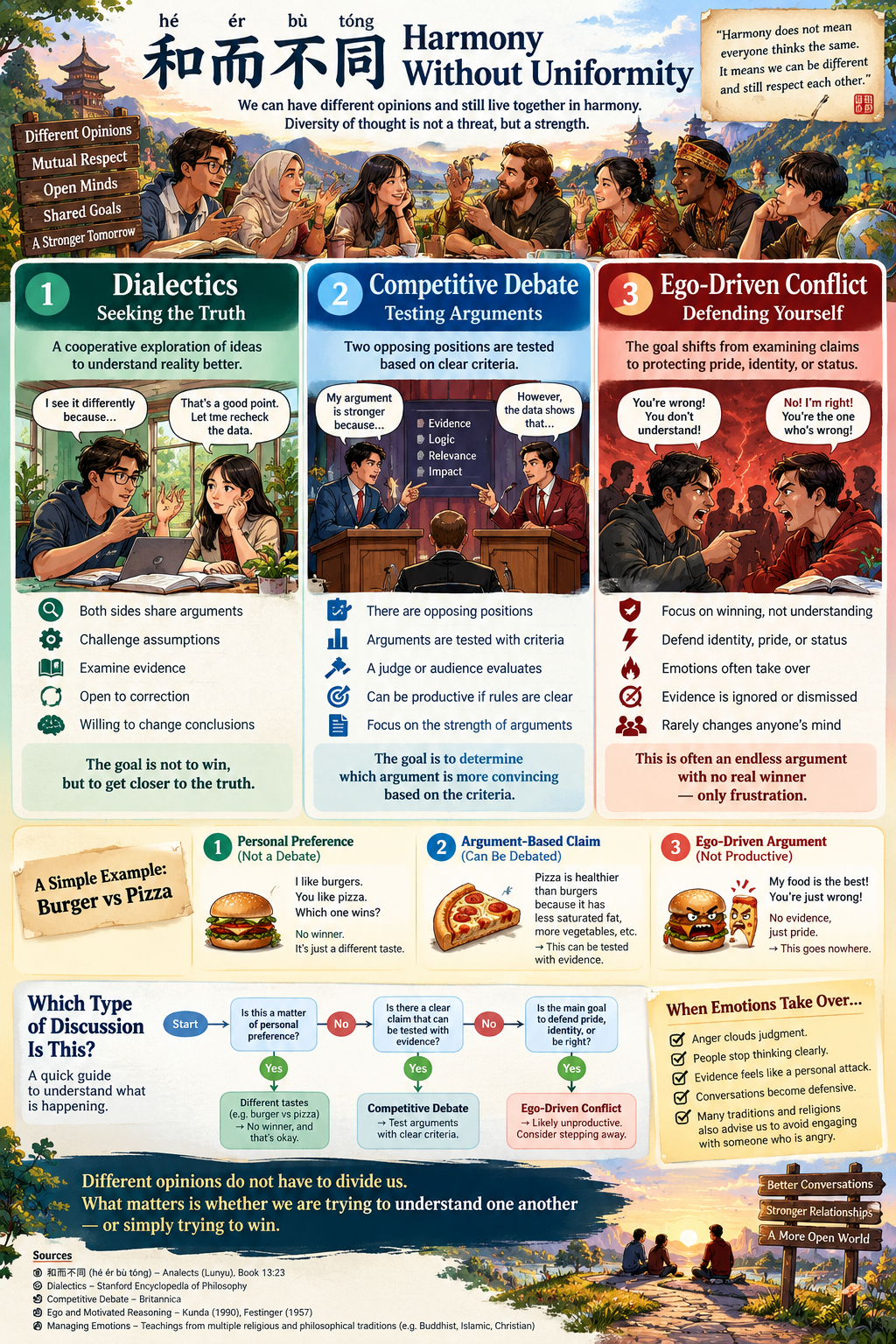
Different perspectives. Shared humanity. A stronger tomorrow.
1. A Chinese Idea: Harmony Without Uniformity
There is a classical Chinese expression that offers a powerful starting point for thinking about disagreement: 和而不同 (Hé ér bù tóng). Commonly translated as “harmony without uniformity,” the phrase is associated with Confucius and appears in the Analects.
The idea is simple, but its implications are profound: people can maintain a harmonious relationship without having to think alike. We can disagree about politics, values, priorities, or how to solve a problem without treating one another as enemies.
Harmony does not require identical opinions. It asks us to find ways to coexist and cooperate while recognising that differences are real. This is not the same as pretending that every claim is equally true. Evidence can still be examined, harmful actions can still be challenged, and ideas can still be criticised.
The Indonesian national motto Bhinneka Tunggal Ika—Unity in Diversity—offers a related point of reflection, though it comes from a different cultural and historical tradition. Both invite us to consider how unity can exist without demanding sameness.
We do not have to share the same opinion to share the same humanity.
For me, this is the heart of meaningful dialogue. I do not need everyone to agree with me. I need disagreement to remain possible without turning into hostility, humiliation, or a contest of egos.
2. Not Every Argument Is the Same
People often use “debate,” “discussion,” and “argument” as if they describe exactly the same activity. But the purpose of an exchange matters. I find it useful to distinguish three patterns: dialectics, competitive debate, and ego-driven conflict.
Dialectics
Seeking the truth
Both sides present arguments, test assumptions, accept correction, and remain willing to revise their conclusions when evidence shows that they are mistaken.
The goal is better understanding—not protecting a position at all costs.
Competitive Debate
Testing arguments
Opposing positions are tested against agreed criteria to determine which argument is stronger. This can be productive, provided the criteria are clear and consistently applied.
A judge may decide who wins the debate without settling every question about reality.
Ego-Driven Conflict
Defending oneself
The purpose shifts from examining claims to protecting identity, pride, status, or the need to appear right.
Evidence becomes ammunition, disagreement feels like an insult, and changing one's mind is treated as defeat.
How the Ideas Fit Together
This map offers a practical route through disagreement: identify whether the issue is a preference or a testable claim, then notice whether the conversation is seeking understanding, testing competing cases, or protecting someone's ego.
Reading the map: preferences may simply coexist; factual claims can be examined; and the purpose behind the exchange helps distinguish dialectics, competitive debate, and ego-driven conflict.
These categories are not rigid boxes. A competitive debate can still teach us something, and a conversation that begins constructively can become defensive. The distinction is about what the participants are trying to do—and whether they remain willing to examine the quality of their reasoning.
I genuinely enjoy dialectics. I can argue strongly, question assumptions, and challenge a position. If your argument is better supported, if your evidence is more reliable, or if you introduce a real variable I overlooked, I am willing to change my mind.
That is not a failure of debate. It is one of the reasons to have the discussion in the first place.
3. “You Keep Changing Your Mind. Are You Ababil?”
I have been called ababil—a colloquial Indonesian label for someone considered fickle or inconsistent—because I sometimes change my position after a discussion.
But we should ask a more useful question than simply counting how often someone changes their mind: why did they change it?
There is a difference between changing an opinion because of social pressure and revising it because a stronger argument reveals a flaw in the original reasoning. There is a difference between following whatever is fashionable and accepting evidence that changes what we have good reason to believe.
Imagine I support a policy because I believe it will improve people's lives. Someone then presents credible data showing that I overlooked a major consequence. After examining the evidence, I conclude that another policy would work better.
If I refuse to revise my position merely because I have already defended it publicly, what am I protecting: the quality of the policy, or my pride in having chosen it?
I do not have to be loyal to every conclusion I have reached. I have to be loyal to the process of examining whether those conclusions are justified.
Principles and conclusions are not the same thing. A person can remain committed to fairness, honesty, or human dignity while changing their understanding of how best to apply those values.
Of course, changing one's mind without good reason can be inconsistency. The point is not that changing is always virtuous. The point is that a change supported by better evidence should not automatically be mistaken for a lack of principles.
My standard is straightforward: I want to be consistent in how I evaluate arguments, not stubbornly attached to every opinion I have ever expressed.
4. What Makes a Disagreement Worth Having?
A productive argument needs more than two people who are confident in their opinions. It needs some shared willingness to examine claims and the reasons supporting them.
Both sides should be able to ask questions, explain their assumptions, challenge evidence, and acknowledge uncertainty. Neither side needs to change their mind simply to make the exchange look successful. But each should be willing to consider whether the other has identified something important.
Sometimes one side has the stronger evidence from the beginning. Sometimes both sides discover that their initial views were incomplete. Sometimes the disagreement remains because the parties prioritise different values or because the available evidence is not sufficient to settle the question.
All three outcomes can be intellectually honest.
The problem arises when one person is willing to examine their own reasoning while the other treats every challenge as something to defeat. The conversation becomes asymmetrical: one side keeps testing ideas, while the other focuses on defending an identity.
We cannot always know another person's motives. Someone who disagrees with us is not automatically closed-minded, and someone who maintains their position is not necessarily acting from ego. They may have reasons we have not understood. The better test is whether they engage with the argument and apply their standards consistently.
5. When Ego Takes Over, Thinking Becomes Harder
I honestly dislike ego-driven arguments. And I recognise that there are people who are much better equipped than I am to handle these situations. They may be able to de-escalate conflict, maintain patience, and keep a difficult exchange constructive.
Personally, I sometimes reach a point where I give up and walk away. I do not claim that this is always the most skilful response. It is simply a boundary I recognise in myself.
When ego takes over and anger rises, the conversation can become increasingly difficult. People may stop listening carefully, interpret neutral statements as attacks, repeat themselves, or focus on defending their dignity rather than examining the issue. Under intense emotion, our ability to reflect calmly and consider alternatives can become impaired.
That does not mean an angry person is incapable of reason or that every emotional response is irrational. Anger can signal a genuine injustice. But when anger overwhelms the exchange, it becomes much harder for either side to think clearly together.
Many religious and ethical traditions encourage restraint when confronted with anger, hostility, or provocation. The details differ across traditions, but the practical wisdom is recognisable: not every provocation needs an immediate response, and stepping away can sometimes prevent harm.
Yes, this is difficult. Especially when we believe the other person is being unfair, unreasonable, or deliberately misrepresenting us. The urge to correct every false statement can be powerful. But we should ask whether continuing will genuinely improve the situation—or merely keep both sides trapped in escalating anger.
I respect people who can handle these moments skillfully. I also accept that I do not need to be the person who can resolve every confrontation. Sometimes I surrender the argument, not because I have accepted the other person's conclusion, but because I no longer believe the exchange is productive.
6. Walking Away Is Not the Same as Admitting Defeat
Leaving a conversation can mean different things. Sometimes it is avoidance: we do not want to face a strong counterargument. Sometimes it is a healthy boundary: the exchange has become hostile or repetitive, and continuing is unlikely to help.
The difference requires honest self-examination. Am I leaving because I feel threatened by the possibility that I am wrong? Or have we reached a point where neither side is engaging meaningfully with the other's reasoning?
I should ask myself these questions, just as I would ask them of someone else. Otherwise, my dislike of ego-driven debate could itself become a convenient excuse to dismiss anyone who challenges me.
Still, I do not believe every disagreement deserves unlimited time and emotional energy. A person can decline to participate in an unproductive exchange without claiming moral or intellectual superiority.
Sometimes we can return to the conversation later, when both sides are calmer. Sometimes we can agree to disagree. And sometimes it is better to stop altogether.
Walking away does not prove that I am right. It simply means that continuing is no longer the best use of my attention.
7. Not Every Question Has the Same Kind of Answer
Another source of pointless arguments is the failure to distinguish facts, values, and preferences.
If I say pizza tastes better than burgers, and you say burgers taste better than pizza, there may be no universal winner. We are expressing preferences. We can discuss ingredients or nutrition, but those facts do not establish which food every person must enjoy most.
If we argue that a particular pizza contains more calories than a particular burger, however, we can investigate the ingredients, serving sizes, and nutritional data. That is an empirical question.
Political disagreements are often more complicated because they combine factual claims, moral principles, and personal or collective priorities. Two people might agree about the available data but disagree about which outcomes matter most. Or they might disagree about the data itself.
Before debating, it helps to ask: Are we disagreeing about what happened, what the evidence means, what ought to happen, or what we personally prefer?
We cannot resolve a preference dispute in the same way we resolve a factual error. Nor can statistics alone settle every disagreement about values. Identifying the kind of question we are discussing helps us avoid demanding a single winner where none is required.
8. Harmony Does Not Mean Every Claim Is Equally True
和而不同 is not a demand to accept all opinions as equally valid. Respecting someone's right to hold a view is different from agreeing that the view is well supported.
We can coexist while challenging misinformation. We can respect a person while criticising a harmful policy. We can acknowledge that people have different values while still examining the real consequences of their decisions.
Harmony without uniformity is not intellectual relativism. It is a way to preserve respectful relationships without requiring everyone to reach the same conclusion.
Nor does harmony mean avoiding difficult conversations. Sometimes respect requires honest disagreement. The challenge is to criticise claims without turning the people who hold them into enemies by default.
We should aim to be curious without being gullible, confident without being arrogant, and critical without being contemptuous.
9. The Role of Analogy and Intellectual Satire
Sometimes, I express criticism through an analogy rather than a direct insult. I might explain a psychological or logical pattern and then use a pointed comparison to reveal a contradiction. It is a form of intellectual satire: the argument comes first, and the sting arrives afterward.
For example: “A discussion in which only one person is allowed to be right is not an exchange of ideas. It is a monologue with an unwilling audience.”
The analogy makes a point without relying on a direct personal insult. But satire also has limits. A clever comparison is not automatically a fair or logically valid one. If the purpose is to encourage reflection, humiliation can be counterproductive; the other person may focus on defending their pride instead of examining the argument.
So even a sharp rhetorical tool should be used with care. The point is to expose a contradiction, not to assume that one clever line proves everything about another person's character.
10. A Practical Guide to Better Disagreement
Identify whether the disagreement concerns facts, values, preferences, predictions, or policy choices.
Ask which variables matter, what is being taken for granted, and what conditions would change the conclusion.
Apply the same expectations of evidence and reasoning to your own position and to the opposing one.
Before criticising a position, describe it in a way its proponent would recognise.
Consider counterarguments seriously, but do not change your mind merely to appear agreeable.
Pause, de-escalate, or leave if the exchange becomes hostile and unproductive.
Not every conversation needs consensus. Better understanding can be a worthwhile result in itself.
11. Living Heritage Is Also How We Treat Difference
When we talk about Living Heritage, we often think about traditions, practices, knowledge, and skills passed between generations. These are essential. But the way we learn to live with difference is also a meaningful part of how communities sustain themselves.
Do we teach young people that disagreement is an opportunity to think, or a threat to their identity? Do we show them that admitting an error can be an act of courage? Do our families, workplaces, and communities make room for respectful criticism? Can people disagree without being humiliated or excluded?
These habits are not preserved by slogans alone. They are learned through repeated interactions: how adults respond to questions, how leaders receive criticism, how communities handle conflict, and how people behave when someone challenges a deeply held belief.
A culture of dialogue does not appear automatically. It must be practised, modelled, and protected. It requires room for different voices and the discipline to distinguish criticism of an idea from rejection of a person.
Perhaps one of the most valuable things we can pass on is not the expectation that the next generation will think exactly as we do, but the ability to disagree thoughtfully and live together respectfully.
The central reflection
Different opinions do not have to divide us. We can challenge ideas without attacking people, change our minds without losing our principles, and walk away from ego-driven conflict without pretending that every disagreement has been resolved.
Harmony does not require uniformity. It requires the willingness to make room for difference while remaining honest about evidence, values, and consequences.
Conclusion: I Would Rather Be Correctable Than Infallible
I enjoy dialectics because an argument can help me discover what I have overlooked. If your reasoning is stronger, if your evidence is better, or if you introduce a variable that changes the analysis, I am willing to reconsider my position.
That does not mean I have no principles. It means I do not assume that every conclusion I reach is beyond correction.
I also know that not everyone wants to debate, and not every argument is an invitation to seek truth together. Some conversations are about sharing experiences; others are competitive; still others become contests of ego. Recognising the difference helps me decide when to engage and when to stop.
I honestly dislike ego-driven arguments. When pride takes over, anger escalates, and both sides stop listening, I sometimes give up. Other people may be better at de-escalating such situations; I accept that I do not always have the patience or skill to tackle them. I would rather step away than keep feeding a conversation that has stopped producing understanding.
That is not a claim that I am always right. It is a recognition that human beings do not think at their best in every emotional state, and that sometimes a pause is wiser than another counterargument.
So, yes, I may change my mind. You may disagree with me. We may never reach the same conclusion. None of that has to destroy the possibility of mutual respect.
“I do not want to be right simply because the opinion is mine. I want to understand why it is right—and to recognise when it is not.”
That, for me, is the spirit of 和而不同: not the absence of disagreement, but the possibility of learning from it. Not the surrender of conviction, but the discipline to examine it. And not the obligation to win every argument, but the courage to remain open to what the other person might teach us.
Article 82 · Living Heritage · Dialogue and Intellectual Humility